
Top 5 Markets Indian MSMEs Should Target Now
Picture This
Last February, a mid-sized auto components exporter in Ludhiana watched his biggest American client cancel a $2 million order in one email. The reason: a 50% tariff had just landed on Indian goods overnight. No warning. No transition period. Just gone.
Six months later, that same tariff was 18%. And the client was back on the phone. That whiplash — from panic to relief in under six months — is the entire story of Indian MSME exports in 2026. If you run a manufacturing business and you're still treating "exports" as a single strategy built around one market, you're playing a dangerous game.
The businesses that will look back at 2026 as their breakout year are the ones diversifying right now, while everyone else is still catching their breath. Let's get into where the real opportunity is.
The wake-up call nobody asked for
Here's the uncomfortable truth: India's MSMEs contribute roughly 45% of the country's exports, yet barely 1% of registered MSMEs actually export anything. Out of 1.58 crore registered units, only around 1.5 lakh sell overseas. Everyone else is fighting for scraps in a domestic market that's smaller than it looks once you account for uneven purchasing power.
Then 2025 happened. The US slapped a 50% tariff on Indian goods, and MSMEs in textiles and leather took the hardest hit, suddenly less competitive than rivals in Vietnam and Bangladesh who faced lower duties. Engineering exporters alone were staring at a $4-5 billion hit. Factories in Tirupur and Surat slowed production. It was a gut punch.
But here's the twist that most trade commentary is missing: the pain forced a pivot that should have happened years ago. And the pivot is now paying off.
Why "2026" is genuinely different
Three things converged this year, and together they change the math for every export-oriented MSME in the country.
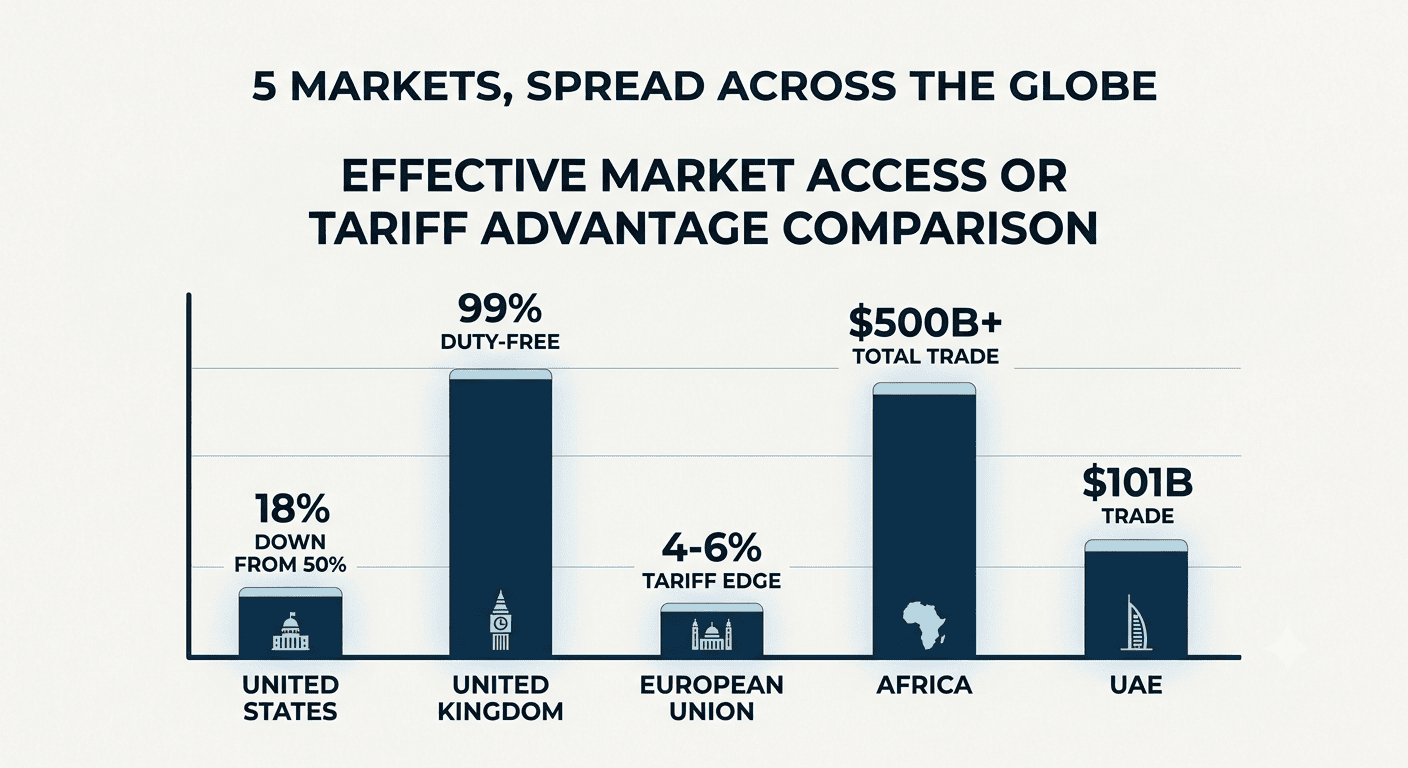
One — the US relationship got fixed. In February 2026, India and the US finalised a trade deal that cut the US tariff on Indian goods down to 18%. FIEO's President called it a historic milestone, and flagged engineering goods, textiles and apparel, pharma, chemicals, leather, gems and jewellery, and agri-products as the biggest beneficiaries.
Two — the UK market flung its doors open. On 15 July 2026, the India-UK Comprehensive Economic and Trade Agreement (CETA) came into force, giving 99% of Indian goods entering the UK duty-free or reduced-tariff access. This isn't a minor bilateral tweak — the UK's Business and Trade Committee called it "the UK's most economically significant bilateral free trade agreement since leaving the European Union."
Three — the government stopped talking and started funding. Budget 2026-27 carved out a ₹10,000 crore MSME growth fund specifically to help small exporters absorb tariff shocks, on top of the ₹25,060 crore Export Promotion Mission running through FY31.
Put those three together, and you get a rare window: cost pressure easing in your biggest legacy market, a brand-new market opening at scale, and real money on the table to help you make the jump. Windows like this don't stay open long. Here's exactly where to point your energy.
The Top 5 Markets to Target Now
1.United States — Still the crown jewel, now de-risked
Yes, the US is still #1. Not because nothing changed, but because what changed is good. The reciprocal tariff falling from 50% to 18% doesn't just restore your old margins — for many product categories it makes India meaningfully more competitive than it was pre-2025, because buyers who panic-diversified away from India last year are now reassessing.
Who benefits: Engineering goods, textiles and apparel, pharmaceuticals, chemicals, leather products, gems and jewellery, agricultural products.
Do this now: If you paused US client conversations during the tariff spike, restart them. Buyers remember who stayed reliable during the chaos — use that.
2.United Kingdom — The best-kept secret of 2026
This is the market most MSME owners are sleeping on, and that's exactly why you shouldn't. The UK-India CETA isn't a "someday" deal — it's live, right now, and it's aggressive. Zero tariffs on gold and diamond jewellery and leather goods. Duty elimination on plastics, industrial chemicals and agrochemicals. India's chemical exports to the UK could quadruple by 2030.
The gems and jewellery numbers alone should make you sit up: current exports to the UK stand at $941 million, but the UK imports roughly $3 billion worth of jewellery annually — meaning there's a $2 billion-plus gap Indian exporters haven't even touched. Tariff relaxations are projected to double India's jewellery exports to the UK within 2-3 years.
There's also a quieter number worth noting: MSMEs already punch above their weight here. In FY2022-23, registered MSMEs made up roughly 40% of India's exports to the UK, versus under 28% of India's total exports. This market already likes doing business with small Indian manufacturers.
Who benefits: Textiles, leather, gems and jewellery, engineering goods, marine products, chemicals, processed foods, auto components.
Do this now: Get your paperwork sorted before your competitors do. India's historical FTA utilisation rate is a dismal 25%, compared to 70-80% in developed economies — most of that gap is smaller firms not bothering with rules-of-origin documentation. Fix that, and you've already beaten most of your competition.
3.UAE — Your gateway to three continents, not just one country
The UAE deserves its own spot on this list not just for what it is, but for what it unlocks. Bilateral trade crossed $101.25 billion in FY2025-26, making the UAE India's largest single trading partner outside a handful of giants. But the real story is what Commerce Minister Piyush Goyal himself has said: CEPA with the UAE acts as a gateway to Africa, other GCC and Middle Eastern countries, CIS nations, and parts of Europe.
Think about that. One agreement, one compliance framework, and you're within striking distance of dozens of downstream markets. Gems and jewellery exports have nearly doubled under CEPA. Engineering products now make up over a quarter of exports to the UAE, with electronics growing the fastest of all categories.
Who benefits: Gems and jewellery, engineering goods, electronics, processed food and agri-products, plastics.
Do this now: If you're a smaller manufacturer intimidated by "going global," the UAE is your training ground. Lower cultural and logistical friction than the US or UK, and a straight flight away from doing business with buyers who re-export across three continents.
4.European Union — Big, slow, and worth the patience
The EU doesn't move fast, but it moves big. India-EU trade already sits near $135 billion annually, and unlike the UK deal, this isn't about creating new demand — it's about removing the friction that's kept Indian MSMEs from capturing demand that already exists. Analysts estimate the pending India-EU deal could hand compliant MSMEs a long-term tariff advantage of 4-6%, stacking with US gains for total competitiveness improvements of up to 7-10%.
Who benefits: Engineering goods, chemicals, textiles, auto components, specialty food products.
Do this now: The EU rewards compliance-readiness more than any other market on this list — sustainability certifications, traceability, ESG documentation. Start building that paper trail now, because when the deal lands, the manufacturers who are "export ready" on paper will move first.
5.Africa (via GCC/UAE corridor and direct trade) — The market everyone's ignoring
Here's your contrarian pick. While every exporter chases the US, UK and EU, almost nobody's building serious Africa strategy — and that's precisely the opportunity. Indian agri and marine exports are already showing it: meat, dairy and poultry exports jumped 22.66% in February 2026 alone, and marine product exports have doubled over the past decade to ₹62,408 crore. A meaningful share of that growth is African demand, often routed and financed through the UAE corridor.
Africa doesn't have the brand-name pull of "exporting to America." But it has something more valuable for a first-time MSME exporter: lower entry barriers, price-sensitive buyers who value Indian manufacturing's cost-quality balance, and far less competition from established Western suppliers.
Who benefits: Agri-processing, pharmaceuticals, textiles, light engineering, two-wheeler components, food processing equipment.
Do this now: Use your UAE CEPA registration as the springboard — many Indian exporters are already using Dubai and Abu Dhabi as re-export and financing hubs to reach African buyers with far less paperwork than a direct bilateral relationship would require.
The part most exporters get wrong
None of this matters if you're still "export-curious" instead of export-ready. Here's the harder truth buried in the data: the Export Promotion Mission and the new SME Growth Fund exist precisely because the government knows most MSMEs get stuck at the finish line — 60 to 90 days of working capital locked up in every export cycle, and execution costs running at 13-14% of GDP versus roughly 8% in developed markets. The opportunity is real, but so is the friction.
Don't be the manufacturer who reads an article like this, nods along, and does nothing for six months. Markets don't wait. FTA windows don't stay this favourable forever. The MSMEs that move in 2026 — securing UK CETA documentation, opening UAE re-export relationships, restarting stalled US conversations — will own the relationships and reputation that late movers spend the next five years trying to catch up to.
Your move
Pick one market from this list — not all five, one — and make it your Q4 focus. Talk to your export promotion council this month. Get your rules-of-origin paperwork audited. Have one real conversation with a buyer in that market before December 31.
2026 isn't the year to wait and watch. It's the year the gap between exporters and everyone else gets permanently wider. Which market are you targeting first? Drop it in the comments. Need our Help, reach out at phoenix.advixory@gmail.com or +91-9967093949, we’ll guide you through the process. Let’s build Indian exports, one country at a time.