
AI driven playbook for Indian MSME’s to replace brittle schedules with adaptive, data-driven plans.
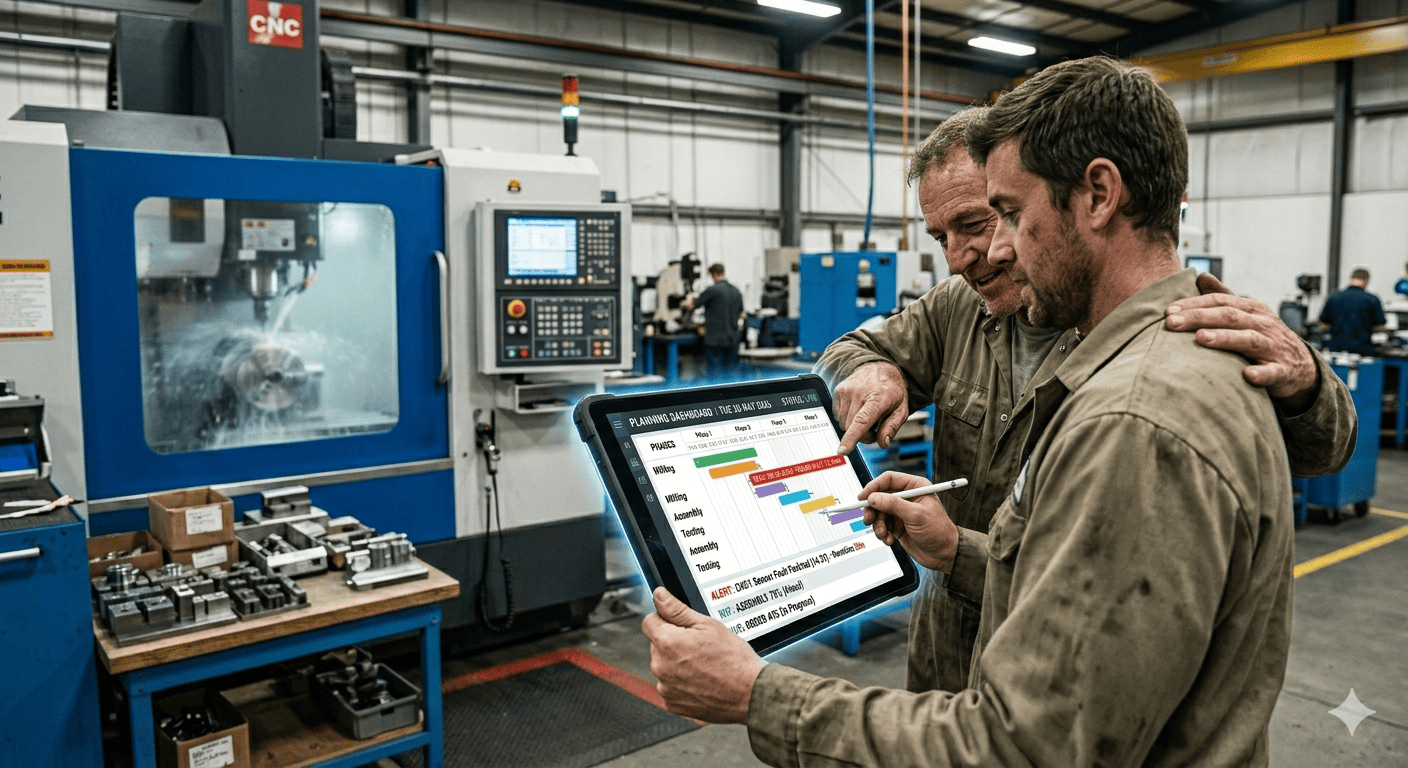
Picture this
They promised delivery by Diwali. Two months later, a line manager stood in a warehouse full of half-finished goods, a whiteboard full of cross-outs, and a CEO asking the one question every manufacturing leader fears: "Where did we go wrong?"
Project plans went off the rails — suppliers delayed, a critical machine broke down, and an urgent design change cascaded into weeks of rework. It’s a familiar story. But the lesson isn’t about luck or blame. It’s about how we plan, schedule, and guard against delay — and how AI is quietly rewriting those rules.
Why this matters:
Indian MSME’s compete on speed, flexibility, and margins. Missed timelines cost customers, reputation, and expensive overtime. The good news: AI isn’t a distant corporate experiment. It’s becoming an operational weapon that turns brittle Gantt charts into living plans that adapt in real-time. Here’s how, and what you should do next.
The end of “set-and-forget” planning
Traditional project planning in manufacturing is an exercise in optimism. We create schedules based on averages, hope suppliers meet ETAs, and pray machines behave. That model collapses when uncertainty hits. AI changes the game by turning static plans into dynamic, probabilistic forecasts that answer not just “what” and “when” but “how likely.”
How AI transforms planning, scheduling, and delay prevention
1.Smarter demand and capacity forecasting (A = Attention)
- What changes: AI uses historical orders, seasonality, macro signals (port congestion, commodity prices), and even sales team chatter to forecast demand and capacity needs with probabilistic confidence bands instead of single-point estimates.
- Why it helps: Instead of planning for "expected demand," you plan for a 70–90% confidence window. That lets you size buffers (inventory, labor, machine time) more rationally and avoid both stockouts and excess WIP.
- Actionable tip: Start by feeding 6–12 months of order and production data into a simple time-series forecasting model (many cloud tools offer this). Measure forecast accuracy (MAPE) by SKU and focus on top 20% SKUs that drive 80% revenue.
2.Dynamic scheduling and “what-if” simulation (I = Interest)
- What changes: AI-driven schedulers consider machine availability, worker skills, tooling changeover times, and supplier variability to generate feasible schedules that optimise throughput, lead time, or cost as you choose.
- Why it helps: When a machine trips or a critical component is delayed, AI can re-sequence jobs in seconds and show trade-offs (which orders slip, overtime needed, cost impact).
- Actionable tip: Run scenario libraries monthly: simulate a critical machine breakdown, a 3-day supplier delay, and a sudden 30% rush order. Use outcomes to set contingency rules (e.g., pre-approved overtime thresholds, alternate supplier lists).
3.Predictive maintenance and uptime optimization (D = Desire)
- What changes: AI analyses sensor data, maintenance logs, and operating patterns to predict failures days or weeks before they occur. It schedules maintenance in windows that minimize disruption.
- Why it helps: Prevent unplanned downtime — the biggest single cause of cascading project delays. Predictive maintenance shifts interventions from reactive to strategic.
- Actionable tip: Start with high-value, high-failure-rate assets. Use vibration, temperature, and runtime data to build simple anomaly detectors. Track MTBF improvements and reduction in emergency repairs.
4.Supplier risk scoring and adaptive procurement (A = Action)
- What changes: AI evaluates supplier reliability using delivery histories, financial signals, port delays, weather, and even social media to assign real-time risk scores. Procurement can then trigger alternate sourcing automatically.
- Why it helps: Instead of learning you’re blocked when your single-source vendor fails, your plan pre-emptively reallocates demand or orders buffer stock from lower-risk suppliers.
- Actionable tip: Create a supplier-risk dashboard. Classify suppliers into “critical,” “secondary,” and “backup.” For critical ones, maintain a small safety stock and qualify at least one alternate.
5.Automated root-cause analysis and continuous improvement
- What changes: After every delay, AI tools can crunch production logs, operator notes, and control systems to propose root causes and next-step corrective actions — faster than manual post-mortems.
- Why it helps: Learning loops accelerate. Fixes are applied before the next similar delay occurs, improving schedule reliability over time.
- Actionable tip: When a delay occurs, require a structured dataset capture (time, machine, operator, supplier batch, QC readouts). Use simple ML clustering to find common failure patterns.
Real-world sketch:
A small foundry that went from firefighting to foresight. A 120-person foundry near Pune faced chronic schedule overruns—pouring, machining, and QC bottlenecks were unpredictable.
They deployed a three-step AI approach:
- Step 1: Forecasting focused on top 30 part numbers; reduced demand variance surprises by 25%.
- Step 2: Dynamic scheduling used machine telemetry plus operator rosters to re-sequence jobs overnight; on-time delivery improved 18%.
- Step 3: Predictive maintenance reduced unplanned downtime by 40%, saving two weeks of lost production annually.
They didn't buy a miracle. They built data discipline, focused on a few high-impact problems, and scaled from there.
Common objections — and how to answer them
1."AI is expensive and complex." Start small. Pick one pain point (e.g., one bottleneck machine) and a minimally viable AI model. Many SaaS tools offer pay-as-you-grow pricing and pre-built connectors for shop-floor systems.
2."Our data is messy." True — but you don't need perfection to extract value. Begin with structured logs (ERP, maintenance records), then gradually add sensor and operator data.
3."We lack in-house AI expertise." Lean on partners and vendors, but keep decisions in-house. Focus on outcomes (reduced delay days, improved OT costs), not model complexity.
4."AI will replace planners." No. It augments planners, freeing them to handle exceptions, negotiate with customers, and improve processes. Think of AI as a seasoned advisor, not a replacement.
Implementation roadmap (90-day sprint)
1.Days 0–30: Problem selection and data audit. Identify top 2–3 pain points (e.g., most delayed SKUs, most-failing machine). Gather data and map current workflows.
2.Days 30–60: Proof of Value. Implement a forecasting or predictive maintenance pilot with clear KPIs (e.g., reduce emergency downtime by 20%, improve forecast MAPE by 10%). Train users.
3.Days 60–90: Scale and embed. Expand to adjacent SKUs/machines, integrate scheduler with ERP, and set governance: who owns AI outputs, decision thresholds, and escalation paths.
Metrics that matter (measure these weekly)
1.Schedule adherence (% orders delivered on promised date)
2.Mean time between failures (MTBF) for critical machines
3.Forecast error (MAPE) for top SKUs
4.Emergency maintenance hours per month
5.Supplier on-time delivery (7/14/30-day windows)
Human factors: The soft skills that make AI succeed
1.Trust: Show planners and supervisors why AI recommends changes — transparency beats "black box" outputs.
2.Incentives: Align KPIs so teams are rewarded for system-level outcomes (on-time delivery, reduced expedite costs), not just local metrics.
3.Training: Combine short hands-on sessions with scenario-based exercises so teams learn to run “what-if” simulations confidently.
A cautionary note:
Don’t chase novelty over value. AI shines when paired with clear processes and clean feedback loops. Tools alone won't solve systemic problems like poor supplier contracts, low-quality raw material, or non-standardized changeovers. Use AI to prioritize and accelerate solutions, not to paper over operational neglect.
Final thought: From liability to agility
For small manufacturers in India, timelines are survival. AI doesn't remove uncertainty — it quantifies it, helps you plan around it, and gives you options when things break. The result is not perfection but resilience: fewer ugly surprises, faster recovery, and a confident leadership team that can promise—and deliver—on time.
Pick one concrete problem this week: a recurring delayed SKU, your most failure-prone machine, or a critical supplier. Run the 90-day sprint above. If you want, tell me which problem you pick and I’ll sketch a focused pilot plan (data to collect, KPIs, expected impact) you can start immediately.
Would you like a 90-day pilot plan tailored to a delayed SKU, a bottleneck machine, or supplier risk? Reach out to me atphoenix.advizory@gmail.com or +91-9967093949. Share this if it hits home. Tag a fellow manufacturer who needs it. Let's make your company data drive, together.