
4 Low-Cost Tools Powering Smart Indian Shop Floors
Imagine This
Picture a typical Thursday morning in an auto-ancillary factory in Chakan, Pune. The promoter, Suresh, is sipping his morning chai while staring at a chaotic WhatsApp group named "Urgent_Mahindra_Tooling_Update." There are 47 unread messages.
The production head says the die casting mold is delayed by three days because the heat-treatment vendor hasn’t dispatched the parts. The quality manager says he never received the updated drawing. Meanwhile, the client's procurement manager in Chennai is calling Suresh directly, asking one simple question: "Where is the prototype sample?"
Suresh checks his desktop. He has six versions of an Excel file titled NPD_Tracker_Final_v3_revised(2).xlsx. None of them tell him who was actually supposed to follow up with the vendor yesterday. If this scenario sounds painfully familiar, you’re not alone.
According to industry estimates, over 70% of India’s 17 lakh manufacturing MSMEs operate on a fragile, duct-taped technology stack: Tally for accounting, Excel for tracking, and WhatsApp for panic control.
It works smoothly when you have 10 employees and 2 active purchase orders. But as soon as you scale to 40 workers, multiple CNC machines, tight OEM delivery schedules, and complex New Product Development (NPD) cycles, the stack cracks open.
Orders get delayed, parts go missing, and customer trust evaporates—not because your shop floor lacks skill, but because your project management relies entirely on individual human memory.
So, what’s the fix?
Enterprise ERPs like SAP Business One or Dynamics 365 cost anywhere from ₹6 lakh to ₹15 lakh annually and take 6 to 9 months to deploy—a luxury most small factories cannot afford.
On the flip side, running a factory off Excel spreadsheets in 2026 is operational suicide. The sweet spot lies in low-cost, modern project management tools that bring shop-floor visibility, task accountability, and milestone tracking—without breaking the bank or requiring a dedicated IT department.
Here is a breakdown of the best budget-friendly project management software for small Indian manufacturing teams in 2026, evaluated on real-world Indian factory fit, INR pricing, and ease of adoption.
Zoho Projects: The Best All-Rounder for Indian MSMEs
If you want a native Indian software stack that speaks GST, bills in Indian Rupees, and doesn't require a credit card with international transactions enabled, Zoho Projects leads the pack.
Why it works for factories:
Manufacturing isn't just about moving cards on a screen; it’s about dependent schedules. If raw material inspection takes 48 hours instead of 12, every subsequent machining stage shifts. Zoho Projects excels at Gantt charts and task dependency mapping. You can visually map out an entire production run or tooling project from raw material indent to final dispatch.
Key Features for Manufacturing:
- Interactive Gantt Charts: Track critical paths for NPD and custom batch orders.
- Native Ecosystem Integration: Connects seamlessly with Zoho Books and Zoho Inventory for automated invoicing and material tracking.
- Time Tracking & Issue Logs: Helps supervisors log machine setup times and re-work issues directly on-site.
The Pricing:
- Free Plan: Up to 3 users and 2 projects (ideal for testing).
- Premium Plan: Starts at roughly ₹350 per user/month, making it one of the most cost-effective paid tools on the market.
Trello: The Visual Shop-Floor Kanban Champion
If your shop-floor supervisors find complex project dashboards overwhelming, Trello is the path of least resistance.
Why it works for factories:
Trello operates on a simple Kanban board concept: To-Do, In-Progress, Quality Check, Done. For a factory floor, this mirrors physical job cards. A non-tech supervisor can simply drag a card representing "Batch #402 - Heat Treatment" into "Quality Inspection" on a smartphone or tablet.
Key Features for Manufacturing:
- Zero Learning Curve: If your team knows how to drag-and-down photos on a phone, they can use Trello in under 15 minutes.
- Custom Field Cards: Add fields for Heat Number, Part Number, Vendor Code, and Target Quantity.
- Butler Automation: Set up automated triggers (e.g., "When a card moves to 'Quality Failed', immediately send an alert to the Plant Head").
The Pricing:
- Free Plan: Generous free tier with unlimited cards and up to 10 workspaces.
- Standard Plan: Starts at around ₹400 ($5) per user/month when you need advanced custom fields and checklist tracking.
ERP Next (Frappe): The Open-Source Powerhouse
For tech-savvy factory owners who want more than basic task tracking—specifically, integrated Bill of Materials (BOM), Work Orders, and Material Requirement Planning (MRP)—ERPNext is unmatched in value.
Why it works for factories:
Unlike standalone task managers, ERPNext was built from the ground up as an integrated enterprise suite, originated in India. It links project management directly with production cycles, job work (ITC-04 tracking), and inventory levels.
Key Features for Manufacturing:
- BOM & Production Scheduling: Tie project tasks directly to manufacturing work orders and assembly lines.
- Multi-Level Workflows: Route approval requests for purchase indents and drawings automatically.
- Self-Hosting Capability: If you have an in-house tech enthusiast or a trusted local IT vendor, you can self-host ERPNext completely free.
The Pricing:
- Self-Hosted:₹0 (Open Source, 100% free under GNU license).
- Managed Cloud: Starts around $50 (~₹4,100) per month for small teams with dedicated cloud hosting and support.
ClickUp: The All-in-One Engine for Fast-Moving Teams
If your manufacturing unit does extensive custom engineering, job-work fabrication, or frequent new component prototyping, ClickUp offers unmatched customizability.
Why it works for factories:
ClickUp allows your team to view the exact same data in multiple formats. The plant manager can view the monthly plant operations as a High-Level Gantt Chart, the shop floor engineer can view it as a Kanban Board, and the procurement head can view it as a Spreadsheet List.
Key Features for Manufacturing:
- Generous Free Tier: Offers unlimited users and unlimited tasks out of the box.
- Custom Dashboards: Build real-time visual widgets for On-Time Delivery Rate (OTD), Pending Vendor Indents, and Machine Downtime logs.
- ClickUp Brain (AI): Summarize long project updates or extract action points from vendor email threads automatically.
The Pricing:
- Free Forever Plan: Includes unlimited team members with basic feature limits.
- Unlimited Plan: Starts at roughly ₹580 ($7) per user/month.
Quick Comparison: Which Tool Fits Your Factory?
Tool | Starting Cost (INR) | Best Used For | Implementation Time | Shop Floor Ease |
Zoho Projects | ₹350 / user / month | End-to-end project tracking & Tally/Zoho integration | 1 to 2 Weeks | High |
Trello | Free / ~₹400 user / month | Visual job-card tracking & simple shop-floor Kanban | 1 Day | Extremely High |
ERPNext | ₹0 (Self-hosted) / Cloud plans | Full MRP + BOM + Production Project Integration | 4 to 8 Weeks | Medium |
ClickUp | Free / ~₹580 user / month | Custom fabrication, engineering design & NPD pipelines | 1 to 2 Weeks | Medium-High |
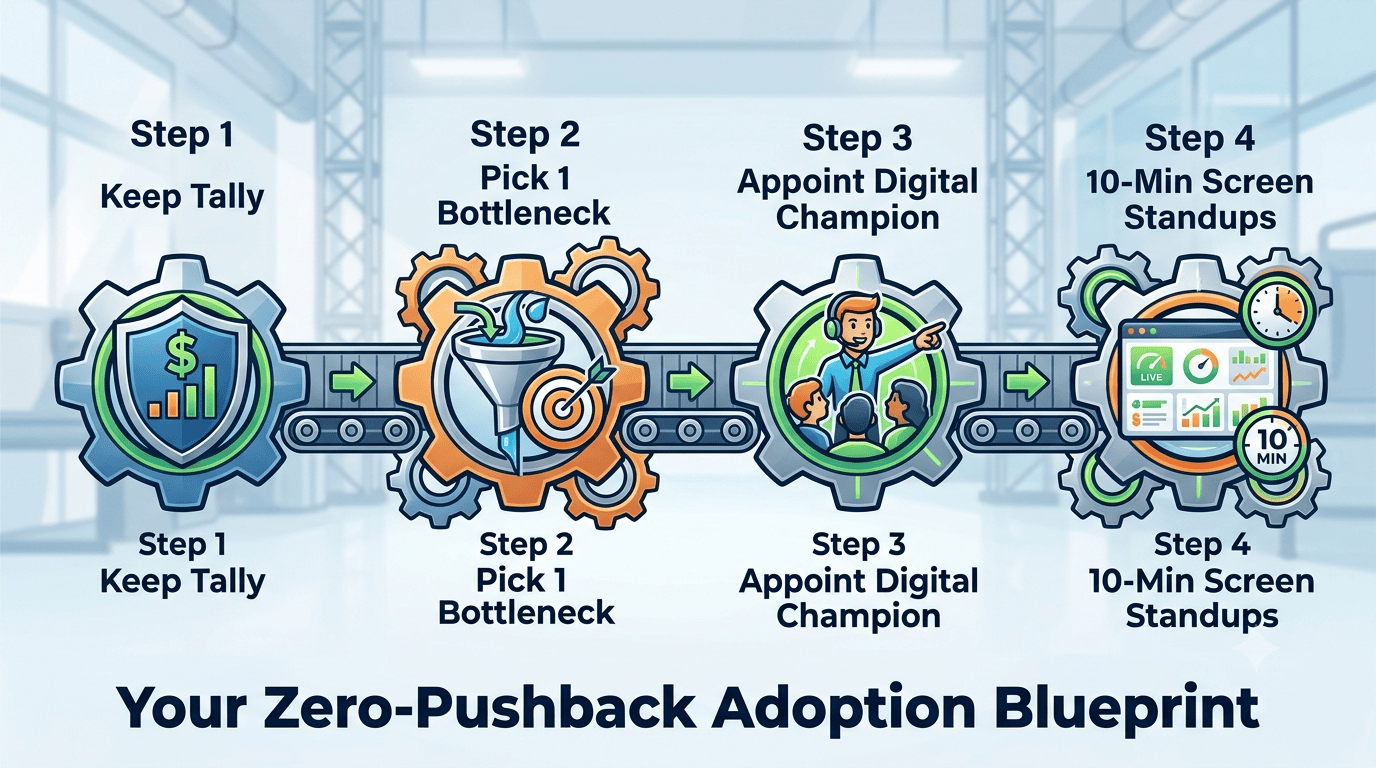
The 4-Step Playbook: Roll Out Without Shop-Floor Pushback
Buying software is easy; getting a 45-year-old shop-floor foreman to actually use it is the real hurdle. Here is a simple playbook to ensure high adoption:
1. Don't Replace Tally—Build Around It
Do not try to migrate accounting, billing, and tax workflows on day one. Keep Tally for GST and vouchers. Use your project management tool strictly for operational execution: delivery timelines, vendor follow-ups, drawing revisions, and sample approvals.
2. Start with One Painful Bottleneck
Do not digitize the entire factory at once. Pick the single process that causes the most heartburn—usually New Product Development (NPD) or Outsourced Job Work Tracking. Run the new tool on this bottleneck for 30 days until the team sees tangible relief.
3. Designate a "Digital Champion"
Appoint a junior engineer or tech-fluent supervisor as the internal champion. Their job isn't to manage the project, but to ensure that updates are logged into the software rather than shouted across the shop floor or lost in WhatsApp chats.
4. Replace 2-Hour Status Meetings with 10-Minute Screen Standups
Instead of gathering department heads in a conference room on Monday mornings to read off paper diaries, open the visual project board on a screen. If a task isn't logged on the board, assume it didn't happen.
The Bottom Line
In 2026, the competitive edge for Indian small manufacturers isn't just buying faster CNCs or bigger presses. It's operational velocity. When a Tier-1 customer asks for an update on a batch order, the factory that responds with precise, real-time tracking in 30 seconds will always win against the factory that needs 4 hours to call three supervisors and check five paper registers.
You don't need a ₹20 lakh enterprise budget to achieve world-class operational clarity. Armed with a budget-friendly tool like Zoho Projects, Trello, or ERPNext, you can transform shop-floor chaos into clockwork execution—starting this week.
What is your factory's current project tracking setup? Are you still surviving on WhatsApp groups and Excel trackers, or have you made the digital leap? If you face difficulties, reach out to me at phoenix.advizory@gmail.com or +91-9967093949 withyour biggest coordination problem and we will help solve it.