
Tracking Every Bolt From Factory To Customer
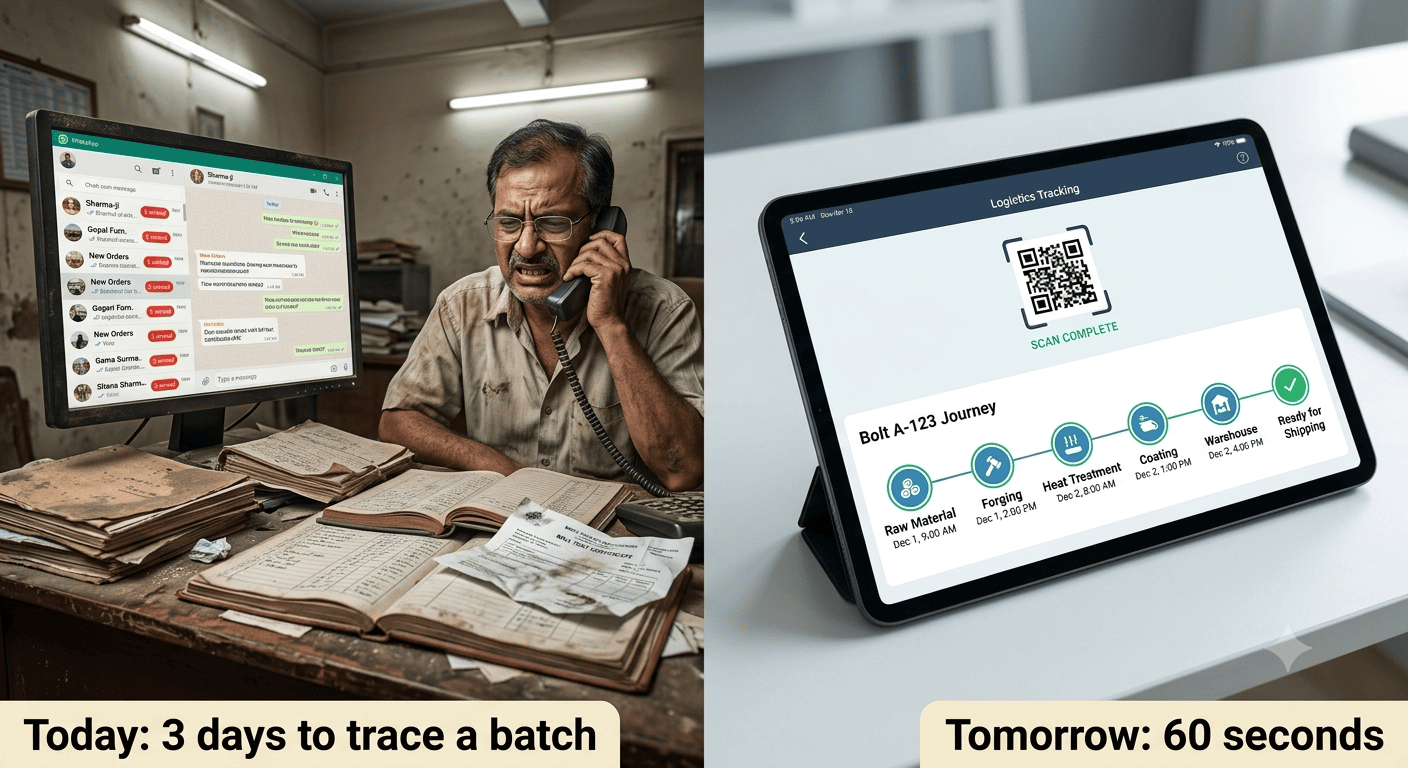
Why traceability is quietly becoming the deciding factor in who wins orders from big OEMs, and what small manufacturers can do about it. (Yes, even the ₹4 bolt.)
Picture This
In 2018, a bridge in Genoa, Italy collapsed. In 2013, a garment factory building in Dhaka came down. Different continents, different industries, and one common thread: when the investigators started digging, the first question was almost always the same.
"Where did this material come from, and who signed off on it?"
Now picture the same question landing on your desk. A customer calls. A batch of fasteners you shipped four months ago has failed in the field. They want to know which heat lot the steel came from, which shift made it, which inspector passed it, and which other customers got the same batch.
How long would it take you to answer? If your honest answer is "a few days, some phone calls and a lot of digging through registers," keep reading. This piece is for you.
The problem nobody puts on the balance sheet
Most small manufacturers in India run on a mix of Tally, Excel, WhatsApp groups and one very reliable person named Ramesh who "just knows." That works until it doesn't. Here's what quietly goes wrong in the gaps:
- The paperwork lives in silos. The supplier's test certificate is in an email. The incoming inspection is in a register. The production batch is in the ERP, if you have one. Dispatch is on a challan. Nothing links them except human memory.
- Certificates can be forged. Anyone who has worked in procurement knows this. A mill test certificate is a PDF, and a PDF can be edited in ten minutes.
- Recalls become guesswork. Without batch-level traceability, a recall isn't "pull batch 47." It's "pull everything from that month and hope."
- Big customers are raising the bar. OEMs and export buyers increasingly ask for traceability as a condition of doing business. The EU is moving toward Digital Product Passports under its sustainability regulations. If you supply into global chains, this isn't optional forever.
So what do you do? Now, a lot of people will say "blockchain." So let's talk about that.
What blockchain actually is (without the crypto noise)
Forget Bitcoin. Forget the hype. Think of a blockchain as a shared logbook that nobody can quietly edit after the fact. Every time something happens to a batch of steel, a record gets added: received, tested, machined, heat-treated, inspected, packed, dispatched. Each entry is time-stamped and linked to the one before it. If someone tries to change an old entry, the chain breaks and everyone can see it.
The important part is that it's shared. Your supplier, you, your logistics partner and your customer can all write to and read from the same record, without anyone having to trust anyone else's spreadsheet. Compare that with how it works today. Your supplier says the steel is Grade 8.8 compliant. You believe them, because what else can you do? Your customer says they never received the right certificate. You say you sent it. Nobody can prove anything. A shared, tamper-evident record doesn't make people honest. It makes dishonesty expensive and disputes short.
Follow one bolt
Let's make it real. Imagine a high-tensile bolt, made by a small fastener manufacturer in Ludhiana for an auto component maker in Pune.
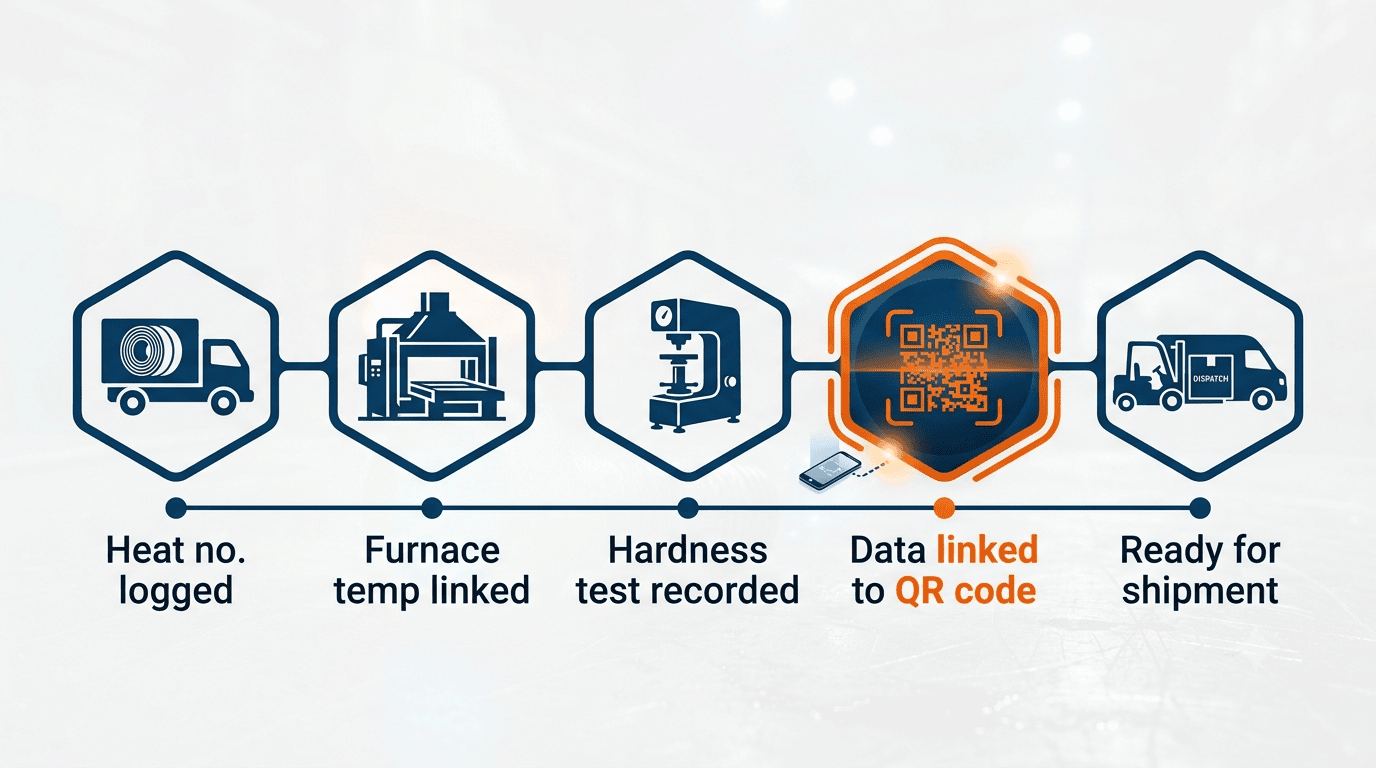
Step 1: Steel arrives. The wire rod comes with a heat number. At the gate, it's scanned and logged. The supplier's test certificate is attached to that record, fingerprinted so any later alteration is detectable.
Step 2: Production. The batch is cold-forged, threaded and heat-treated. Furnace temperature logs, machine ID and operator are linked to the same batch ID.
Step 3: Quality. Hardness and tensile test results are recorded against the batch, not floating in a separate register.
Step 4: Packing. Each carton gets a QR code. Scan it and you see the whole journey.
Step 5: Dispatch. The transporter and the customer's receiving team add their own entries.
Six months later, a bolt fails. Instead of three days of panic, someone scans a QR code and in under a minute knows the heat lot, the shift, the test values, and every other carton from that batch and where it went. That's the difference between a crisis and a Tuesday.
Okay, but here's the honest part
Nobody tells small manufacturers this: you probably don't need a full blockchain on day one. Most of the pain above is solved by the boring basics: batch numbering, QR codes, one connected system, and discipline.
Blockchain earns its place when three things are true:
- Multiple parties need to trust the same data (you, suppliers, customers, auditors).
- Those parties don't fully trust each other, or have a history of disputes.
- The cost of being wrong is high: safety-critical parts, export compliance, expensive recalls, warranty claims.
If you make decorative hardware for a single local buyer, a good ERP is enough. If you supply fasteners, castings or components into automotive, aerospace, infrastructure or export chains, the maths changes fast. A good rule of thumb: digitise first, then decentralise. Blockchain on top of messy data just gives you a permanent record of messy data.
The India angle
India has quietly built a strong foundation for this. GST e-invoicing and e-way bills mean your invoices and movements are already digital and time-stamped. Digital payments are everywhere. Large Indian conglomerates and global OEMs are already experimenting with traceability platforms, and when the big fish ask for it, it flows down to the Tier-2 and Tier-3 suppliers. That's you.
The smart move is to be the supplier who is ready when the request arrives, not the one scrambling to say "we'll get back to you." Because here's how these things usually go: first, it's a "nice to have" in the vendor questionnaire. Then, it's a scoring criterion. Then, it's the reason you lose the order to someone who can show a QR-code trail in a two-minute demo.
Your 90-day starter plan
You don't need a crore of budget. You need a sequence.
Days 1-30: Fix the foundation
- Assign a unique batch ID to every production lot, with no exceptions.
- Record the raw material heat number against every batch.
- Move test certificates out of email and into one organised, searchable place.
Days 31-60: Make it scannable
- Print QR codes on cartons or tags that link to batch records.
- Pick one product line and one anchor customer. Don't boil the ocean.
- Test your own traceability: pick a random dispatched batch and see how fast you can trace it backward. Time it. It'll be humbling.
Days 61-90: Add the trust layer
- Talk to one key supplier and one key customer about sharing records.
- Evaluate blockchain-based traceability platforms. Ask about cost per transaction, ease of onboarding for small suppliers, and whether data can be exported if you switch vendors.
- Run a small pilot on that one product line before committing.
One warning: be wary of any vendor who leads with the word "blockchain" instead of your actual problem. The technology is the plumbing. Start with the leak.
The bottom line
Traceability used to be a compliance chore. It's becoming a competitive weapon. The manufacturer who can say "scan this, see everything" wins the trust of buyers faster, handles complaints in minutes instead of weeks, and gets to say yes to export orders that others can't touch.
The ₹4 bolt isn't really a ₹4 problem. It's a reputation problem, a recall problem and, increasingly, an order-winning problem. You don't have to track everything tomorrow. But you should be able to answer one simple question today: "If this bolt fails, how fast can I prove where it came from?" If the answer makes you uncomfortable, that's your starting point.
Your next step
Pick one batch you shipped last month. Try to trace it end to end: raw material, process, inspection, dispatch. Time yourself. Then drop your time in the comments, or DM me the biggest gap you found. Need our help to close this gap, reach out at phoenix.advizory@gmail.com or +91-9967093949 and we’ll work on a traceability checklist built for your specific situation. And if you know a fellow owner who still runs on Ramesh's memory, send them this. Until next time, keep building.