
The New Energy Playbook for Indian Factories
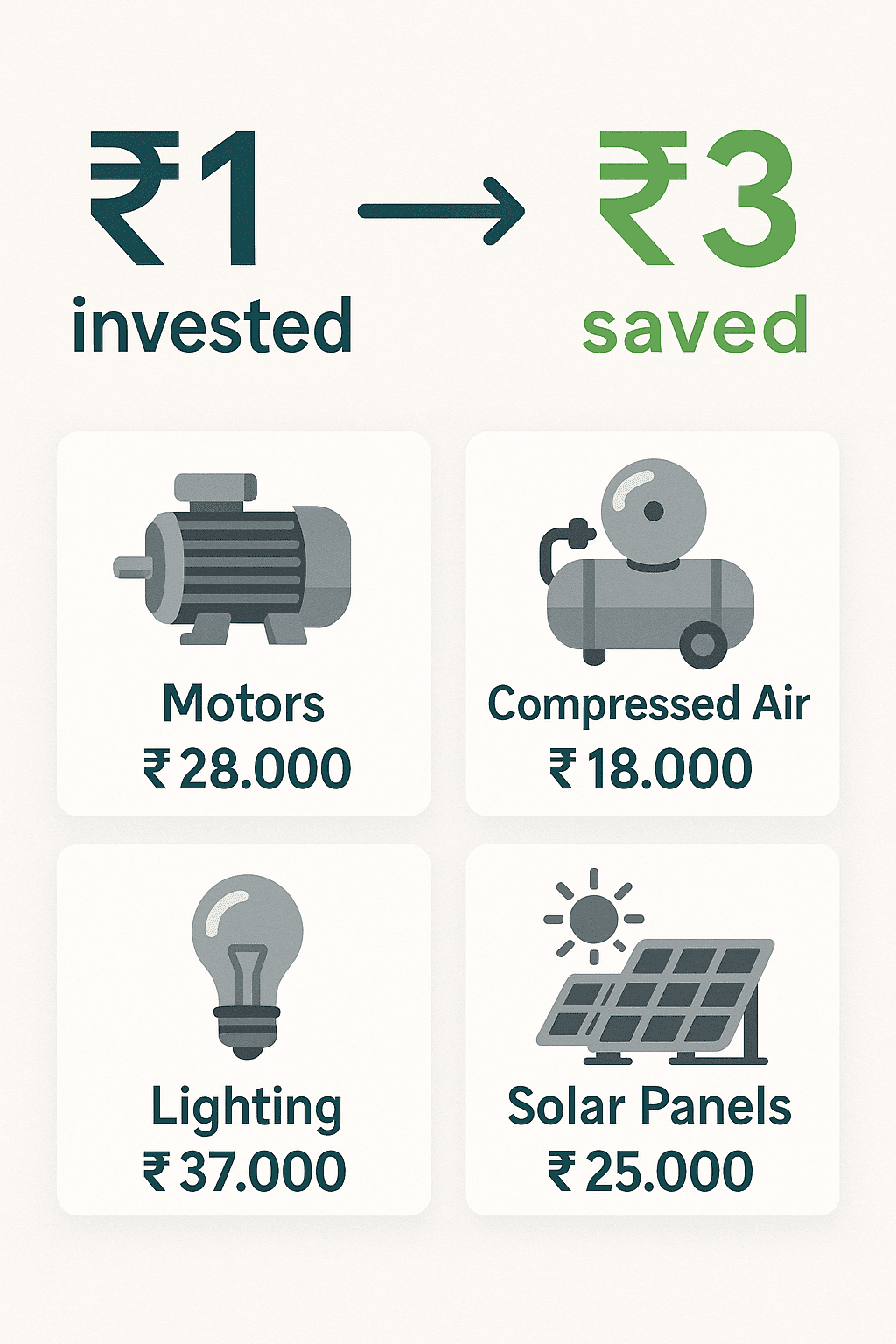
Energy Efficiency for Manufacturers
On a humid July afternoon in Pune, Rajesh stood inside his small machine shop, staring at the spinning meters on his electricity panel. The digits climbed like a petrol pump showing ₹120 per litre — but these weren’t litres. This was his energy bill.
That month alone, his power costs had jumped 18%. Input materials were up. Freight was unpredictable. And now, even staying lit was expensive. Rajesh sighed and said, “We’re working harder, but the profits are vanishing faster.” He’s not alone.
Thousands of business owners across India’s manufacturing belts — from Ludhiana to Coimbatore — are feeling this same pressure. Rising energy costs are quietly eroding margins, especially for small and mid-sized manufacturers who can’t simply pass on costs to customers.
But here’s the twist: the same crisis that’s hurting margins also hides your best opportunity to protect them. Let’s talk about how energy efficiency can cut your costs — without cutting corners.
The Elephant in the Factory: Power Costs Are Eating Your Profits
Energy isn’t just another expense line. It’s often the third-largest cost in manufacturing, after raw materials and labor. In some industries — like foundries, textile mills, or food processing — it can gobble up 20–30% of operating expenses.
Yet, many manufacturers treat it as a fixed cost — like rent or taxes — assuming it can’t be changed. But that’s a myth. Here’s what’s actually happening on your factory floor:
- Air compressors leaking ₹50,000 worth of energy each month.
- Old motors consuming 10–15% more power than efficient equivalents.
- Lighting that’s on long after production stops.
- Over-sized machines running on low load — like driving alone in a bus.
Small inefficiencies, left unattended, can drain lakhs of rupees every year.
The Forgotten “Energy Audit” That Could Save You Lakhs
Here’s the good news — identifying these leaks isn’t rocket science. Start with an energy audit. Think of it as a health check-up for your factory — it tells you where energy is leaking, what’s causing it, and how to fix it.
A professional audit typically costs between ₹50,000 and ₹2 lakh, depending on your plant size. But the ROI is impressive: savings of 10–25% on power bills are typical within a year.
Even without a formal audit, here’s a quick checklist you can start today:
- Measure, don’t guess. Install sub-meters for major equipment. If you can’t measure where energy goes, you can’t manage it.
- Fix the leaks. Air leaks in compressors can silently waste up to 30% of power. Sonic leak detectors or even soap-water tests can quickly identify problem areas.
- Optimize load management. Run high-load processes during non-peak hours. Many DISCOMs offer cheaper off-peak tariffs.
- Check power factor. A poor power factor attracts penalties and wastes supply. Capacitor banks or active power factor correction systems help you avoid this.
Every rupee saved on energy is a pure profit rupee. You don’t need to sell one more unit to earn it.
Case Study: How a Tier-2 Auto Supplier Saved ₹9 Lakhs a Year
A small auto component maker in Aurangabad had an annual power bill of ₹60 lakhs. After a quick audit, they identified:
- Outdated 5 HP induction motors running at 72% load efficiency.
- Compressed air leaks in three lines.
- Cooling tower fans running continuously even during night idle hours.
They invested ₹5 lakhs in replacements — IE3-rated motors and automated timers. The result?
- Annual energy savings: ₹9 lakhs.
- Payback period: 6.5 months.
No fancy tech. No major disruption. Just disciplined observation and small upgrades.
That’s the beauty of efficiency — it pays for itself.
The Tech Advantage: IoT, Smart Sensors & Data
If you’ve been hearing buzzwords like “smart factory” and “Industry 4.0” and figured that’s for the Tatas and Reliances of the world — think again. Affordable IoT energy management tools are changing the game for Indian SMEs. Platforms now offer plug-and-play monitoring for as little as ₹5000 per sensor. Imagine seeing your machine-wise energy use on your smartphone — daily, hourly, even by shift.
What this data reveals is often astonishing:
- A CNC idling during lunch break consuming 2.5 kWh per hour.
- A chiller unit working harder than needed because a valve sticks open.
- Lighting in a warehouse that never sleeps.
When you see energy in real time, inefficiencies stop being invisible. And you can act — instantly.
Renewable Energy: Your Silent Margin Builder
For small manufacturers, solar energy has quietly become one of the smartest capex decisions in 2025. The cost of solar installations is now under ₹35 per watt, with payback periods as short as 3–4 years depending on location.
Many state DISCOMs — like TN, Maharashtra, and Gujarat — support net metering, allowing you to feed excess power back to the grid. Beyond the cost benefit, solar signals something powerful to your customers: resilience, sustainability, and leadership. It’s no longer just about saving money. It’s about building brand trust and long-term competitiveness.
The People Factor: Energy Culture Inside the Factory
Equipment upgrades are great, but real savings come when your people care. Many of the most efficient plants in India haven’t achieved their success through massive investments, but through everyday discipline.
Manufacturers can build this energy-conscious culture by:
- Setting measurable targets (e.g., 5% annual reduction in energy per unit).
- Training operators to shut machines off properly.
- Recognizing and rewarding shop-floor teams for ideas that cut consumption.
- Displaying energy dashboards as visibly as production targets.
When energy awareness becomes part of your daily routine — like safety or quality checks — the compounding benefit is immense.
The Inevitable Future: ESG and Carbon Disclosure
Customers and investors are watching. Whether or not you plan to report ESG metrics, your buyers absolutely will. Large OEMs and exporters are already factoring suppliers’ energy intensity and emissions in procurement decisions.
Indian manufacturers who get ahead of energy efficiency now won’t just save money — they’ll secure long-term business. Inefficiency, in future contracts, won’t just cost you money — it could cost you customers.
From Cost Center to Competitive Edge
Here’s a perspective shift worth remembering: Energy efficiency isn’t about doing “less.” It’s about doing “more with less.” It doesn’t slow production — it refines it. It doesn’t require huge capex — it requires sharp focus.
Just like lean manufacturing transformed operations in the 90s, energy lean manufacturing is the next frontier for competitiveness. And for India’s small manufacturers, this next wave won’t come from government schemes or consultants. It’ll come from factory owners who decide that every unit of energy should contribute to growth, not waste.
The Takeaway
If you’re a business owner or CXO in manufacturing, here’s what you can do starting this month:
- Start small. Audit one department. Measure, benchmark, and act.
- Invest strategically. Replace only what’s inefficient, not everything.
- Adopt tech. Digitize energy data for visibility and accountability.
- Build awareness. Make energy savings a team KPI, not an afterthought.
Energy efficiency is not an expense. It’s your most underutilized profit lever. And in today’s competitive landscape — where every rupee counts — cutting costs without cutting corners might just be the smartest manufacturing strategy of the decade.
If you run or advise a manufacturing business, start a simple “Energy Efficiency Sprint” this quarter — a 90-day drive to identify leaks, upgrade low-hanging systems, and track savings. You’ll be surprised how quickly the numbers — and your margins — start smiling back. If you need us to help, reach out to me at phoenix.advizory@gmail.com or +91-9967093949. Let’s make MSME Manufacturing energy efficient, together.