
MSME's need a Dashboard before you need a Manager
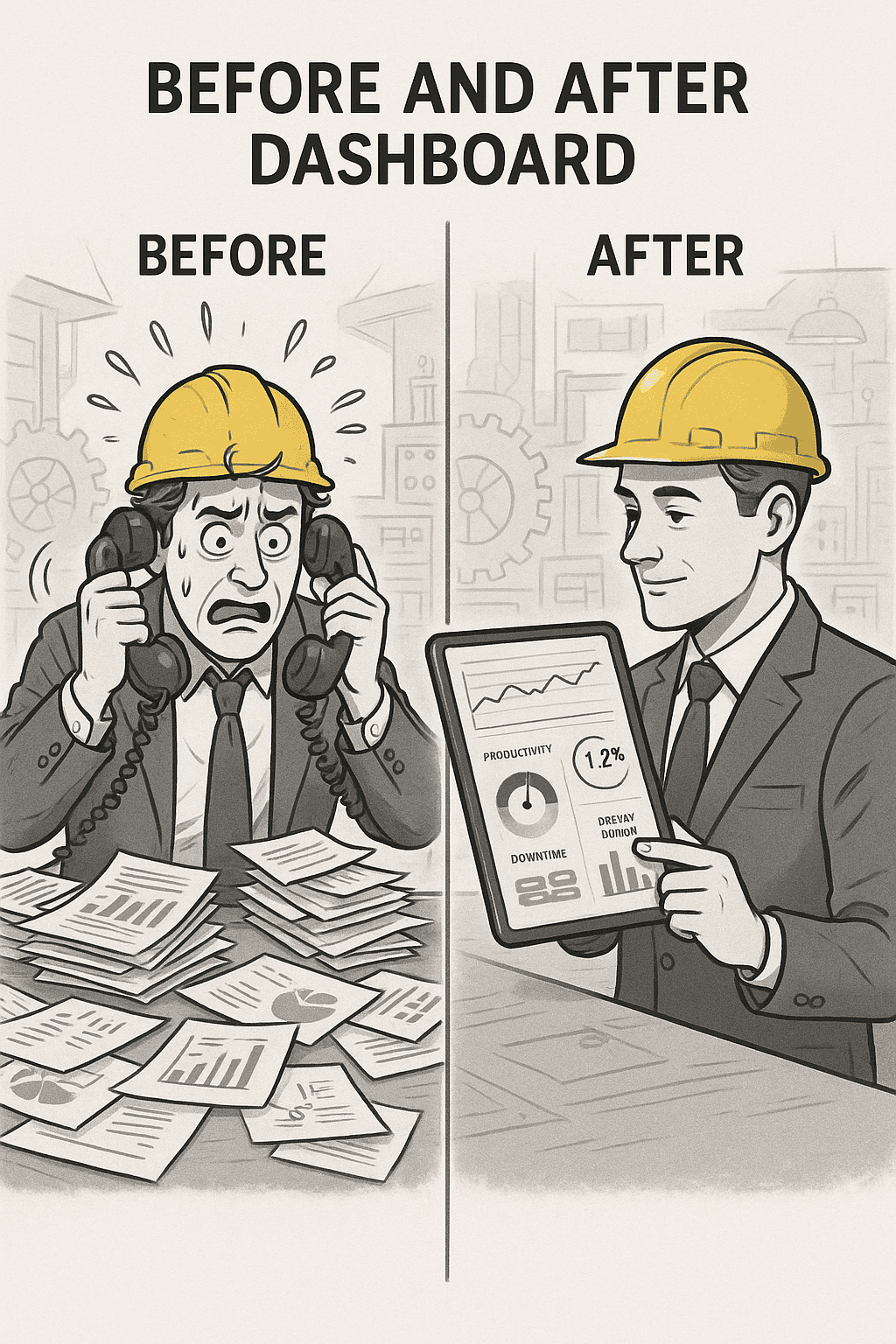
Imagine this
At 7:30 a.m. sharp, Rajesh was already in his factory, scanning yesterday’s production reports on WhatsApp. Half a dozen Excel sheets. A few voice notes from line supervisors. One blurry photo of the packing area. By 8:15, he was shaking his head. “Why did the target fall short again?”
The maintenance head blamed machine downtime. The production manager pointed to raw material delays. Procurement said vendors didn’t deliver on time. And Rajesh’s day began—with approximate answers to urgent questions. Sound familiar?
That’s the daily reality for thousands of small and mid-sized Indian manufacturers. Every decision relies on second-hand updates, phone calls, and instinct. But imagine if Rajesh could open a simple color-coded dashboard that told him, instantly
1.Which machines were running
2.Which lines had hit bottlenecks
3.How many units shipped
4.And even the live energy cost per product
Would he still need five people sending WhatsApp updates?
The Age of Gut Feeling Is Over
For decades, Indian manufacturing has run on experience and instinct. And honestly, it worked for a time. Veteran factory managers could tell something was wrong just by the sound of a running motor. Procurement heads remembered vendor credit terms by heart.
But in 2025, customer timelines are tighter, prices are thinner, and competition is global.
Gut feeling doesn’t scale anymore—data does. And that’s where digital dashboards step in.
The Power of Seeing Everything, in Real Time
Imagine a simple browser-based dashboard. In one view, you can see:
1.Production output vs plan (shift-wise, daily, or weekly)
2.Downtime hours and their reasons
3.Raw material stock levels
4.Order-wise progress
5.Energy or utility consumption trends
No fancy system overhaul. Just your existing machines, an IoT plug-in, and a dashboard tool feeding live data from your shop floor. It’s like having an X-ray of your entire operation—real-time, visual, and mobile-friendly.
“But We’re a Small Factory—Do We Really Need This?”
That’s the most common reaction. So let’s bust this myth right away. You don’t need an ERP overhaul or a data team. Tools like Power BI, Google Looker Studio, and lightweight IoT integrations can give you powerful insights in under a week.
Take Sunder Auto Components, a Chennai-based Tier-2 supplier. They started by connecting just two CNC machines via low-cost sensors. Within three months, they identified 18% unplanned downtime that no one was tracking before. Result? A ₹6 lakh productivity gain in one quarter—just by seeing what was already happening, more clearly.
Visibility changes behavior. Once your team sees their numbers live, they act faster, own more, and solve problems before they grow.
The Indian Factory Dashboard Starter Kit
Here’s what you really need to begin. Not jargon, not a million-dollar system—just a smart roadmap.
Step 1: Define What to Measure, Not What to Digitize
Pick 3-5 metrics that truly move the needle:
1.Machine Utilization (%)
2.On-Time Delivery
3.Rejection Rate
4.Energy Cost per Unit
5.WIP Inventory
If these numbers improve, your bottom line improves. Everything else is noise.
Step 2: Capture the Data
Most modern machines already support data output through PLC or simple IoT modules. If not, even manual entry via cheap tablets works. The key is consistency, not complexity.
Step 3: Visualize It Simply
Use tools your people already understand. Power BI / Google Looker Studio / Zoho Analytics for visualization. Google Sheets or Airtable for base data capture. Keep dashboards mobile-accessible—so shift leads can check results before tea break, not at end of day.
Step 4: Review Daily, Decide Weekly
Set a 15-minute daily huddle using the dashboard. Train your managers to look for patterns—not excuses. Discuss “Why did this happen?” and “What’s the action?” Dashboards don’t just show data—they drive accountability.
What Changes Once You Go Live
When a factory owner implements a dashboard, three big shifts happen almost immediately:
1.You Move from ‘I Think’ to ‘I Know’ - When you can see live rejection rates or downtime causes, meetings shift from guesswork to precise action.
2.Teams Start Competing on Results, Not Stories - Transparency creates positive pressure. When all teams view the same data daily, people start owning outcomes naturally.
3.Firefighting Gives Way to Forecasting - Spot a rising downtime trend early, and you prevent next week’s delay. That’s the difference between running your factory and your factory running you.
The Emotional Payoff No One Talks About
Ask any factory owner what keeps them up at night. It’s rarely the profit margin—it’s the uncertainty. “Are things running right?” “Will this shipment go out?” “Why is scrap suddenly up again?”
A digital dashboard doesn’t just give information. It gives peace of mind. It brings you one step closer to “Control Mode” instead of “Chaos Mode”. You no longer depend solely on people’s memory, mood, or Monday motivation. You depend on data that doesn’t lie.
Common Fears (and How to Tackle Them)
“My team won’t use it.” Start small. Get one line team to use it and celebrate their success publicly. Factory pride spreads fast.
“It’ll be expensive.” It doesn’t have to be. Low-code dashboards can start under ₹25,000. The ROI is often visible in weeks, not months.
“We’ll need a tech expert.” Partner with a local vendor or train your most curious engineer. Most tools are drag-and-drop once data sources are set.
A New Kind of Factory Owner
Five years ago, the smartest factory owner was the one who negotiated best with vendors.
Today, the smartest one is the owner who can read their dashboard at 8 a.m. and know exactly what went wrong—and what’s about to. Because in modern manufacturing, insight is the new currency. Factories that see more, win more.
The 1 week Dashboard Challenge
If you’re reading this, take this challenge: Within the next 24 hours, call your plant manager and ask: “What’s the one metric that costs us the most money when it goes wrong?”
Then, task them to start tracking it visually by next Monday. Even a simple Google Sheet + chart is enough. Once you see data on one screen, you’ll wonder how you ever managed without it.
Final Thought
Digital dashboards aren’t about replacing your people or adding gadgets. They’re about making every conversation in your factory more factual, faster, and focused. In an increasingly competitive Indian manufacturing landscape, the factories that thrive will be those that turn real-time insight into lightning-fast action. Your machines are already talking. It’s time you listened.
If you're a manufacturing founder or CXO ready to turn your data into daily action, start with a pilot dashboard this month. If you’d like me to help implement these guidelines suitable for your business — reach out to me at phoenix.advizory@gmail.com or +91-9967093949. Let’s get Indian SMEs data focussed, one machine at a time.