
THE playbook for government schemes
Imagine This
Your machine is humming, orders are steady — and then the phone rings: a big buyer wants a bulk order if you can scale in 45 days. Or your bank manager says you need collateral you don’t have to fund new equipment. Panic or opportunity? For thousands of Indian MSME manufacturers, government loan schemes are the bridge between “we could” and “we will.” But most owners treat them like a maze. This guide makes that maze a straight path.
Why this matters
Small manufacturers in India account for huge employment and output, yet access to affordable credit remains a top bottleneck. Subsidized loans, credit guarantees, and special schemes intended to unlock capital are often underused because of paperwork myths, mismatched expectations, and timing errors. The result: missed orders, delayed upgrades, and avoidable stress.
If you run a shopfloor with 20–200 employees, this piece will help you:
- Identify which schemes actually suit manufacturing MSMEs.
- Know what documentation and timelines to expect.
- Pick one practical next step that increases your chance of getting funded fast.
The problem
Problem: Government schemes exist, but they’re confusing.
Agitation: You don’t have time for complex government portals, and a rejected application can burn months. Meanwhile competitors who understand the process move faster and capture markets.
Solution: A simple, step-wise approach that helps you pick the right scheme, prepare documentation, and submit an application that passes quick checks.
Quick map: What government loan schemes mean for manufacturers
- Credit Guarantee Fund Trust for Micro and Small Enterprises (CGTMSE): Guarantees loans for MSEs without collateral, typically up to a certain limit. Useful if you lack fixed assets to pledge.
- Priority Sector Lending (PSL) and MUDRA loans: Banks provide loans under PSL targets; MUDRA covers micro enterprises up to certain caps with simple documentation.
- Credit Linked Capital Subsidy (CLCS) / Credit Linked Capital Subsidy Scheme for Technology Upgradation (now part of other schemes): Gives subsidy for buying approved machinery—effectively lowering loan cost.
- Emergency and special windows (e.g., RBI/GoI schemes during crises): Time-bound schemes that can offer lower interest or special terms.
- State-specific MSME schemes: States often have concessional loans, interest subventions, or single-window assistance tailored to local industry clusters.
- SIDBI and NABARD schemes: Small Finance with specialized products for manufacturing clusters, especially for machinery, working capital, and modernization.
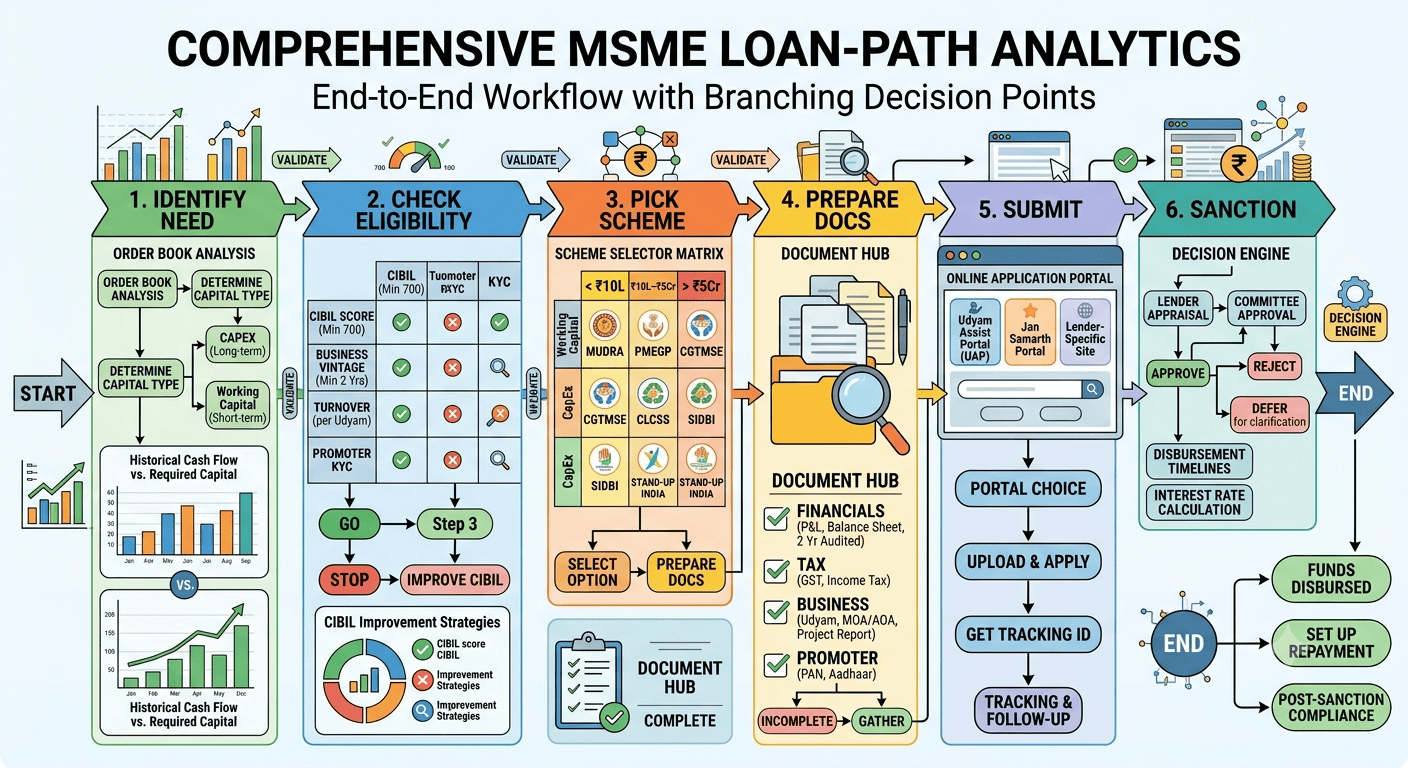
How to choose the right scheme — a practical 5-step filter
- Define the need: working capital vs capital expenditure
- Working capital: run-rate cash, raw materials, payroll, short-term supplier credit.
- CapEx: machines, plant upgrades, factory expansion.
Match your need first; some schemes only fund CapEx (e.g., machinery subsidy), others are for working capital (e.g., PSLC-backed loans).
- Check eligibility quickly (2-minute rule)
- Turnover threshold, enterprise classification (micro/small/medium), Udyam registration, GST returns, operational vintage (months/years).
If you don’t meet basic eligibility, don’t waste the formal application — fix the prerequisite first (e.g., complete Udyam, file missing GST returns).
- Pick the right channel
- For low-ticket needs (< ₹10 lakh): look at MUDRA, NBFCs, and micro-credit options.
- For ₹10 lakh–₹5 crore: approach commercial banks under CGTMSE guarantee; SIDBI financing for machinery.
- For bigger modernization spends: CLCS/subsidy + term loan from bank or NBFC; consider state industrial loan programs.
- Calculate the true cost
- Interest rate, processing fee, guarantee fee (CGTMSE), prepayment terms, subsidy timelines.
Example: A ₹50 lakh machine with 20% CLCS subsidy reduces loan principal by subsidy amount — but the subsidy may be disbursed later. Plan cashflows.
- Time and documents — plan the timeline
- Standard bank sanction can be 2–8 weeks; with clean documents and pre-approved schemes it can be faster.
- Prepare Udyam, last 2–3 years audited or CA-certified P&L and balance sheet, GST returns, bank statements (6–12 months), business plan/term plan, quotations from machine suppliers, and shop floor photos.
Common mistakes that kill approvals (and how to avoid them)
- Incomplete GST or Udyam: Fix first. Banks will reject or delay.
- Over-optimistic revenue projections: Use conservative numbers tied to orders or purchase orders.
- Not matching the loan purpose: Don’t apply for CapEx loan for working capital; it raises red flags.
- Ignoring guarantee fees and subsidy disbursal lag: Plan for interim cash outflow.
- Weak repayment plan: Show conservative cashflow, not best-case scenarios.
A real-world example
Ravi runs a metal parts shop in Pune, with a turnover of ₹4 crore, needed a CNC press for a medical components order worth ₹2 crore. He:
- Identified the need as CapEx.
- Got three quotes, chose a vendor on the approved list for CLCS-type subsidy.
- Applied to his bank with CGTMSE guarantee, submitted Udyam, 2 years of audited accounts, GST returns, POs from the buyer, and a simple repayment cashflow.
Outcome: Sanction in 4 weeks with 75% guarantee; machine delivered and revenue doubled within 6 months. The key: match scheme to need and present credible cashflows.
How to prepare a bank-friendly application
- Formal documents: Udyam registration, PAN, Aadhaar, GST, business address proof.
- Financials: Last 2 years audited accounts or 3 years if available; bank statements 6–12 months.
- Operational proof: Purchase orders, contracts, supply agreements, inventory list, photos of shopfloor.
- Project details (for CapEx): Vendor quote, technical specs, expected productivity uplift, timeline.
- Cashflow statement: Month-wise projection for next 12 months showing loan repayment.
- Personal info: Promoters’ KYC, income tax returns if required.
Speed hacks for busy CXOs
- Use a single “loan pack” folder (digital). Keep updated financials, standard vendor quotes, and basic documents ready.
- One-page project brief: 1-paragraph objective, ₹ amount, timeline, repayment source — hand this to the bank relationship manager.
- Work with trusted NBFCs or SIDBI-linked partners for faster processing if urgency is high.
- Use TReDS or invoice-discounting platforms to bridge small working-capital gaps quickly.
Where to get help (trusted partners)
- Your primary bank’s MSME desk or relationship manager.
- SIDBI’s centers and state MSME facilitation centers.
- Accredited NBFCs and fintech lenders that specialize in MSME manufacturing.
- Local industry associations, cluster-level helpdesks, and the District Industries Centre (DIC) for state schemes.
Red flags and caution
- Avoid brokers promising “sure approvals” for a fee who ask you to manipulate documents.
- If a scheme requires upfront payment to a third party to “expedite” subsidy, pause and verify with the scheme’s official portal.
- Read fine print on guarantee fees and prepayment penalties.
Actionable 30-day playbook
Day 1–3: Gather basics — Udyam, GST, PAN, bank statements.
Day 4–7: Decide CapEx vs working capital; get 2–3 machine/service quotes if CapEx.
Day 8–14: Prepare 1-page project brief and 12-month cashflow projection.
Day 15–21: Meet your bank RM and SIDBI/NBFC partner with the loan pack; ask for pre-sanction checklist.
Day 22–30: Submit formal application; follow up weekly; use invoice discounting for any interim cash needs.
Final thoughts
Access to the right loan at the right time can be the difference between business stagnation and growth. Government schemes are not a bureaucratic trap — they’re tools. Wield them with a plan, not panic.
If you want, I can review and suggest the three best schemes for your specific need if you tell me turnover, vintage, and loan requirement. Reach out to me at phoenix.advizory@gmail.com or +91-9967093949 with your one-page project brief and cash flow draft.