
How MSME’s are quietly automating on a shoestring.
How Indian SMEs Can Afford Industry 4.0
A textile unit in Tirupur. A auto-ancillary shop in Rajkot. A pump manufacturer in Coimbatore. Different products, different states, same conversation happening in their owner's head right now: "Everyone's talking about Industry 4.0. My competitors are putting sensors on machines and dashboards on tablets. Do I need to spend ₹50 lakh I don't have, just to stay in the game?"
Here's the uncomfortable truth: if you keep believing automation means robotic arms and a crore-sized capex line, you'll keep doing nothing. And doing nothing is the most expensive decision on the table. Here's the reassuring truth: it doesn't have to cost that much. Some of India's smartest SMEs are automating on budgets that wouldn't cover a single industrial robot — and getting real, measurable returns. Let's talk about how.
The ₹50 lakh myth
When large consultants pitch "Industry 4.0," they usually mean the German model — fully networked factories, machine-to-machine communication, AI-driven predictive maintenance across hundreds of assets. That's a real thing. It's also completely irrelevant to a business running 15-40 machines with a working capital cycle that's already stretched thin.
What actually matters for an Indian SME isn't the scale of the tech. It's the answer to one question: where is money leaking on my shop floor, and can I plug that leak for less than it's costing me? That reframing changes everything. Because most of the leaks aren't fixed by robots. They're fixed by visibility.
Start with data, not machines
Ask any plant owner where their biggest losses hide, and you'll get vague answers. "Machine downtime, I think." "Some rework issue." "Maybe it's the changeover time." Nobody knows the number — because nobody's measuring it. This is the first, cheapest, highest-ROI move available to any SME: instrument what you already have before you buy anything new.
A retrofit IoT sensor — the kind that clips onto a motor or spindle to track runtime, vibration, and stoppages — costs anywhere from ₹3,000 to ₹15,000 per machine, depending on sophistication. Compare that to a new CNC machine at ₹30-80 lakh. You're not replacing the asset. You're finally seeing it.
Several Indian startups (Flutura, Altizon, Bridgera, and increasingly homegrown solutions built by engineering colleges) offer pay-per-machine SaaS models starting under ₹1,000/month per node. No massive upfront licence fee. No six-month implementation. Data starts flowing in days. One auto-component maker in Pune did exactly this on 22 machines. Total spend: under ₹4 lakh. What they found in month one: three machines were idle almost 30% of the shift due to poor changeover sequencing — not breakdowns, just bad scheduling. Fixing that scheduling problem, with zero new hardware, recovered capacity equivalent to buying a new machine. That's the shoestring version of Industry 4.0: cheap sensors, expensive insight.
Vision, without the enterprise price tag
Quality inspection used to mean either hiring more QC staff or investing in a vision system that cost more than your annual profit. That gap has closed dramatically. Off-the-shelf camera modules paired with open-source computer vision models (built on frameworks like YOLO or OpenCV) can now be trained to spot surface defects, missing components, or dimensional mismatches for a fraction of what enterprise vision systems used to cost.
Several Indian AI service providers now offer this as a managed service — you send them sample images of good and defective parts, they train the model, and you get a working defect-detection setup for ₹1-3 lakh, sometimes running on nothing more exotic than an industrial-grade webcam and a mini-PC. Compare that to the cost of a single large customer rejection batch, or worse, a recall. The math isn't close.
Your ERP doesn't need to be SAP
A huge number of Indian SMEs still run their production planning on a WhatsApp group and an Excel sheet that only one person understands — and that person just went on leave. You don't need SAP S/4HANA. You need visibility into orders, inventory, and shop-floor status that doesn't live in someone's head.
Cloud-based, India-built MES and lightweight ERP tools (think Katana, Fabrico, or homegrown platforms increasingly available through MSME-focused vendors) now offer modular pricing — pay for production tracking this quarter, add inventory next quarter, skip the modules you don't need. Monthly costs for a 20-30 machine unit typically fall in the ₹15,000-₹40,000 range, not the ₹10 lakh+ enterprise deployments of a decade ago.
The unlock here isn't the software. It's that decisions stop depending on tribal knowledge and start depending on data anyone can pull up on a phone.
Let the government co-fund your leap
This is the part most SME owners skip past because scheme names sound bureaucratic — and it's the part that can cut your automation bill by 25-50%.
1.SAMARTH Udyog Bharat 4.0, under the Ministry of Heavy Industries, specifically funds Industry 4.0 pilot centres and demonstration projects for MSMEs, including subsidised access to sensors, robotics, and data analytics platforms.
2.CLCSS (Credit Linked Capital Subsidy Scheme) offers a 15% capital subsidy on institutional finance for technology upgradation, including automation equipment.
3.ZED (Zero Defect Zero Effect) certification support from the MSME Ministry subsidises the very quality and process-monitoring tools discussed above.
Several state industrial policies (Gujarat, Tamil Nadu, Maharashtra) layer on their own capital subsidies for MSME tech upgrades, sometimes stacking with central schemes. Most owners never claim these because the process feels opaque. Hire a consultant for a one-time fee (usually ₹25,000-75,000) to navigate the paperwork — it typically pays for itself several times over.
The sequencing that actually works
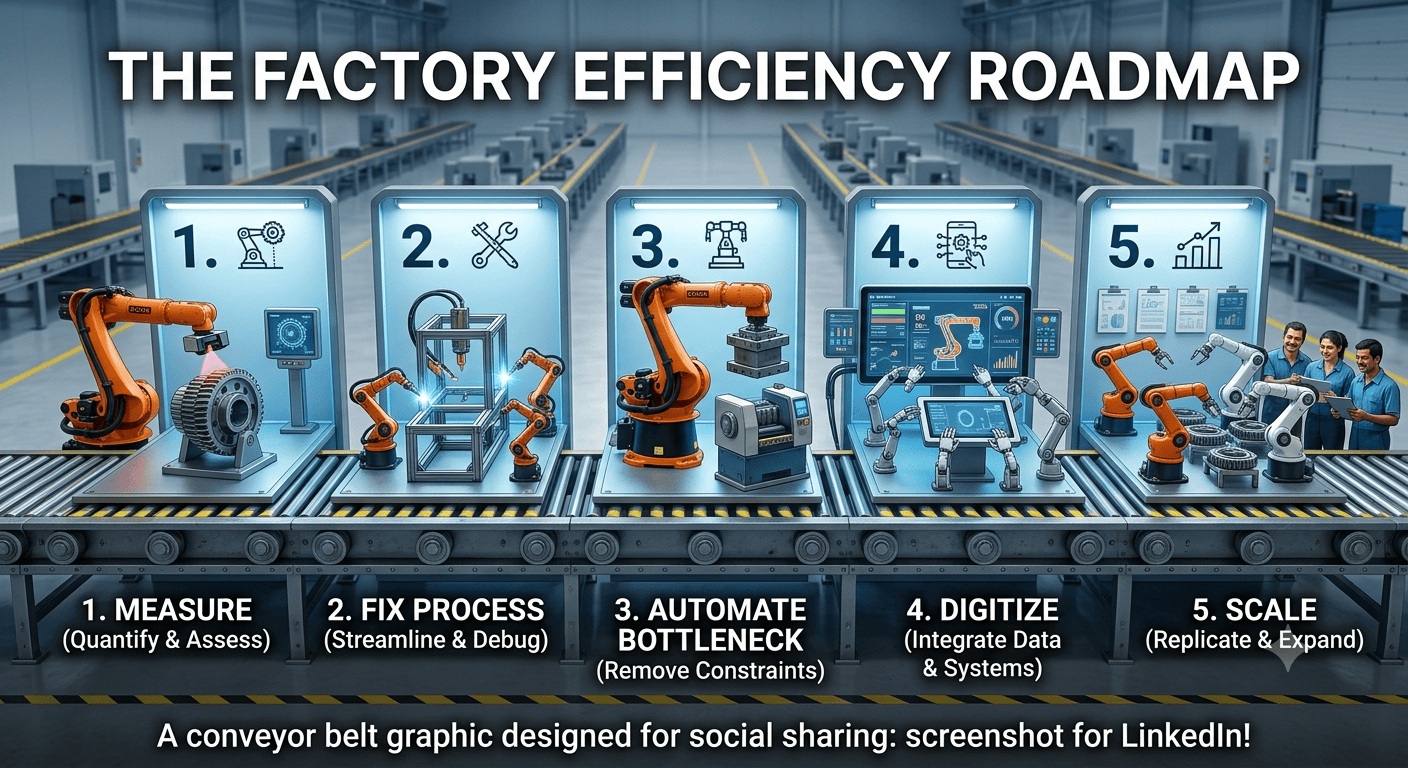
If budget is tight — and for most SMEs, it always is — the order of operations matters more than the size of the cheque:
1.Measure first. Cheap sensors on your worst-performing machines. Understand where time and money leak.
2.Fix the process, not just the equipment. Often the biggest wins are scheduling, changeover, and material flow — free or near-free changes once you have data.
3.Automate the highest-leverage bottleneck. Not the whole line. The one station that's constraining your output.
4.Digitize the record-keeping. Once physical processes are tightened, layer in software so the gains don't erode back into chaos.
5.Scale what's proven. Only after a pilot shows real ROI on one line, replicate it across the plant.
Owners who skip straight to step 3 — buying a flashy automated cell because a trade show impressed them — are the ones who end up with expensive machinery gathering dust next to a shop floor that's still running on guesswork.
The real competitive risk
Here's what should keep you up at night: it's not that automation is expensive. It's that your competitor — quite possibly a smaller, scrappier one than you — just did the ₹4 lakh sensor pilot, found 18% hidden capacity, and used it to underquote you on the next big order.
Industry 4.0 for Indian SMEs was never about matching German factories. It's about not being the last person in your cluster still running blind while everyone else can see. If you're a manufacturing owner sitting on this exact decision — start smaller than you think you need to. Pick your worst-performing machine. Instrument it for under ₹10,000. Look at the data for two weeks. You'll know within a month whether the bigger investment is worth making.
Found this useful? Follow along for more no-fluff breakdowns on running a manufacturing business in India. Need our Help? Reach out at phoenix.advizory@gmail.com or +91-9967093949. Let’s automate your business, profitably and efficiently.