
How MSMEs Can Grow Without Burning Out
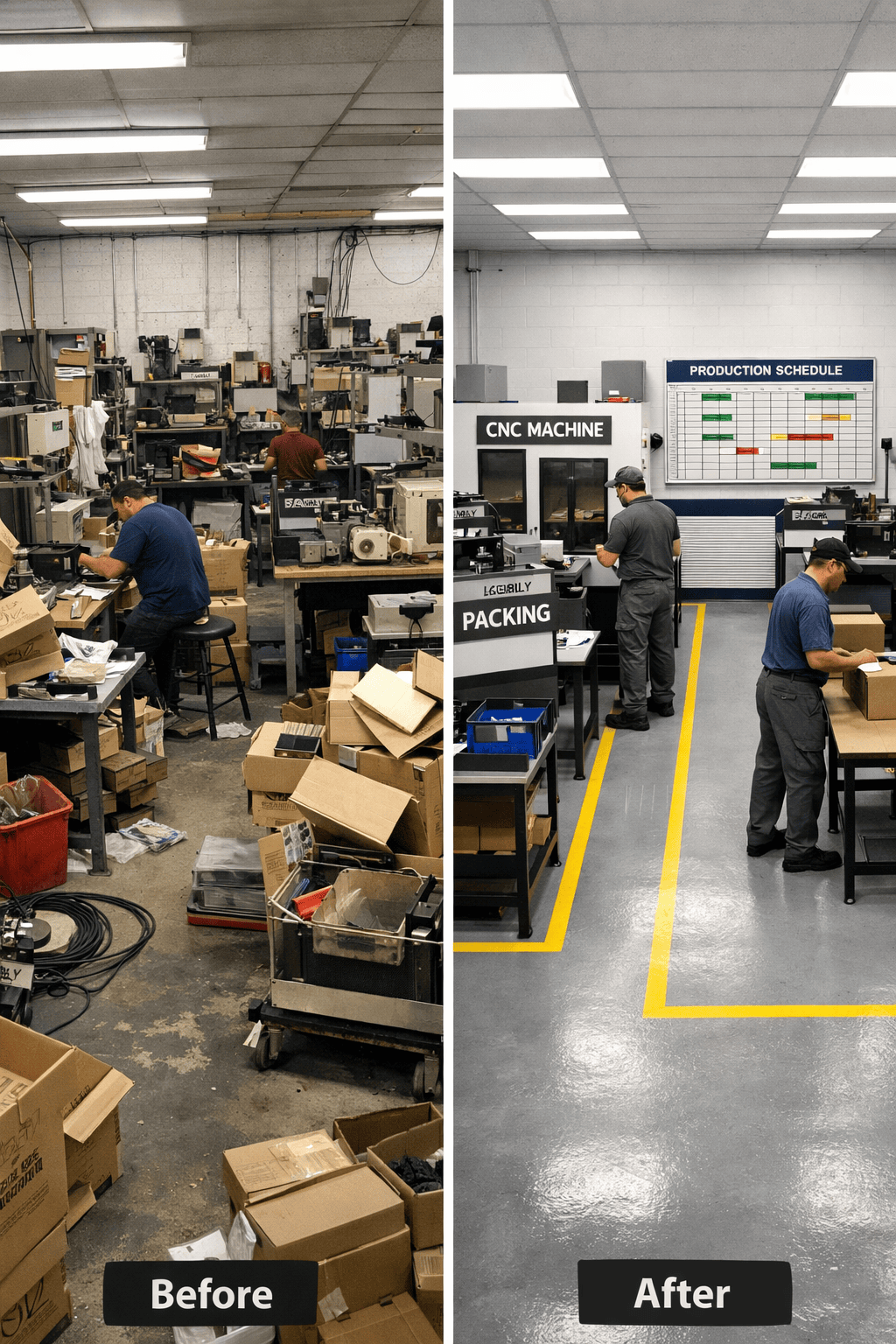
Picture this
You started your business with a machine, a few workers, and a lot of trust in your own instincts. Today, you’re making good, even respectable, money. But you constantly feel like you’re running on a treadmill—no time to plan, no clarity on where to grow next, and no real handle on who’s doing what in your shop.
That feeling isn’t random. It’s the cost of running an MSME without professional management.
The “typical” Indian MSME today
Most small manufacturers in India are built on three pillars:
- Owner’s personal effort
- Trust in loyal workers and local relationships
- “We’ve always done it like this”
On the surface, this formula works. You get orders, you push out parts, and you keep the bank account above zero. But step back, and you see the hidden leakage:
- Machines running at 40–50% utilization because there’s no proper planning.
- Cash stuck in inventory or receivables because no one owns the numbers.
- Customers leaving for a slightly bigger factory that “at least replies on time.”
What “professional management” really means
Forget jargon like “Six Sigma” or “KPI dashboards” for a minute. At its core, professional management in an MSME simply means:
- Assigning clear roles and responsibilities
- Setting measurable targets and tracking them
- Making decisions based on data, not gut feeling
- Building simple but repeatable systems (not chaos by email and WhatsApp)
In other words, it’s about replacing “whatever the owner shouts from the shop floor” with structured accountability across your team. Professional management doesn’t make you less “hands‑on.” It just makes your hands‑on work more effective.
Real stories from Indian MSMEs
1. The precision job shop that stopped being “snow‑blind”
A small precision job shop in Pune used to accept anything that came in the door. Owner‑cum‑production‑manager would jump from RFQ to machine to customer, always firefighting.
Then they hired a small‑factory operations manager (someone with 8–10 years in job shops) and did three simple things:
- Introduced a weekly order planning meeting with machines, tooling, and capacity on a board.
- Set OTD (on‑time delivery) and quality targets for each machine group.
- Started daily “15‑minute huddles” at the start of each shift.
Within 12 months:
- OTD jumped from 65% to 92%
- Rejection rate dropped by more than half
- Bankers started treating them as a “serious account” for term loans
The business didn’t change its product mix. It changed how decisions were made.
2. The auto‑component supplier that finally grew beyond one big customer
A small auto‑component unit in Chennai depended on a single OEM, which kept squeezing margins and changing schedules. The owner knew diversification was critical but “had no time to market.”
They brought in a part‑time operations and supply‑chain consultant and implemented:
- A simple capacity planning sheet showing bottleneck operations
- A 12‑week rolling production plan shared with the OEM
- A basic ERP‑lite (even Excel‑based) system for tracking quotations, orders, and deliveries
Result?
- The owner could finally say “No” or “Yes, but at this date and price” with data in hand.
- They secured two new Tier‑2 customers within 18 months by promising reliable delivery, not just cheap parts.
Professional management didn’t magically create new customers. It created the credibility to keep them.
3. The family‑owned chemical company that stopped “blaming seasons”
A family‑owned chemical company in Coimbatore had the same pattern every year: good sales in Q3–Q4, losses in Q1–Q2, and periodic cash crunches.
They onboarded a small‑industry operations specialist and took three steps:
- Standardized reactor schedules and line utilization metrics.
- Broke down cost per kg by product line instead of “company level” P&L.
- Introduced basic weekly reviews on inventory, receivables, and reactor downtime.
Within two years:
- The best‑margin products were identified and pushed through better planning.
- Cash flow became smoother; they stopped borrowing to pay workers.
- The younger generation could finally argue about “strategy” instead of “emergency fund‑raising.”
This is the quiet power of professional management: it converts chaotic survival into deliberate growth.
Why professional management unlocks MSME value
Professional management doesn’t just “improve efficiency.” It changes the game MSMEs are playing. Let’s break it down:
1. From “owner‑centric” to “organization‑centric”
In most MSMEs, the owner is the beating heart of the business: sales, purchasing, finance, and HR all run through one person. This is a single‑point‑of‑failure system.
Professional management spreads decision authority across a small team. That means:
- Owner can finally start focusing on what to grow, not how to push
- Critical decisions continue even when the owner is away (or on the phone with a relative)
2. From “hoping for good days” to “planning for everyday”
Amateur operations live on ad‑hoc orders and “this month is good.” Professional management insists on:
- Weekly production planning
- Capacity vs. demand tracking
- Buffer planning for bottleneck machines
Suddenly you stop being surprised by “Why is the machine idle this week?” or “Why did we miss that shipment?”
3. From “WhatsApp orders” to documented systems
In informal setups, critical information sits in:
- WhatsApp messages
- Memory of the foreman
- Loose chits on the wall
Professional management forces:
- A simple order‑tracking sheet or ERP
- Standard SOPs for key processes
- Basic performance dashboards (even if printed every Monday)
This isn’t about “becoming a corporate.” It’s about not losing money for the sake of cheap informality.
4. From “employees as helpers” to “team as partners”
Most MSME owners complain about “bad workers.” Many of them actually have un‑managed workers. Professional management introduces:
- Clear roles and expectations
- Feedback cycles (not just yelling)
- A sense of “this is our system” instead of “this is the owner’s mood”
That’s why you see MSMEs that hired a small‑factory HR or operations manager and then found their rejection rate dropped, attendance improved, and even family members started behaving more like colleagues than “boss’s relatives.”
What Indian MSMEs get wrong about “professional help”
Most owners resist formal management because of four myths:
- “Professionals bring unnecessary complexity.”
They simplify: they separate “what matters” from “what looks fancy.”
- “We’ll lose our culture.”
What dies is fear‑based culture and replaces it with role‑based clarity.
- “We can’t afford them.”
The real question is: Can you afford not to? A single major lost order or penalty can fund months of a good operations manager.
- “They don’t understand our small scale.”
The best MSME‑level professionals are those who have worked in 10–50 machine shops and know how to scale simplicity.
How to start—if you’re not ready to hire a full‑time COO
You don’t need to jump into a full‑blown corporate structure. Start small but start. Here’s a practical path for an owner‑operator in India:
Step 1: Own the “one pager” for your business
Create a single sheet that answers:
- What are our 3 most profitable product lines?
- Which machine is our bottleneck?
- Who is responsible for procurement, production planning, and dispatch?
This simple exercise forces you out of “everything is important” into “these are the constraints.”
Step 2: Bring in a part‑time professional (even 2–3 days a week)
Look for:
- Someone with 8–15 years in manufacturing operations
- Experience in small or mid‑sized units, not only big MNCs
- Comfort with Excel, WhatsApp‑driven teams, and regional suppliers
Their first job isn’t to “transform” but to document current systems and highlight 2–3 glaring leaks.
Step 3: Implement three basic systems
Within 90 days, aim for:
- A weekly planning board for machines and key resources
- A simple order‑tracking log (physical or digital) showing status and date
- Weekly performance review on: on‑time delivery, quality, and machine downtime
These are not “corporate” tools. They are MSME survival tools.
Step 4: Connect professional management to money
Once planning stabilizes, shift the focus to:
- Cash‑flow visibility (receivables, payables, inventory)
- Product‑wise profitability
- Cost of quality (rework, scrap, consequential losses)
This is where professional management becomes directly visible on your balance sheet and bank account.
The real transformation: from “owner” to “business owner”
Here’s the emotional truth no one talks about. Most MSME owners are reluctant to systematize because it means surrendering some control. And with that control goes part of their identity.
But the flip side is this:
- When you have systems, you can sleep at night knowing that production is planned, cash is monitored, and problems are visible.
- You can take a vacation without your business collapsing.
- You can start thinking about exit, succession, or sale instead of just “how to survive next month.”
Professional management isn’t something that happens to your business. It’s something you allow to happen—and then you watch your business grow beyond the limits of your own stamina.
Your next move
If you’re an owner of a small manufacturing unit in India and you’re still doing everything yourself, chances are:
- You’re not short on orders.
- You’re short on professional structure.
Before you invest in another machine, another marketing campaign, or another “digital transformation” workshop, ask yourself:
- “Can I answer, in 10 minutes, what my 3 biggest operational constraints are?”
- “If I take 15 days off, can someone run this shop without panicking?”
If the answer is “no,” then your next investment should be time and money in a professional operations or management resource—even if it’s part‑time, even if it’s a consultant for the first 6 months. Because in today’s India, the difference between an MSME that survives and one that transforms isn’t just about orders or subsidies.
It’s about whether you’re willing to let your business be run less like a one‑person show and more like a small but professional enterprise.
If you’re an MSME owner reading this: Reply with one sentence: “What’s the one thing I’m most scared to systematize in my unit?” Then commit to fixing that one thing in the next 90 days. If you need us to help, reach out to me at phoenix.advizory@gmail.com or +91-9967093949. Either way, start. Because your business isn’t waiting for a miracle. It’s waiting for you to treat it like a real, professional company.