
WHY IT COULD MAKE OR BREAK YOUR MANUFACTURING BUSINESS
You’ve probably felt it already.
The machines on your shop floor are getting smarter, your customers are demanding faster deliveries, and your competitors—somehow—are producing more with fewer people. But here’s the real kicker: it’s not your machinery holding you back. It’s your people.
Welcome to the quiet revolution of Indian manufacturing—where upskilling has become the most underrated lever of competitiveness.
The Real Crisis Isn't Labour Shortage. It's Skill Obsolescence.
Across India, MSME manufacturers have one consistent pain point: finding and retaining skilled workers. But the real issue isn’t just the lack of people—it’s the mismatch between what workers know and what modern factories need.
Think about it.
- Your CNC operator was trained 10 years ago on a single-axis lathe. Today, your machines run on multi-axis systems connected via IoT.
- Your production planner is still managing schedules on Excel while larger players are using real-time ERP dashboards.
- And your maintenance engineer knows mechanics but not mechatronics.
This skill gap is widening—and it’s eating into productivity, quality, and profitability. According to a recent CII report, India could face a shortage of nearly 30 million skilled manufacturing workers by 2030 if upskilling doesn’t catch up with technology adoption.
The irony? We’re entering the era of "smart factories"—while many workers still operate like it’s 2005.
Why Traditional Training No Longer Works
Let’s be honest. Most small manufacturers treat training as a box-ticking exercise:
“Send two people for safety training.”
“Do a one-day session on 5S.”
“Invite a vendor for a product demo.”
But that’s not upskilling, that’s maintenance. It keeps things running—it doesn’t move the needle. True upskilling is about transforming how your workforce thinks, not just what it knows. It means teaching your machinists to interpret data from a dashboard. Helping supervisors use digital tools to improve OEE. Encouraging your QC team to think in terms of root cause analytics instead of inspection checklists.
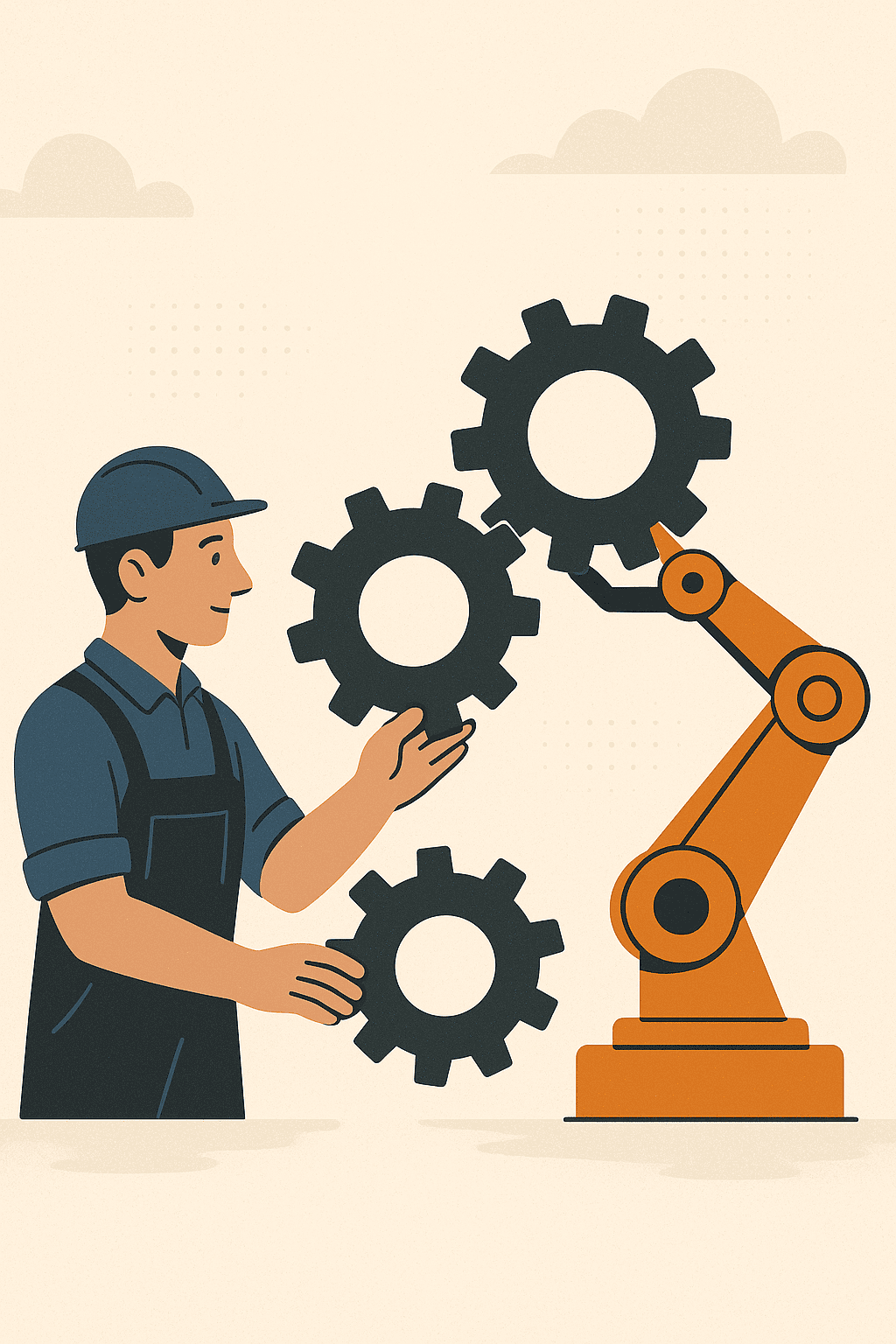
Here’s the truth: the next phase of manufacturing growth in India won’t come from automation alone—but from "human automation"—people who know how to work with intelligent systems, not be replaced by them.
The Economic Argument: Upskilling Pays for Itself
Many owners hesitate to invest in capability development because it feels like a cost center. But it’s one of the highest ROI investments you can make.
Consider this:
- A study by McKinsey found that companies investing in workforce upskilling saw up to 30–40% productivity gains.
- German MSMEs that adopted structured apprenticeship programs reported a 25% reduction in defect rates and faster onboarding times.
- Closer home, a precision parts manufacturer in Pune reported 20% lower machine downtime after training its operators on sensor diagnostics.
So yes, upskilling costs money—but so does not upskilling. Every time a trained employee leaves, you lose months of efficiency. Every machine stopped due to operator error costs you lakhs in lost production. Upskilling converts operational chaos into a competitive advantage.
Step 1: Identify Your “Skill Bottlenecks”
Before jumping into courses and certifications, you need clarity.
Ask yourself:
- Where do delays or mistakes most often occur?
- Which parts of your process depend heavily on one or two senior people?
- What new technologies have entered your line that your team doesn’t fully understand?
You’ll find that skill bottlenecks—like poor digital literacy, a lack of process understanding, or resistance to change—often hurt performance more than any material shortage.
For example, one electrical components manufacturer in Coimbatore realized that 60% of its rework came from incorrect machine setup. Instead of buying new equipment, they trained all operators on part-machine matching and setup protocols. Within a month, rejections dropped by half. Sometimes, your biggest productivity lever isn’t a new machine—it’s a new mindset.
Step 2: Create a Culture That Rewards Learning
Upskilling only works when it’s built into the culture. That means shifting from “training as punishment” (“You messed up; go get trained”) to “training as privilege” (“You’re valuable; we’re investing in you”).
Try this:
- Start monthly “learning hours” where employees share improvements they’ve made.
- Recognize internal trainers publicly.
- Link learning achievements to career progression.
When people see growth opportunities, motivation skyrockets. Think of companies like Toyota or Siemens—they treat training not as HR activity but as strategy. That’s what separates operational excellence from survival mode.
Step 3: Leverage Digital Platforms Wisely
The good news is—upskilling no longer needs massive classrooms or global trainers. Digital learning platforms, AR/VR simulations, and micro-learning modules are reshaping how manufacturing teams learn.
For Indian MSMEs, this means you can:
- Partner with ed‑tech platforms offering industry‑ready modules tailored for your domain (CNC, welding, mechatronics, lean manufacturing).
- Use low‑cost tools like YouTube private playlists or WhatsApp micro‑lessons to train operators.
- Implement “shadow learning” programs where senior staff guide apprentices with checklists and digital task sheets.
The best training programs don’t feel like “extra work.” They feel like part of work.
Step 4: Train Managers Before Workers
Here’s a hard truth: most upskilling initiatives fail not because workers don’t learn—but because managers don’t lead. Supervisors and shift‑in‑charges are the bridge between strategy and shop floor execution. If they don’t understand why upskilling matters, they won’t enforce it.
Equip managers with:
- Coaching skills—how to mentor and give feedback.
- Data literacy—how to interpret dashboards and KPIs.
- Change management techniques—to overcome initial resistance.
When leaders model learning behavior, the workforce follows.
Step 5: Start Small, Scale Fast
You don’t need a massive program from Day 1. Start with a pilot—say, upskilling five operators on predictive maintenance. Measure the impact on downtime, quality, and efficiency. Then expand the model gradually.
One packaging SME in Gujarat began by digitizing just its maintenance logs and training technicians in basic analytics. Within six months, they reduced unplanned breakdowns by 40%. Seeing this, the owner invested in similar training across all departments. In short—the best strategy is “learn, apply, repeat.”
The Human Side of the Upskilling Revolution
Let’s zoom out for a moment. Beyond competition and KPIs, there’s a more emotional reason to upskill your team—it’s about dignity and progress. For many factory workers, the fear of becoming obsolete is real. They’ve given decades to one skill, and now technology seems to threaten that skill. Upskilling tells them:
“You’re not being replaced—you’re being retooled for the future.”
That single belief can transform morale and loyalty. It also creates ripple effects—more confident workers, safer operations, better retention, stronger communities.
The India Opportunity
We’re at a pivotal point. India’s manufacturing sector is expected to cross $1 trillion in output by 2030, driven by Make in India, PLI schemes, and China+1 supply chain shifts. But none of it is sustainable without skilled human capital.
India doesn’t just need more factories—it needs smarter factories.
And smarter factories aren’t built by robots. They’re built by people trained to work smarter. Your factory could be one of them—if you act now.
What You Can Do This Quarter
If you’re wondering where to start, here’s an immediate roadmap:
- Audit your team’s skills against new process and technology requirements.
- Nominate internal champions who will own learning initiatives.
- Pick one learning theme per quarter — like digital tools, lean practices, or maintenance analytics.
- Track metrics — downtime reduction, quality improvement, retention rates.
- Celebrate results publicly to reinforce behavior.
Small, consistent actions compound faster than grand, one-time projects.
The Final Thought
Upskilling isn’t about teaching people to survive automation—it’s about preparing them to lead it. Every machine upgrade, every digital dashboard, every new ISO requirement—you’ll only get full value if your people know how to use it.
So, the next time you plan your CAPEX budget, ask yourself: “What if I invested the same energy in my people as I do in machines?” That’s how you future‑proof your business—from the ground up.
If you’re a small or mid‑sized manufacturer ready to make upskilling a competitive advantage, start today. Begin with one skill, one team, one week. The future factory is not built—it’s trained. And if you’d like me to help implement upskilling programs for your business — reach out to me at phoenix.advizory@gmail.com or +91-9967093949. Let’s get Indian SMEs to upskill, one person at a time.