
The AI Revolution Happening on the Shop Floor
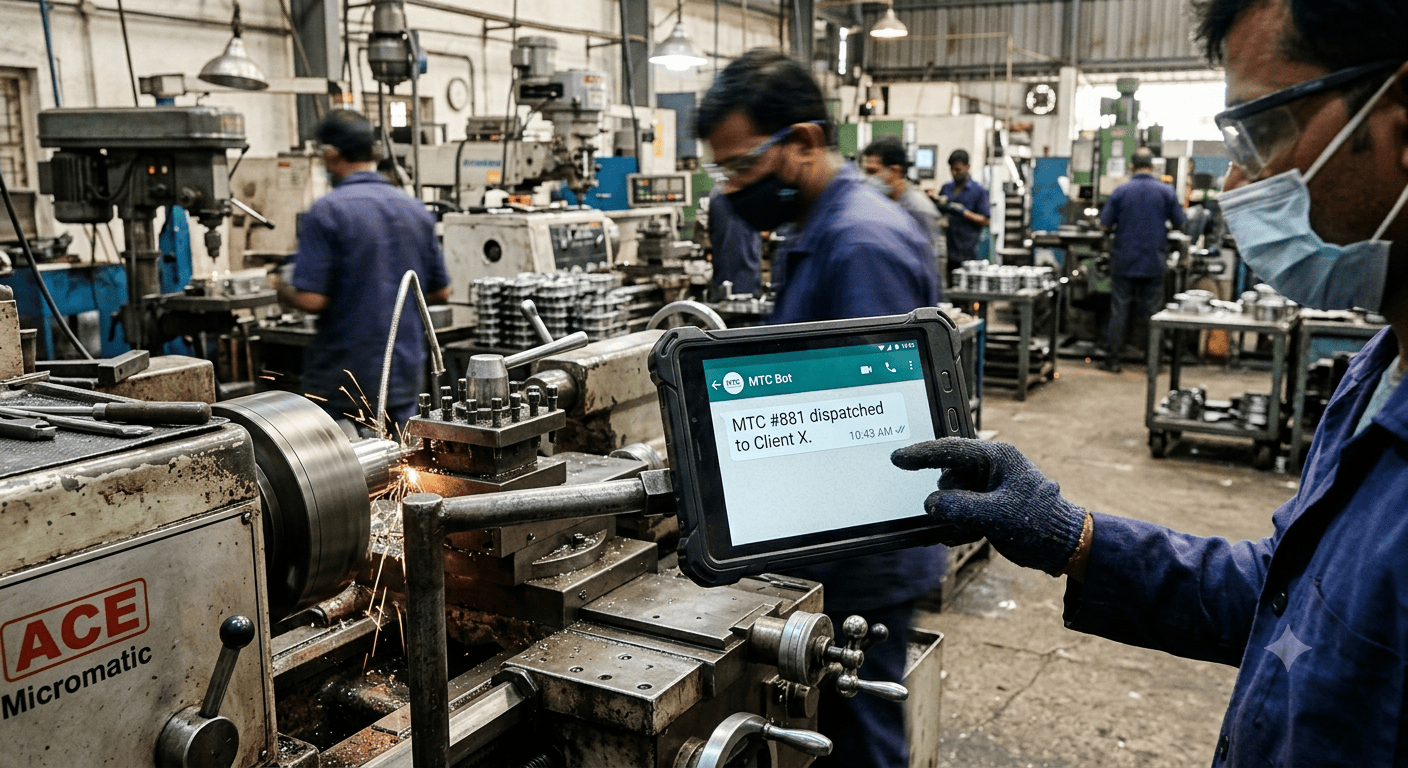
Imagine This
Picture a typical Tuesday afternoon in Bhosari, Pune. A chemical factory owner, Ramesh, is sitting in his cabin, nursing a lukewarm cup of chai. On his desk sits a freshly cancelled order of 75MT to be delivered over the next 2 months. Why was it cancelled?
Not because of poor quality. Not because of a delayed dispatch. But because a tier-1 buyer’s procurement team in Chennai asked a simple question at 7:30 PM on Monday: "Can you give us a revised dispatch schedule for the 1st lot of 20MT of the products ordered?"
Ramesh was on the shop floor. His dispatch manager had packed up for the day. The inquiry sat unread on WhatsApp until 10:00 AM the next morning. By then, the Chennai buyer had already placed the order with a competitor down the road who responded within six minutes.
If you run a MSME manufacturing unit in India, this scene probably makes your stomach knot up. Because deep down, you know it isn't an isolated incident. It’s a systemic leak in Indian manufacturing. We spend crores buying equipment, upgrading power capacity, and negotiating raw material rates down to the paisa. But when it comes to customer communication, most small factories operate like it’s 1998.
And it’s costing us millions. Here’s the story of how that's quietly changing—and how AI chatbots are pulling small Indian factories out of the reactive dark ages.
The Silent Crisis on the Factory Floor
Let’s be honest about how customer service traditionally works in an Indian manufacturing MSME:
Customer Enquiry → Owner's Personal WhatsApp → Forwarded to Sales Engineer → Checked with ERP/Excel → Manual Draft → Reply Sent (3 to 24 Hours Later)
It’s slow, it’s chaotic, and it relies heavily on individual human memory. When a B2B buyer reaches out to an Indian manufacturer today, they aren't asking for marketing fluff. They usually want one of four things:
- A quick Quote/RFQ based on drawings or specs.
- Order & Dispatch Status ("Where is my shipment?").
- Inventory Availability ("Do you have raw stock ready?").
- Technical Test Certificates (COAs/TCs) for compliance.
When your sales coordinator takes 6 hours to find a COA from a folder buried in desktop drives, your client isn't just waiting—they’re doubting your operational capability. In modern supply chains, response velocity is treated as a proxy for operational capability. If your communication is slow, buyers assume your factory floor is equally chaotic.
Enter the Conversational AI Revolution
For years, when tech consultants said "AI," small factory owners tuned out. And rightly so. Implementing traditional enterprise software involved 6-month timelines, expensive system integrators, and software that required a computer science degree to operate. But over the last two years, something fundamental shifted.
AI didn't come in the form of complex, million-rupee software dashboards. It came attached to the single tool every Indian factory owner, floor manager, and vendor already uses every single minute of the day: WhatsApp.
Today’s manufacturing AI chatbots aren't those annoying decision-tree bots from 2018 that keep saying, "Sorry, I didn't get that. Press 1 for Sales." Modern AI chatbots use Large Language Models (LLMs) integrated via WhatsApp Business API. They can read technical CAD drawings, parse Excel inventory sheets, read ERP data, and speak natively in Hinglish, Tamil, Gujarati, or Marathi.
How AI Chatbots Actually Work in a Factory Setup
Let’s step away from the tech jargon and look at three real scenarios where small factories are using AI to out-compete larger rivals.
1.Instant Quotation Engine
Normally, when an enquiry / drawing comes in, an engineer manually measures dimensions, checks material grade rates, calculates cycle time, and writes up an estimate.
Now? A customer uploads a RFQ to WhatsApp AI assistant. The AI parses the specifications, quantity details, delivery and other commercial terms, cross-references current raw material pricing from the factory’s database, calculates standard production time, and generates a formal preliminary quotation within 45 seconds.
Or a customer uploads a PDF drawing to the factory’s WhatsApp AI assistant. The AI parses the specifications, cross-references current raw material pricing from the factory’s database, calculates standard machining time, and generates a formal preliminary quotation within 45 seconds. If it’s a highly complex job, the AI collects critical specs (tolerance levels, surface treatment requirements) and passes a clean, organized summary to the owner for final approval. No lost details. No delayed quotes.
2.The 24/7 "Where Is My Order?" Desk
Your production manager shouldn't spend two hours every morning answering phone calls from clients asking for dispatch updates. Connected to basic shop-floor tracking or ERP tools (like Tally or Zoho), an AI chatbot answers buyer queries instantly:
Client:"What's the status of PO #8491?"
AI Chatbot:"Hi Rajesh! Your order for 3MT of Disinfectants currently at the packing stage. Expected dispatch is the day after tomorrow at 3 PM. Here is the live tracking link for the partial batch sent yesterday."
The buyer gets instant clarity at 10 PM on a Sunday without bothering your staff.
3.Automated Document Retrieval (COA & Invoices)
Ask any quality manager about the headache of dispatching Test Certificates (COAs). A batch of 3MT of chemicals arrives at the buyer's plant, but the gate security won't let the truck unload because the paper COA was lost in transit.
With an AI system in place, the buyer’s gate inspector simply messages the batch number to your factory’s WhatsApp number. The AI retrieves the exact PDF from your cloud folder and sends it back in 5 seconds. The truck unloads without delay, and your payment cycle stays on schedule.
The ROI Math for MSME Manufacturers
Let's address the elephant in the room: What does this cost, and what's the actual return? Many owners assume AI tools cost lakhs of rupees month. The reality in 2026 is vastly different.
METRIC | AVG IMPACT AFTER AI DEPLOYMENT |
Set up Time | 3-7 days |
Monthly Investment | ₹2,000 – ₹10,000 / mo |
Average RFQ Response Time | Down from 18 Hours to 2 Minutes |
Order Conversion Rate | Up by 22% - 35% |
Unproductive Phone Time Saved | ~15 Hours/week per Manager |
When you calculate the cost of lost orders due to missed inquiries or slow follow-ups, an AI system pays for itself the first time it secures a contract while your office is closed for the evening.
The Human Reality: AI Enhances Your Team, It Doesn't Replace Them
There is a common fear among MSME owners that introducing AI will alienate floor staff or confuse traditional B2B clients. The reality on the ground is the exact opposite.
AI doesn't replace the deep personal relationships that drive Indian manufacturing. It simply handles the repetitive, clerical friction—tracking dispatches, sending certificates, acknowledging purchase orders—so your sales team can focus on what actually builds business: visiting clients, solving technical issues, and building trust.
Your customers don't want to wait 4 hours for a PDF, and your engineers don't want to spend half their day searching for lost emails. Removing that friction makes life better for everyone involved.
How to Get Started Without Burning Your Fingers
If you're ready to modernize your factory's customer service, don't try to build an over-engineered system on day one. Follow a simple 3-step roadmap:
- Audit Your Inquiries: Track all incoming buyer calls and WhatsApp messages for one week. Identify the top 3 repetitive questions your team spends time answering.
- Start with WhatsApp API: Integrate an off-the-shelf AI engine with your existing WhatsApp Business line to automate responses to those top 3 questions.
- Connect Your Data: Connect the AI to your basic inventory sheets, Tally/Zoho data, or Google Drives so it pulls accurate, real-time information.
The Bottom Line
The gap in Indian manufacturing is no longer just about who has the newest machinery or the cheapest labour. It's about speed and responsiveness. The factories that survive and scale over the next decade won't necessarily be the biggest ones. They will be the ones that are easiest, fastest, and most reliable to do business with. If a buyer can get an instant response, immediate technical documents, and live order tracking from your shop, why would they ever go anywhere else?
How does your factory currently handle after-hours client inquiries and instant RFQs? Have you tried automating any part of your customer communication yet? Reach out to me at phoenix.advizory@gmail.com or +91-9967093949 withyour highest volume automation requirements and we will help solve the problem.