
Fixing Healthcare Sales Incentives
Imagine This
Picture a rainy Thursday morning in Cuttack, Odisha. Your senior territory manager, Rajesh, steps out of a bustling hospital procurement office. He just spent three weeks nurturing this lead, navigating four levels of administrative gatekeepers, and finally closed a deal. The total order value? ₹8,00,000. You should be celebrating, right?
Except when you look at the product mix, your heart sinks. Out of that ₹8 Lakh order, ₹7.5 Lakh consists of low-margin, high-commodity items like basic surgical gloves, disposable syringes, and standard cotton rolls—products where your net margin is a razor-thin 3%. The high-margin, proprietary fast-moving healthcare consumables (FMHC) you actually needed to push—like advanced wound dressing kits, bio-capped IV cannulas, and specialized disinfectant concentrates carrying 35% margins—were barely touched.
At the end of the quarter, Rajesh hits 110% of his top-line revenue target and walks away with a handsome bonus check. Meanwhile, your manufacturing plant in Solan is running at peak capacity, your working capital is stretched tight, and your net profit margins are flatlining. If you own or manage a mid-sized healthcare manufacturing company in India, this scenario plays out every single month.
We invest millions in cleanrooms, automated blow-fill-seal lines, and strict ISO certifications. But when it comes to compensating field sales teams and mapping their routes, Indian manufacturers rely on two outdated tools: flat percentage commissions on gross revenue and unstructured, ad-hoc daily travel.
Here is how you fix both issues—aligning sales compensation with profit margins while maximizing field rep time across India's complex geography.
Part 1: Margin Preservation vs. Volume Growth in Healthcare Sales
In fast-moving healthcare consumables, not all top-line revenue is created equal. Flat percentage commissions (e.g., 2% on total sales) encourage sales reps to take the path of least resistance:
1.The Commodity Trap: Standard commodity items face fierce price competition. They require little sales effort but produce virtually no bottom-line margin.
2.The Clinical Push: High-margin consumables require clinical detailing, hospital committee demos, and doctor buy-in. Without a higher incentive, reps won't do the heavy lifting.
3.The Payment Cycle: In Indian healthcare—from corporate hospital chains to Tier-3 nursing homes—collections can stretch beyond 90 days. Revenue isn't real until cash hits the bank.
Step 1: Implement a Tiered Incentive Matrix
Replace flat rates with a margin-aligned commission structure:
Portfolio Tier | Product Category Example | Gross Margin Profile | Baseline Commission Rate | Strategic Focus |
Tier 1: Commodities | Syringes, basic drapes, standard gloves | Low (< 10%) | 0.5% – 1.0% | Volume throughput & order-taking |
Tier 2: Core Consumables | Disinfectants, airway management items | Medium (15% – 25%) | 2.5% – 4.0% | Market expansion |
Tier 3: Specialized FMHC | Advanced wound dressings, bio-cannulas | High (> 30%) | 6.0% – 8.5% | Clinical detailing & account penetration |
Step 2: Add a DSO Payment Accelerator
Tie a portion of the commission payout directly to Days Sales Outstanding (DSO):
·Full Commission (100% Payout): Payment collected within 30 days.
·Standard Payout (80%): Payment collected within 31–60 days.
·Penalty Payout (50%): Payment collected within 61–90 days.
·Zero Commission: Payment pending past 90 days (rep actively assists in collection).
Part 2: Maximizing Rep Time with Territory Beat Planning
A smart incentive model only works if your sales team spends time in front of the right buyers. Most field reps spend less than 30% of their workday actively selling. The remaining 70% is swallowed by traffic chokepoints, unplanned travel routes, unannounced cold calls, and payment chasing.
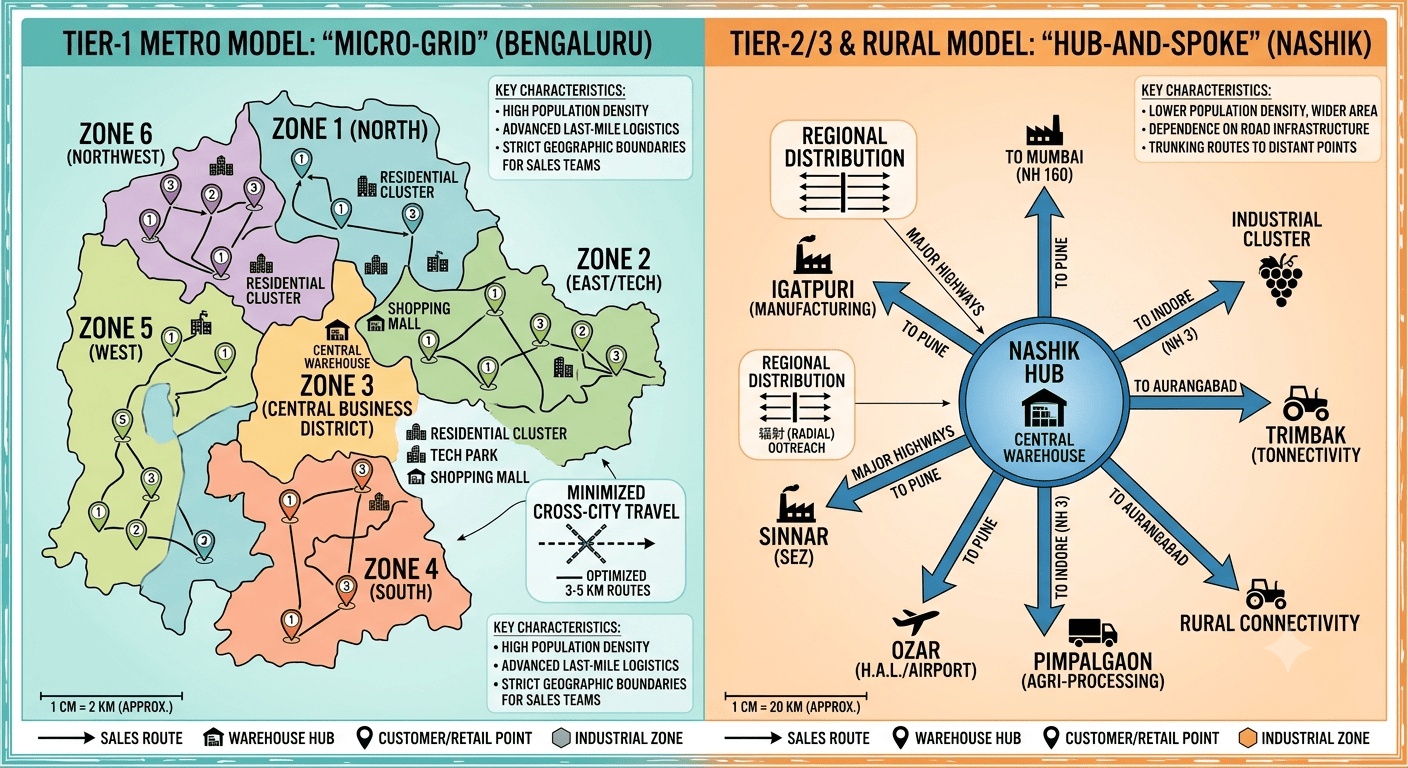
To solve this across India’s diverse city tiers, build a structured Permanent Journey Plan (Beat Plan) built around two geographic models:
1. The "Micro-Grid" Model (Metros & Tier-1 Cities)
·Context: In metros like Bengaluru, Mumbai, or NCR, travel time—not physical distance—is the primary bottleneck.
·Strategy: Divide the metro into tight 3–5 km clusters (e.g., Peenya vs. Whitefield).
·Rule: Reps must stay within one cluster per day, avoiding major cross-city commutes during peak morning or evening traffic.
·Target: 8 to 10 focused field visits per day.
2. The "Hub-and-Spoke" Model (Tier-2, Tier-3 & Rural Hubs)
Context: In industrial clusters like Nashik, Belagavi, or Coimbatore hinterlands, clients are spread across transport highways.
Strategy: Anchor the rep at a main commercial hub (e.g., Nashik) and assign dedicated corridor days outward (e.g., Nashik–Sinnar belt on Wednesdays).
Rule: Combine high-value hub visits early in the week with designated outstation cluster days.
Target: 4 to 6 high-touch, relationship-building visits per day.
Part 3: Categorize Accounts & Eliminate the Cold Visit Trap
Before mapping daily routes, categorize your customer base using a strict ABC Matrix:
Category | Revenue Contribution | Visit Frequency | Coverage Type |
A Class | Top 70% of revenue | Weekly/Bi-weekly | Physical Visit |
B Class | Next 20% of revenue | Monthly | Hybrid (Rep+Phone) |
C Class | Bottom 10% of revenue | On-Demand | Digital/Distributor |
Eliminating Wasted Travel Hours
1.Pre-Journey Confirmations: Mandate that reps send a quick WhatsApp confirmation at 5:00 PM every evening to lock in next-day appointments.
2.Anchor & Cluster Visits: Schedule 1–2 "Anchor Meetings" (high-value A-Class accounts) each day, then fill open time slots with nearby B-Class accounts within a 15-minute radius.
3.Shadow Beats: Equip every rep with 3 "Shadow Accounts" nearby. If an anchor meeting gets cancelled unexpectedly, the rep pivots immediately without losing productive hours.
Action Plan for MSME Founders & COOs
1.Audit Your Product Margins: Categorize your catalog into Tiers 1, 2, and 3 based on net profitability rather than gross volume.
2.Restructure Sales Commissions: Implement a tiered incentive model with a collection-linked DSO accelerator.
3.Re-Map Sales Territories: Transition your metro teams to Micro-Grid clustering and your Tier-2/3 teams to Hub-and-Spoke corridors.
4.Deploy Lean Tracking: Use low-cost mobile Sales Force Automation tools (GPS/SFA) to monitor route adherence, payment collections, and visit productivity in real time.
Are your sales reps driving high-margin growth, or are they burning fuel chasing low-margin volume? Need our help to benchmark your sales incentive model, or to build a new one, reach out at phoenix.advizory@gmail.com or +91-9967093949. Let’s scale your business, profitably and efficiently.