
MSME playbook to automate repetitive work fast and affordably
Picture This
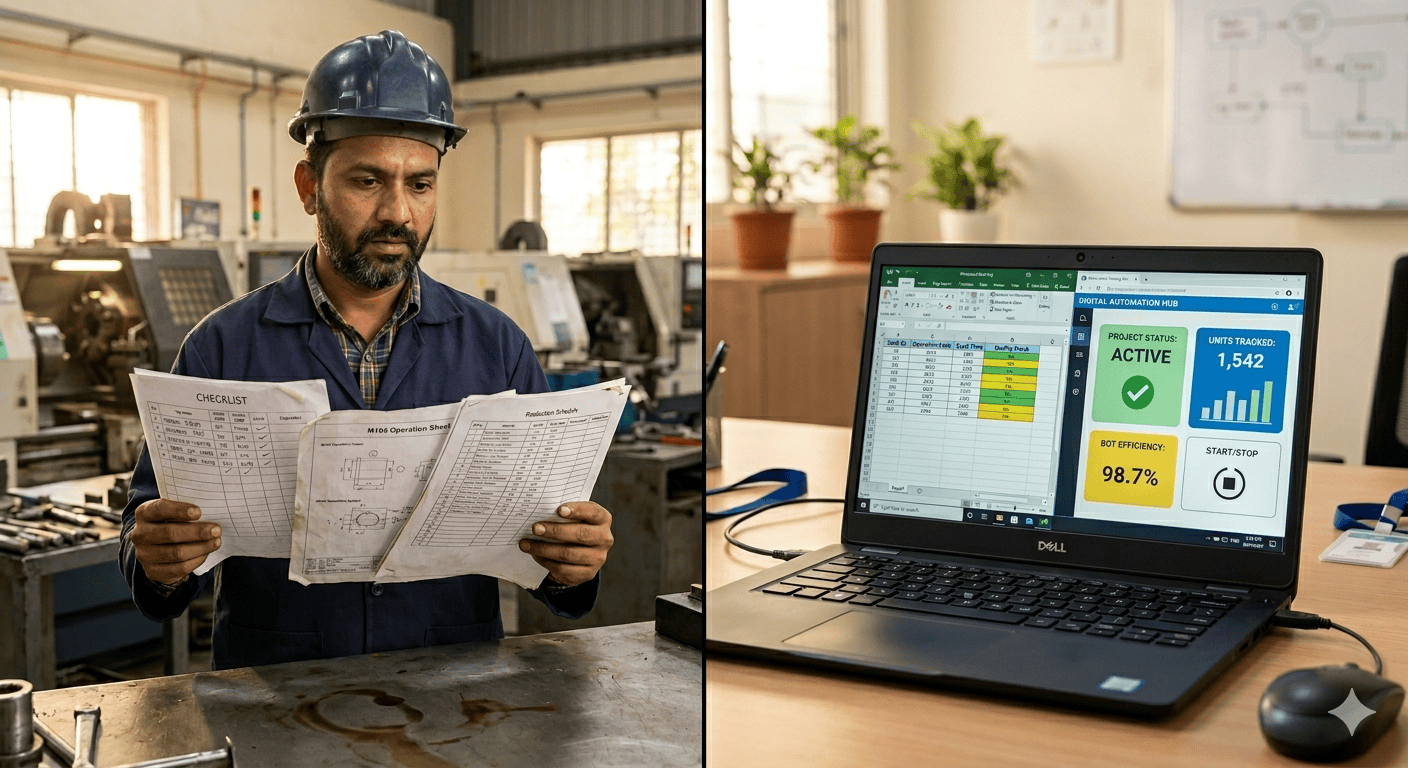
Three months ago, Ravi — owner of a MSME precision parts shop near Pune—walked into my office with a stack of forms, a tired face, and a question: "Can my factory work like my phone apps? Click once and the job gets done?" He wanted fewer errors, less chasing, and more time to focus on customers. He did not want to hire expensive IT consultants or learn code.
What he discovered was not magic. It was RPA: Robotic Process Automation. And done right, it can quietly turn routine, repetitive admin work into a reliable, always-on assistant. The result? He reclaimed hours, reduced mistakes, and freed his people to do value-adding work.
If you’re a non-techie factory manager or owner, this is for you. Here’s how to understand RPA, decide where it fits, and implement it without becoming a programmer—or bankrupting your company.
Why this matters now
Labour and compliance costs are rising everywhere. Efficiency is not a buzzword; it’s survival. Small factories juggle spreadsheets, paper jobsheets, email approvals, and legacy ERP systems that don’t “talk” to each other.
RPA is a low-risk, high-impact entry point to automation: it doesn’t rip out systems; it mimics human actions across apps.
How do we address this
- Problem: Time lost in repeatable tasks, errors, and delayed decisions
- Solution: RPA focused on processes, not tech
- Action: Three-step plan you can start this week
What exactly is RPA? (Simple, non-tech definition)
RPA is software that performs repetitive digital tasks—like filling forms, moving data between systems, or sending standard emails—by mimicking the actions a human would do on a computer. Think of it as a virtual clerk: it logs in, copies numbers, pastes into another system, and closes the window—24×7, with no coffee breaks and fewer mistakes.
Three myths that scare non-techie managers (and why they’re wrong)
- Myth 1: "RPA requires coding or an IT team." Reality: Many RPA tools now offer visual builders and ready-made templates. You don’t need to write complex code to automate invoice matching or data transfer.
- Myth 2: "RPA will replace my people." Reality: RPA replaces repetitive tasks, not people. Operators, supervisors, and planners are more valuable when freed from tedium.
- Myth 3: "It’s expensive and only for big firms." Reality: Small deployments for specific high-volume tasks have fast payback—often within months.
How to spot the first RPA opportunity (3 simple rules)
Pick processes that meet these three conditions:
- High frequency: Done many times per day or week (e.g., daily production reports, order confirmations).
- Rule-based: Follows a clear step-by-step flow with predictable decisions (e.g., copy value A, paste into field B, check if value > X).
- Cross-system: Requires moving data between two or more applications (e.g., Excel → ERP → Email).
Examples from the floor
- Order-to-production: Auto-transfer of approved orders from email/Excel into ERP work orders. Result: fewer input errors, faster shop release.
- Daily production reporting: Robot collects machine counters, counts, and uptime from spreadsheets and dashboards, and compiles a consolidated PDF for management.
- Supplier invoice matching: Robot validates invoice numbers and amounts against POs, flags mismatches, and emails exceptions.
- QC sampling logs: Robot pulls test results and populates the regulatory log, saving the QA lead hours each week.
A realistic implementation plan (do this in 30–90 days)
Week 0: Quick diagnosis
- Walk the shopfloor for 2 days, interview 3-4 people who do repetitive admin tasks, and list every task that fits the 3 rules above.
- Prioritize the top 3 by frequency and cost (time × hourly rate).
Week 1–4: Pilot one process
- Choose one high-impact process (example: daily production report).
- Use a low-code RPA platform (UiPath, Power Automate, or an India-friendly local vendor) or a trusted integrator who offers fixed-price pilots.
- Build the bot with the team members who do the task—this ensures you automate correctly.
- Run in shadow mode (bot runs but a human validates) for 2–3 weeks.
Month 2: Measure and scale
- Measure time saved, error reduction, and business impact (e.g., faster customer confirmations).
- If gains are real, roll out 1–2 more bots in the next month, following the same build-validate-measure loop.
Getting Started
Checklist for vendor selection (keep your money safe)
- Look for experience in manufacturing processes, not just generic IT.
- Ask for a fixed-scope pilot and transparent pricing (no open-ended dev cycles).
- Check for local support and post-deployment SLA (how fast will they fix a broken bot).
- Insist on documentation and a simple runbook so your floor manager can restart the bot if needed.
People change management: don’t skip this
- Start with the people who do the work. Involve them from day one.
- Explain that RPA will remove boring tasks, not jobs; show how their time will be repurposed to higher-value responsibilities (supervision, quality, customer engagement).
- Offer small incentives for suggestions that reduce process steps—crowdsource continuous improvement.
Risks and how to mitigate them
- Fragile bots: UI changes break robots. Mitigation: Prefer APIs where available; choose robust selectors; include restart scripts.
- Shadow IT proliferation: Avoid a dozen small bots with no governance. Mitigation: maintain a simple RPA register and one owner (operations or IT).
- Compliance and security: Bots need credentials. Mitigation: use secure vaults and rotate credentials; limit access to production systems.
Simple ROI math you can do in a minute
- Time per task saved (minutes) × frequency per month × hourly cost of the person = monthly savings.
- Subtract vendor fees or license cost. Many pilots pay back within 3–6 months for typical rule-based tasks.
A practical example: Invoice matching that paid for itself
- Before: Invoice match took 30 minutes per invoice; 300 invoices/month → 150 person-hours.
- After RPA: Robot processed 80% automatically; human handled exceptions = 30 person-hours.
- Saving: 120 hours/month. At INR 300/hour effective cost → INR 36,000/month. If the bot costs INR 60,000 to implement, payback in under 2 months.
What to automate later (advanced but not urgent)
- Integrations that require AI-like judgment (e.g., reading handwritten notes) — consider Intelligent Document Processing only after you’ve proven simple bots.
- Predictive maintenance triggers — combine RPA with simple analytics once data flows are clean.
- Full order orchestration across multiple vendors — scale to orchestration after governance is in place.
How to get started this week (3 actions)
- Pick one pain point: Ask your supervisors to list the single most repetitive computer task they do.
- Do the quick ROI: Estimate time saved and compute monthly savings using the ROI math above.
- Run a pilot: Contact one vendor for a 30-day pilot or try Power Automate/UiPath Academy tutorials and build a simple bot (copy–paste Excel to ERP simulation).
Final thoughts
Automation is not about replacing people—it's about upgrading them. The factories that will thrive are the ones that stop glorifying busywork and start amplifying human judgment. RPA is the easiest way to buy that amplification. It’s not flashy like robots on the shopfloor; it’s quiet, pragmatic, and it pays back fast.
If you’re a factory owner or CXO and you want help turning one specific process into a pilot, tell me the task and the systems involved (ERP name, Excel spreadsheet, email, etc.). I’ll sketch a one-page plan with estimated benefits and a suggested timeline you can present to your leadership in one meeting. Reach out to me atphoenix.advizory@gmail.com or +91-9967093949.