
Strategic Planning for India’s MSME’s
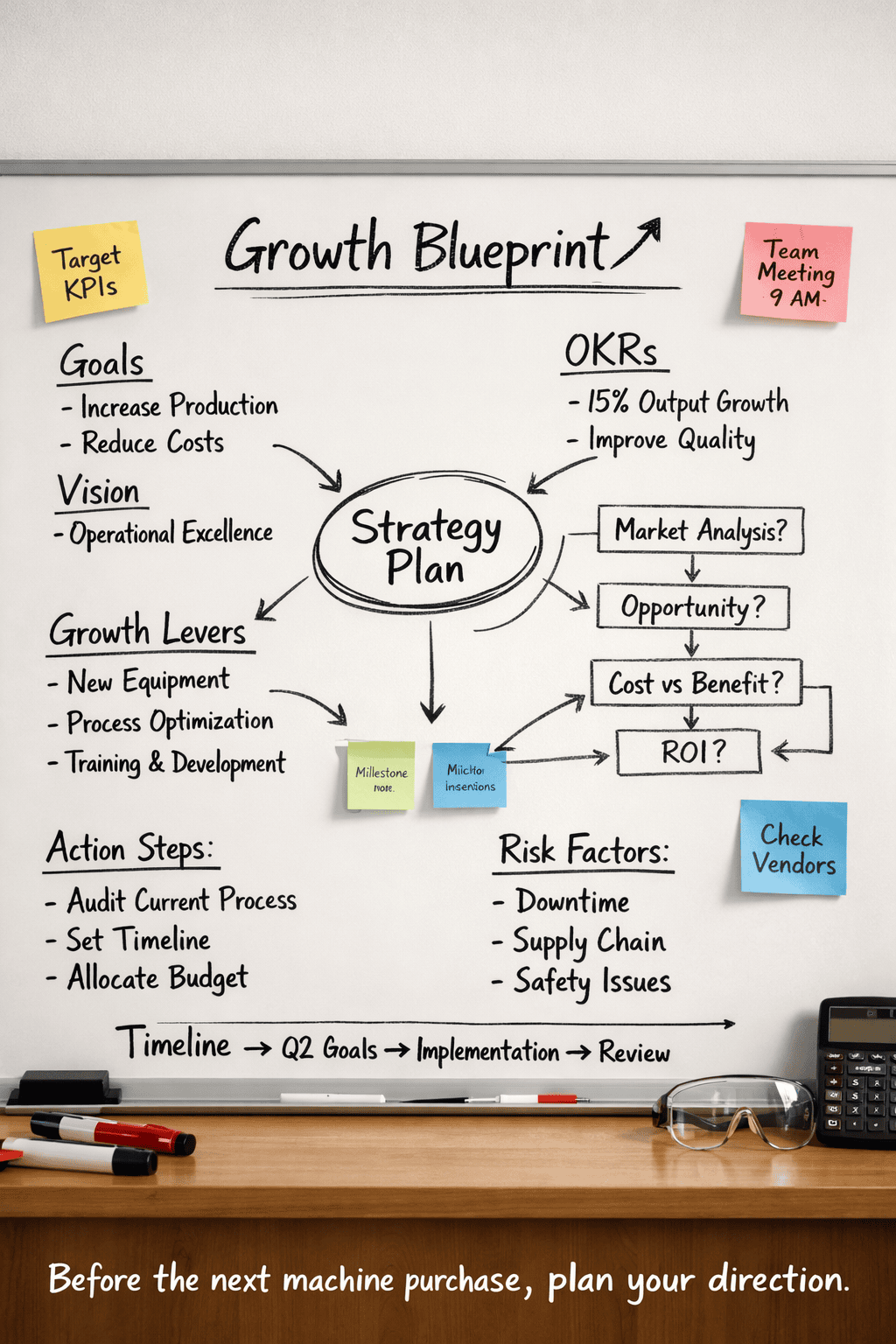
Laying the Groundwork for Growth
Atul ran a small fabrication unit in Pune. Orders were flowing in, machines were humming, and the team barely had time to breathe. But within six months, the cracks began to show — delays, rework, cash crunches, and suppliers missing deadlines. When his biggest client hinted they might look elsewhere, Atul realized something crucial: he had been running fast… but with no direction.
And that’s the story of half the MSME’s in India today. Not because they lack ambition or hard work — but because growth, when unplanned, can be just as dangerous as stagnation.
Why strategic planning matters
Let’s face it. The Indian manufacturing ecosystem is changing faster than ever:
- Government incentives under Make in India and PLI schemes are opening new markets.
- Export opportunities are growing as global supply chains diversify away from China.
- Technology adoption (IIoT, automation, AI) is no longer a luxury — it’s a competitively critical move.
And yet, many MSME owners are stuck fighting daily fires — production issues, labour challenges, supply delays — with little time to think strategically. Here’s the harsh truth: in the absence of a strategy, you’re always reacting instead of leading.
The problem: You can’t scale hustle
Small manufacturers often run on what I call “jugaad strategy” — agile, flexible, and full of heart. It works brilliantly in the early stages. But beyond ₹10–20 crore in revenue, that same agility creates cracks:
- Every decision routes through the owner.
- Planning happens in the head, not on paper.
- Growth creates chaos faster than revenue.
Sound familiar? Most entrepreneurs mistake being busy for being strategic. But no business has ever hustled its way sustainably to scale. Strategy isn’t paperwork — it’s your operating GPS.
Step 1: Start with the “why”
Before you talk machines, markets, and manpower, pause. Ask: Where do we really want to go in the next 3–5 years? This isn’t about a vague dream like “we want to grow.” It’s about clarity:
- Do you want to move up the value chain (e.g., from job work to branded products)?
- Are you diversifying into new sectors or geographies?
- Do you want to focus on profitability or expansion?
Write that down. Because everything else — from hiring to investments — flows from this one decision.
Step 2: Audit your reality (not your assumptions)
Every growing plant hides inefficiencies under the carpet of “busyness.” But strategy begins with truth. Do a quick internal audit:
- What’s your current capacity utilization?
- Where is the bottleneck in your production flow?
- Are your top 5 customers profitable, or just keeping you occupied?
- How healthy are your supplier relationships and payment terms?
This exercise feels uncomfortable — but it’s liberating. It helps you see where attention and capital should really go. Pro tip: Involve your shopfloor supervisors, not just managers. They see problems (and opportunities) that dashboards don’t.
Step 3: Identify your growth levers
Once you’ve audited reality, the question becomes: what will move the needle? For most small manufacturers, there are only four true levers of growth:
- Market access – entering new clients, regions, or export markets.
- Productivity improvement – adopting lean, digital, or automation practices.
- Capability building – upskilling teams, training middle managers, or bringing in specialists.
- Financial discipline – managing working capital and pricing smartly.
Pick one or two. You don’t need a 20-slide strategy doc. You need focus and commitment.
Step 4: Translate the vision into execution
Strategy often fails not because it’s wrong, but because it’s stuck in a PowerPoint presentation.
To avoid that, use the “Objectives and Key Results” (OKR) approach:
- Objective: Big, inspiring goal (e.g., reduce production lead time by 25%).
- Key Results: Measurable steps (e.g., implement line balancing, adopt production scheduling software, train supervisors).
Then track progress monthly. Discuss outcomes in your management meetings, not just production hiccups. The magic lies in turning strategy into habits of execution.
Step 5: Think long-term—but act short-term
A good strategic plan has a 3–5 year horizon. But the actions live in quarters. Break your grand plan into 90-day execution cycles:
- Q1: Fix internal processes.
- Q2: Improve productivity through training and visual dashboards.
- Q3: Experiment with one new market or client segment.
- Q4: Consolidate gains and prepare for the next year’s investment.
This rhythm keeps the team motivated, ensures accountability, and prevents overwhelm.
Step 6: Build resilience — not just growth
In today’s volatile world, having one big customer or one key supplier is a dangerous comfort zone. Strategic planning also means risk mapping:
- What if your top client reduces volumes?
- What if a geopolitical event disrupts your imports?
- What if a key operator leaves suddenly?
Resilience is now a competitive advantage. Diversify, document processes, and build redundancies — not just for crises but for confidence.
Step 7: Involve your people early
Too many manufacturing founders fall into the “lone warrior” trap. They plan in isolation, then announce it like a decree. That never sticks. Instead, build strategy collaboratively:
- Ask your supervisors, “If we had to double output, what would break first?”
- Ask your sales team, “Which clients are most painful versus most profitable?”
- Ask your finance head, “What’s dragging our cash conversion?”
These conversations don’t just create better plans — they create buy-in. And buy-in is the secret fuel behind execution.
Step 8: Keep your digital eyes open
You don’t need Industry 4.0 robots to go digital. Start small:
- Digitize production records or maintenance logs.
- Adopt cloud-based inventory tools.
- Use data dashboards to track daily outcomes.
Technology isn’t replacing people — it’s freeing them from routine firefighting. The real advantage is visibility. Seeing problems early lets you act faster.
The mindset shift: From operator to architect
Here’s a hard truth: many small manufacturers remain small not because of market limits, but because of mindset limits. They’re brilliant operators — hands-on, intuitive, dependable. But as the business grows, their biggest job is no longer “fixing problems.” It’s designing systems that prevent them. Strategic thinking is that shift — from being the hero of every battle to being the person who builds an army that wins without you.
Your 1-page strategic plan
If you had to summarize it on a single sheet, it would look like this:
Step | Focus Area | Key Questions |
1 | Define “Why” | What’s our 3–5 year vision? |
2 | Audit Reality | What’s working? What’s broken? |
3 | Choose Levers | What few things will move the needle most? |
4 | Set OKRs | How will we measure progress? |
5 | Build Rhythm | What’s our next 90-day focus? |
6 | Manage Risk | Where are we overexposed? |
7 | Engage Team | How do we ensure buy-in? |
8 | Go Digital | What can we automate or visualize? |
That’s not theory — that’s your blueprint.
The takeaway
Strategic planning isn’t a corporate luxury. It’s a survival skill for every growing manufacturing unit in India. The time you spend thinking today saves you ten times the chaos tomorrow. The factories that thrive over the next decade won’t be the biggest — they’ll be the most prepared, most focused, and most adaptable.
Block one day next month. Switch off your phone, sit with your key team, and work through this 8-step framework. Don’t overcomplicate it. One whiteboard, a few honest conversations, and you’ve already done more than 90% of your peers. And who knows — like Atul, you might just realize that clarity, not capacity, is your real growth engine.
Ready to turn strategic planning into your growth engine? Sit with your team and follow the framework. If you need us to help, reach out to me at phoenix.advizory@gmail.com or +91-9967093949. Let’s make MSME manufacturing the engines of Indias growth story.