
Balancing Tradition and Technology in Indian Manufacturing
Picture this:
You’re in the middle of your factory in Coimbatore. The hum of machines mixing with the shouted instructions of foremen. The same walls your father and grandfather built. The same processes they trusted.
But outside those gates? Customers are placing orders on WhatsApp, suppliers are tracking you on ERP dashboards, and your competitor’s 20-year-old nephew is already pitching on LinkedIn. It’s not that tradition doesn’t work anymore.
It’s that tradition alone won’t win the next decade. And here’s the hard truth: Indian family manufacturing businesses are reaching a critical cross-road—either go digital or risk being left behind.
Why Is This Happening Now?
For decades, Indian family businesses thrived on relationships, jugaad, and trust built across generations. But the rules of the game are changing.
- Global buyers demand digital visibility into your supply chain.
- Margins are shrinking because competitors with automated systems operate leaner and faster.
- Smart young engineers prefer to work in places where data, not guesswork, runs the floor.
- Even kirana stores around the corner run digital ledgers on Khatabook.
If they’ve digitized, what’s our excuse?
The Emotional Blind Spot
Let’s be honest. In most family-run businesses, digitization is not a technical challenge. It’s emotional.
- “But this is how we’ve always done it.”
- “What if data replaces relationships?”
- “Our staff won’t understand these new systems.”
- “It’s too expensive, too risky.”
Sound familiar? These fears are real. After all, your father built this company without an ERP. Your uncle managed supplier relationships on sheer goodwill. Your brother has every customer phone number in his pocket. But here’s the point: digital doesn’t erase tradition. It strengthens it. The real challenge is not replacing the old ways, but integrating them with new possibilities.
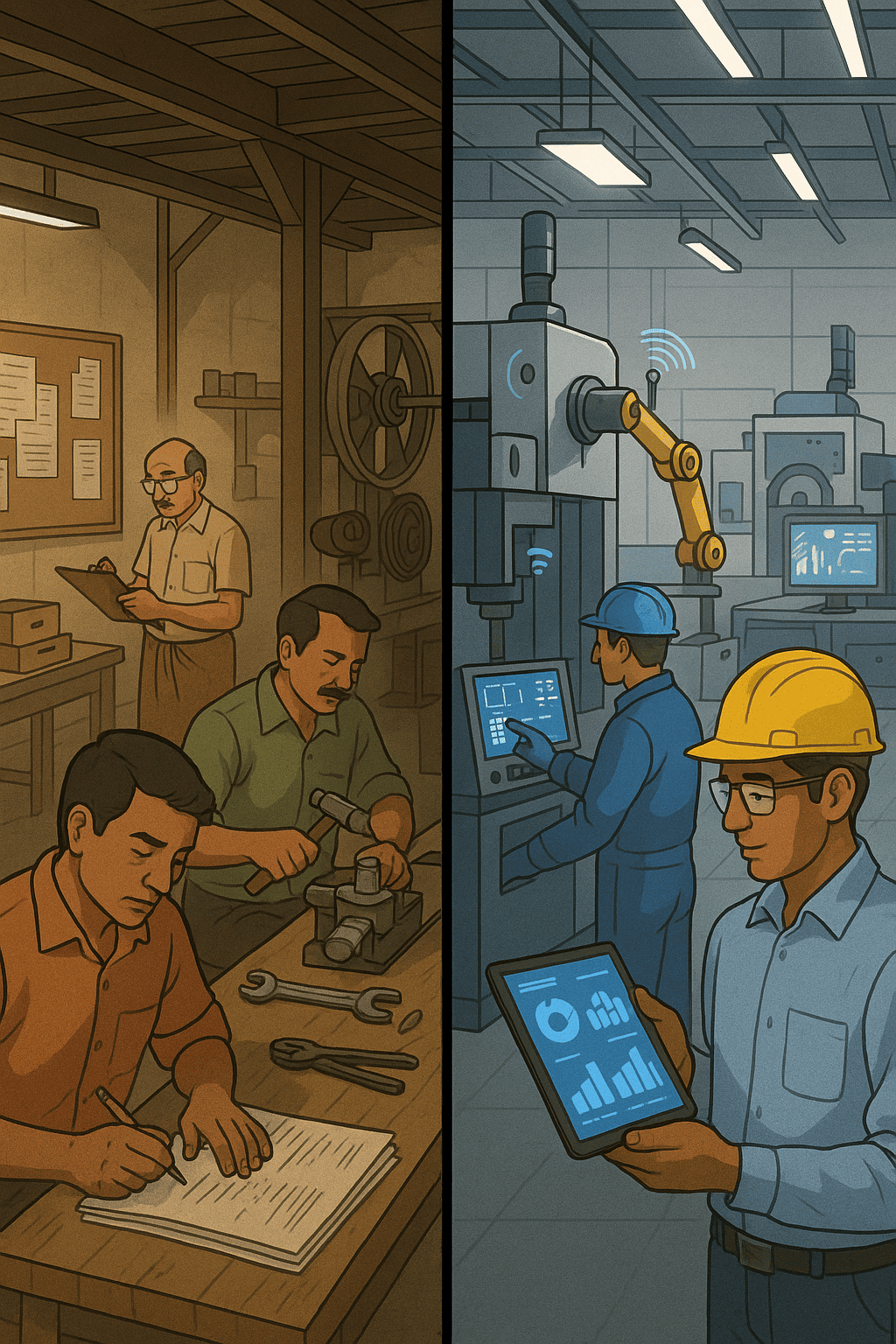
A Tale of Two Factories
Let’s break it down with a simple example.
Factory A (Traditional) – A second-generation owner continues with manual job cards, paper invoices, and long supplier phone calls. Things function, but production deadlines slip, rejects pile up, and younger staff feel suffocated.
Factory B (Transformed) – Same scale, same history. But the third-generation owner digitized:
- Instead of paper registers, shopfloor operators now update on tablets.
- Suppliers are connected on a common portal.
- Sales leads come in via LinkedIn and get tracked digitally.
- He still calls suppliers personally, but the follow-up is backed by data.
Now guess who the global buyer trusts more? Guess whose margins look healthier? Guess whose kids want to join the business, instead of fleeing to consulting firms in Gurgaon or fintech startups in Bangalore?
Balancing Tradition + Technology = Competitive Edge.
Here’s how Indian family businesses can combine the best of both worlds:
1. Digitize, Don’t Destroy
Think of digitization as adding steel reinforcements to your father’s sturdy old home, not demolishing it.
- Keep the personal supplier visits but track deliveries digitally.
- Continue customer lunches but also send them analytics dashboards.
- Let your "pet-employee" supervisors run the line but support them with real-time data.
Tradition is your moat. Technology is your multiplier.
2. Start Small, Scale Fast
Common mistake? Buying a fancy ERP and trying to transform everything on Day 1. Instead:
- Begin with digital invoicing.
- Shift production planning from whiteboards to simple tools like Google Sheets or Tally plugins.
- Use WhatsApp Business to track orders and queries formally.
Once your people get comfortable, move towards integrated ERPs, IoT sensors, and predictive analytics.
3. Make Next-Gen the Champions
Every family business has a generational gap. The elder generation trusts relationships, the younger trusts technology. Instead of clashing, make them allies.
- Seniors anchor values and relationships.
- Juniors champion digital adoption.
- Together, they blend experience with innovation.
This balance doesn’t just improve business—it ensures succession is smooth and the next generation wants to stay on.
4. Data ≠ Cold Transactions
A big fear in Indian businesses is that data and dashboards will steal the "human touch."
But ask yourself: Doesn’t having delivery accuracy data improve how you negotiate with suppliers? Doesn’t tracking quality reduce the stress that affects relationships?
Digitization doesn’t replace trust—it protects it from being diluted by errors and inefficiencies.
5. Culture Eats Technology for Breakfast
Even the best digital tools fail if your people don’t buy in.
- Train managers in plain Hindi/Tamil/Kannada, not just English tech jargon.
- Incentivize staff who adopt new systems.
- Recognize that mistakes will happen initially, and treat them as learning moments, not failures.
When your people see digitization as a tool that makes their work easier, adoption takes care of itself.
What’s at Stake?
Let’s be blunt. Five years from now, buyers won’t give you time to fax quotations or scan paper invoices. Banks will prioritize lending to businesses with transparent financial data.
Talent will prefer companies where innovation is not boxed up in dusty files.
So the question is not: “Should we go digital?” The question is: “Can we afford not to?”
Action Plan: Where Can You Start This Quarter?
- Audit the Current State
- Make a digital map of your business: What’s already online? (Accounts, SCM, HR?) Where are the bottlenecks?
- Pick 1–2 High Impact Areas
- Don’t boil the ocean. Choose areas where digitization shows results fast—say, order tracking or supplier management.
- Build Trust with Pilots
- Run small pilots with one department. Show visible results. Scale gradually.
- Upskill People
- Invest in small workshops. Encourage your nephew who’s tech-savvy to coach the floor managers.
- Find the Right Partners
- Don’t just buy expensive software. Look for partners who speak the language of family businesses—not just IT jargon.
A Personal Note to Owners & CXOs
If you’re reading this, you are likely the custodian of a legacy. Your father, your uncle, or grandfather laid down roots in the soil of Indian enterprise—years before "digital transformation" was even a phrase. No one’s asking you to abandon that legacy.
The call is to extend it into a future where your children won’t have to choose between “tradition” and “technology.”
Because the real legacy isn’t just the factory. It’s the ability to keep the family’s dream alive, relevant, and scalable in a changing India.
So here’s the challenge: This quarter, commit to digitizing one core process in your family manufacturing business. Just one. It could be invoicing, order management, or supplier coordination. Watch how quickly it builds momentum. Remember—tradition got you here. Technology will take you further. And the fusion of the two? That’s the real competitive advantage of Indian family manufacturing.
📌Question for you: If you had to digitize only ONE area of your business first, what would it be—and why? Have a success story or a burning challenge around digitizing your family business? Reach out to me at phoenix.advizory@gmail.com or +91-9967093949. Let’s build Indian Manufacturing 2.0, together.