
Your Best Engineer Doesn't Want to Work for You Anymore
Picture This
A mid-sized auto-components manufacturer in Pune had a problem. Their new CNC line was underperforming by 18%. Not a machine issue. A programming issue. They needed a senior manufacturing engineer who understood G-code optimization, tolerance stacking, and Six Sigma — for exactly six weeks.
They didn't hire one. They couldn't afford to. A candidate like that commands ₹1.8-2.2 lakh a month, plus PF, gratuity, insurance, a laptop, a desk, and a two-year runway to justify the onboarding cost. So they did something smarter. They hired a freelance manufacturing engineer for the project. Cost: ₹4.5 lakh. Duration: six weeks. Result: the line hit 96% efficiency, and the engineer moved on to his next client.
That story isn't an exception anymore. It's the new default. And if you're running a small or mid-sized manufacturing company in India, ignoring this shift is going to cost you — not in money, but in speed, in talent, and eventually, in market share.
The problem nobody talks about
Here's the uncomfortable truth about hiring in Indian manufacturing: your best engineers don't want to work for you full-time anymore.
Not because you're a bad employer. Because the economics of their career have changed. A senior process engineer who's spent 12 years optimizing shop floors in Coimbatore or Ludhiana has realized something powerful — she doesn't need one employer to survive. She needs three or four clients running in parallel, each paying for outcomes, not attendance.
Meanwhile, you're stuck in the old playbook. Post a job. Wait six weeks. Interview twelve people. Hire one. Watch them leave in eighteen months because a bigger company poached them with a 40% hike you couldn't match. You're not competing for talent against your direct competitors anymore. You're competing against freedom.
What's actually driving this shift
This isn't a fringe trend. The numbers are hard to ignore. India's gig workforce grew from 7.7 million workers in FY21 to 12 million in FY25 — a 55% jump — and non-agricultural gig work is projected to make up 6.7% of India's workforce by 2029-30, contributing ₹2.35 lakh crore to GDP. India already has a pool of roughly 15 million freelance workers active across engineering, IT, and design projects.
And this isn't just a tech-sector story — construction, manufacturing, retail, and transportation together are projected to generate over 70 million gig-based jobs in the coming years. Three forces are converging here:
- 1.Specialization has outpaced full-time hiring. Manufacturing today needs people who understand PLC programming, lean Six Sigma, supply chain analytics, and CAD/CAM simultaneously. No single full-time hire covers all of it. But a freelance bench of specialists does — on demand.
- 2.Project-based work is now infrastructure, not improvisation. Project-based hiring in India surged roughly 38% in FY25, led by technology and consulting roles — and manufacturing is catching up fast, because plant upgrades, ERP rollouts, and automation projects are inherently project-shaped work, not permanent-role work.
- 3.Engineers have discovered what founders discovered years ago. Indian freelancers now earn an average of around ₹20 lakh a year, with 23% crossing ₹40 lakh — often working with three to four clients instead of one employer. That math beats a corporate ladder every time.
Why your best move might be to stop hiring
Let's do the math a lot of CXOs avoid doing. A full-time senior manufacturing engineer costs you roughly ₹22-28 lakh annually once you add CTC, benefits, infrastructure, management overhead, and attrition risk. And here's the part that stings: you're paying that salary every month, whether or not there's ₹22 lakh worth of high-value engineering work available that month.
A freelance engineer flips that equation entirely. You pay for outcomes — a die design, a line rebalancing project, a supplier audit, a digital twin build — not for a seat. When the project ends, so does the cost. No notice period. No severance. No HR headache. This isn't about cutting corners. It's about buying expertise in the exact dose you need, exactly when you need it — the same logic that made you switch from owning a fleet of trucks to using 3PL logistics.
Where this works brilliantly (and where it doesn't)
Freelance engineering talent is a phenomenal fit for:
- New product introduction (NPI) projects — where you need a specialist for 8-12 weeks, not a lifetime hire
- Automation and Industry 4.0 pilots — where in-house teams simply lack the exposure
- Quality system overhauls — ISO audits, IATF certification prep, Six Sigma black-belt projects
- Capacity expansion planning — layout design, capex justification, vendor evaluation
- Digital transformation — ERP/MES implementation, where you need someone who's done it five times before, not zero.
Where it doesn't work: your core production leadership, your shop-floor supervisors who need daily continuity, and any role where institutional memory and trust-building matter more than raw technical skill. Freelancers extend your capability. They don't replace your culture.
The three mistakes CXOs make when they try this
Mistake one: Treating freelancers like cheap labour. The best freelance engineers charge premium rates because they solve in weeks what takes your internal team months. If you're negotiating them down to junior-engineer pricing, you'll only attract junior-engineer talent.
Mistake two: No clear scope. Full-time employees absorb ambiguity because they're around long enough to figure it out. Freelancers need a tightly defined deliverable, a timeline, and success metrics from day one — or the engagement drifts and everyone loses.
Mistake three: No knowledge transfer plan. If your freelance engineer walks out the door with all the institutional learning in their head, you've just paid to solve today's problem and created tomorrow's. Build documentation and handover into every contract.
The real shift you need to make
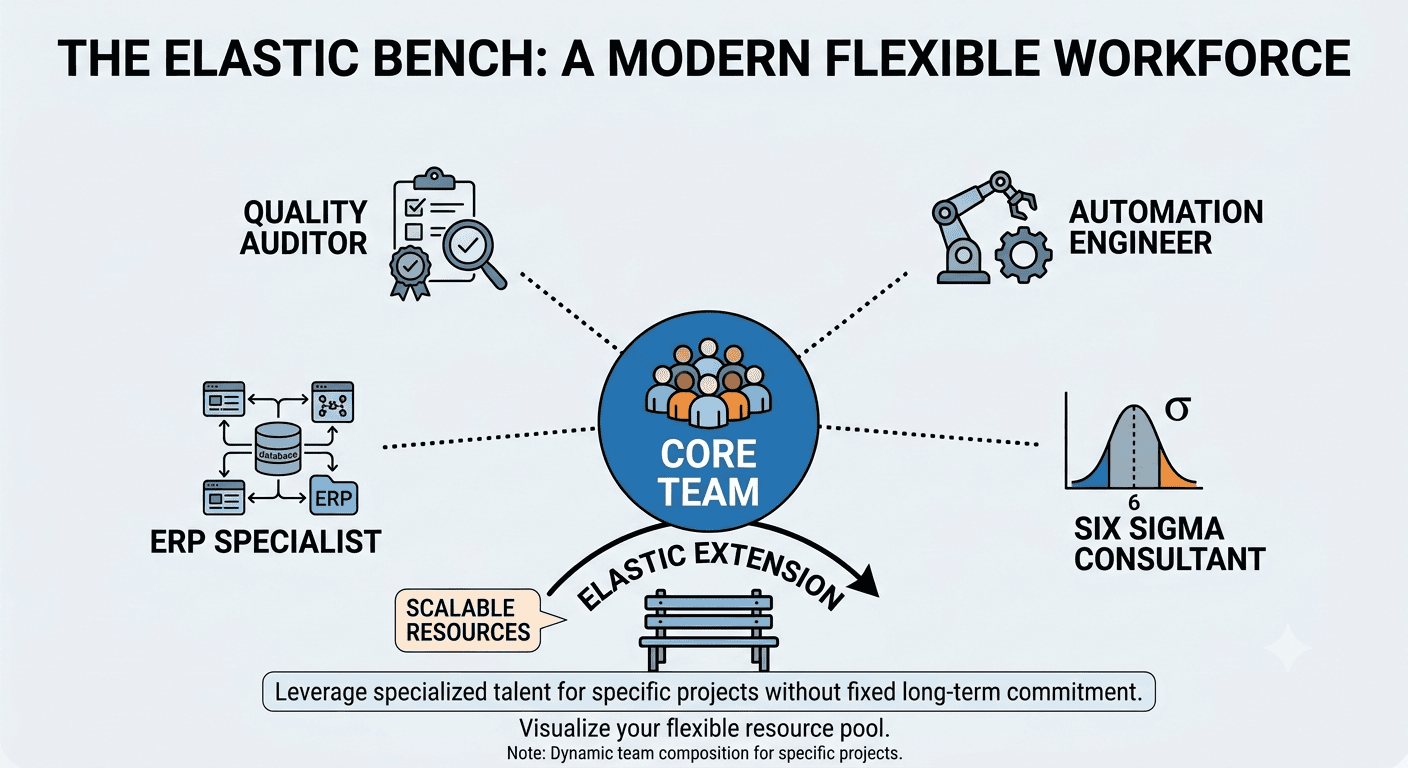
Stop thinking of your organization as a fixed headcount with fixed capabilities. Start thinking of it as a core team plus an elastic bench of specialists you can scale up or down as projects demand.
The manufacturers winning right now — from Tier-1 auto suppliers in Chennai to precision component makers in Aurangabad — aren't the ones with the biggest payroll. They're the ones with the fastest access to the right expertise at the right moment. Your competitors are already building this bench. The question isn't whether the freelance engineer economy is real. It's whether you're going to access it before or after your competitor does.
Building your freelance engineering bench, or just starting to explore it? Reach out with the one project you'd outsource first if cost weren't a factor as phoenix.advixory@gmail.com or +91-9967093949. We’ll share how manufacturing MSMEs are structuring their freelance engineering engagement, contracts and all.