
From Traffic Jams to High-Margin Orders
Picture This
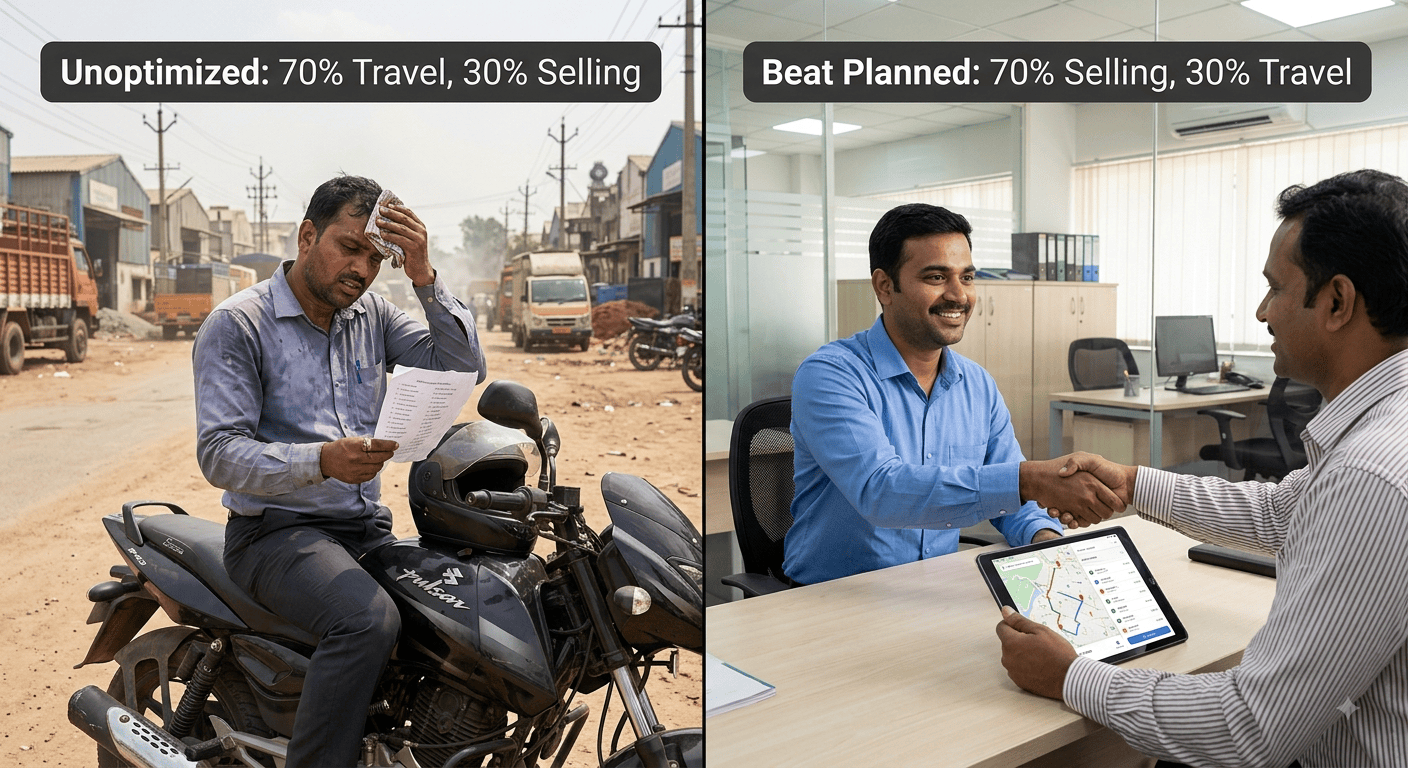
It’s a hot Tuesday afternoon in Belagavi, Karnataka. Your senior sales representative, Vikram, is sitting on his motorcycle outside an industrial estate, wiping sweat off his forehead. He just spent 90 minutes navigating congested lanes to pitch your electrical switchgear to a medium-sized machine builder—only to find out the purchase manager is on leave today.
So, what does Vikram do next? He opens WhatsApp, calls three nearby distributors in his contact list, finds out two are busy, and ends up traveling 18 kilometers across town to meet a small retailer who buys barely ₹15,000 worth of stock a quarter. At the end of the month, Vikram’s TA/DA (travel/daily allowance) claim is sitting at ₹22,000, his daily visit report claims 6 visits a day, but his closed revenue is down 30%. If you own or manage a small-to-midsize manufacturing company in India, this scene probably feels painfully familiar.
We invest heavily in shop-floor automation, CNC machines, and raw material sourcing. But when it comes to ground-level distribution and field sales, most Indian manufacturers run on hope, habit, and legacy WhatsApp groups. The result? Your sales reps spend less than 30% of their actual workday selling. The remaining 70% gets swallowed by transit, back-and-forth phone calls, chasing payments, and wandering around unoptimized routes.
Today, we dive into how you can fix this: by building high-efficiency, geography-smart Beat Plans that work across India’s messy spectrum—from packed Metros to sprawling Tier-3 and rural districts.
The Indian Distribution Reality: One Size Fits Nobody
A "beat plan" (or Permanent Journey Plan) is simply a scheduled route that a sales rep follows on specific days to visit dealers, distributors, or industrial clients. Sounds simple, right?
The problem is that most manufacturing leaders copy sales coverage models straight out of Pharma or FMCG playbooks. They assume a rep in South Mumbai can be managed using the same route logic as a rep covering rural Kolhapur or Tier-2 Hubballi. It fails every single time. Here is why:
- In Metros (Tier-1): Traffic congestion, parking nightmares, and gatekeepers mean time is your primary bottleneck. Distance isn't the issue; travel time is.
- In Tier-2 & Tier-3 Towns: Clusters are dispersed. Distributors expect high-touch relationships, extended chai conversations, and on-the-spot problem solving.
- In Rural/Semi-Urban Hubs: Road connectivity is unpredictable, order sizes are small, and a rep visiting twice a month might be burning more fuel than the margin on the order.
To maximize rep time, you need a tiered beat plan design framework built specifically for the Indian terrain.
Step 1: The Tiered Beat Framework (Grid vs. Hub-and-Spoke)
Stop assigning territories by state or large administrative districts. Instead, structure your beat planning using two distinct geographic archetypes:
Archetype A: The "Micro-Grid" Model (For Metros & Tier-1 Cities)
In cities like NCR, Mumbai, or Ahmedabad, geography-based clustering is everything.
- The Strategy: Divide the city into tight 3 to 5 km micro-clusters (e.g., Peenya Industrial Area vs. Whitefield; Okhla Phase 1 vs. Faridabad).
- The Rule: A rep must never cross major city choke-points during peak operating hours. Monday is strictly Cluster A; Tuesday is Cluster B.
- Frequency: High-value B2B buyers or top-tier distributors get visited weekly; Tier-B buyers every fortnight.
- Target: 8 to 10 quality visits per day.
Archetype B: The "Hub-and-Spoke" Model (For Tier-2, Tier-3 & Rural Clusters)
In regions like Coimbatore hinterlands, Western UP, or Northern Karnataka, reps spend hours on highways traveling between industrial pockets.
- The Strategy: Define a primary commercial hub (e.g., Nashik) as the anchor point. Radiate outward along transport corridors (e.g., Nashik–Sinnar belt on Wednesday, Nashik–Ozar belt on Thursday).
- The Rule: Schedule high-priority distributor visits near the hub early in the week. Dedicate fixed "outstation route days" for distant clusters where multiple smaller accounts are grouped together.
- Frequency: Tier-A accounts get visited fortnightly; Tier-B and C accounts get visited monthly or serviced via tele-sales and digital catalogs.
- Target: 4 to 6 high-value visits per day (with higher travel allowance allocation).
 Step 2: Tier Your Accounts Before You Map Your Routes
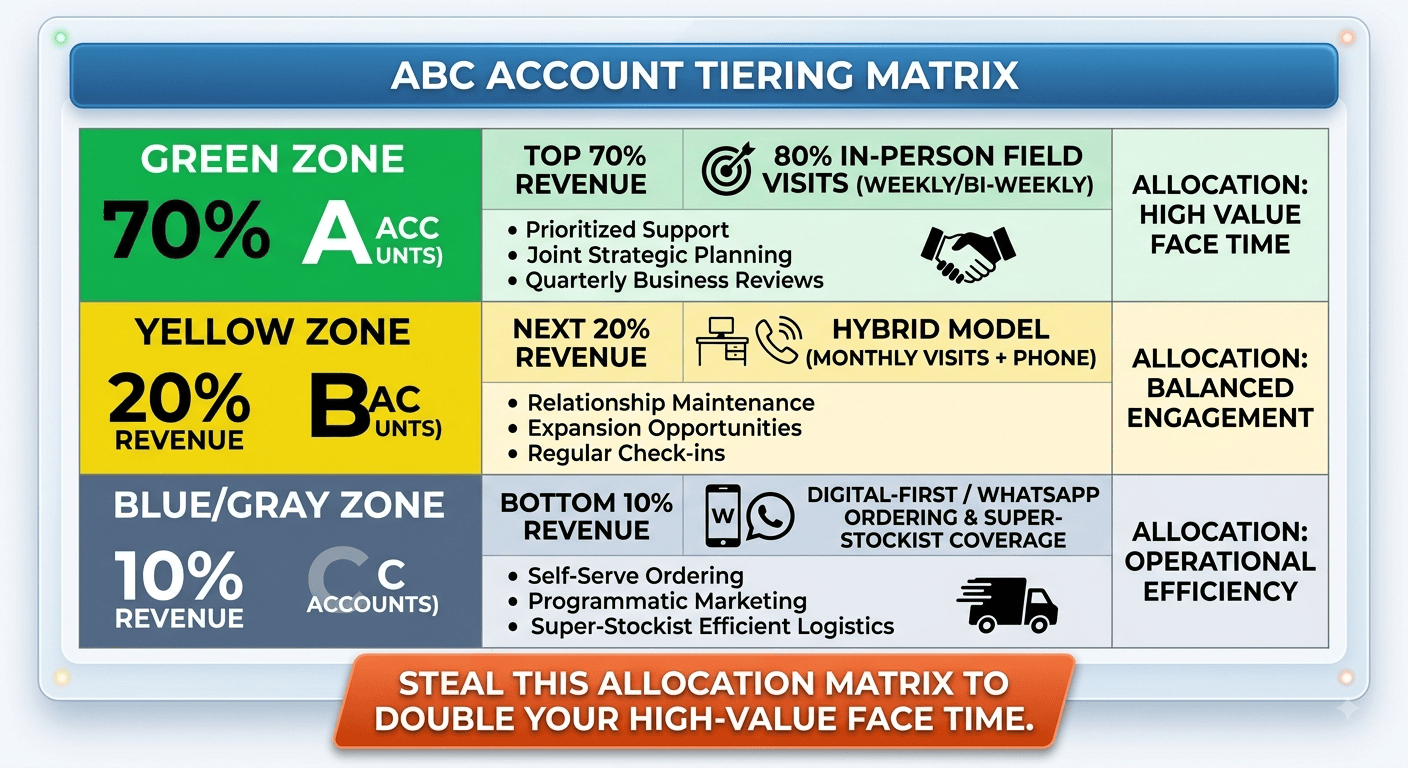
The biggest mistake sales managers make is treating every dealer, distributor, or B2B client equally. If your rep visits an account that generates ₹50,000/month with the same frequency as an account generating ₹10 Lakh/month, your beat plan is broken.
Categorize your market into an ABC Matrix:
Category | Revenue Contribution | Visit Frequency | Coverage Type |
A Class | Top 70% of revenue | Weekly/Bi-weekly | Physical Visit |
B Class | Next 20% of revenue | Monthly | Hybrid (Rep+Phone) |
C Class | Bottom 10% of revenue | On-Demand | Digital/Distributor |
Now, map your beats so that 80% of your rep’s physical field time is spent on A & B accounts. What about C-class accounts in rural or Tier-3 belts? Shift them to a digital-first channel: WhatsApp Business catalogues, automated phone ordering, or servicing through your regional super-stockist.
Step 3: Eliminate the "Cold Visit" Trap
In Indian manufacturing, a sales rep walking into a factory or dealer showroom unannounced is a recipe for wasted hours.
To maximize pitch time:
- Mandate Pre-Journey Confirmation: Implement a simple rule—every evening at 5:00 PM, reps must send a quick WhatsApp confirmation message or automated SMS to tomorrow’s scheduled beat list.
- Anchor Visits: Build every beat around 1 or 2 "Anchor Meetings" (fixed appointments with high-value clients). Fill the remaining slots of the day with flexible "cluster visits" located within a 15-minute radius of the anchor client.
- The "Shadow Beat" List: If an anchor meeting gets cancelled at the last minute, the rep shouldn't default to sitting in a coffee shop or riding home. Every beat must have 3 designated "Shadow Accounts" (secondary accounts or warm prospects nearby) that can be visited on short notice.
Step 4: Tech-Enable Without Over-Complicating
You don't need a ₹20 Lakh enterprise software suite to optimize beat planning. But relying on handwritten diaries and post-facto Excel reports is costing you lakhs in leakage.
Here is the lean stack for Indian MSME sales teams:
- GPS-Enabled SFA (Sales Force Automation) Apps: Low-cost mobile apps (like BeatRoute, FieldSense, etc.) give reps their daily beat sequence on Google Maps with optimal routing.
- Geofenced Check-ins: Prevent fake reporting by enabling geo-verified check-ins at client premises.
- WhatsApp API Integration: Allow distributors to place routine repeat orders directly via WhatsApp, freeing reps from acting as glorified order-takers so they can focus on new business development and collections.
The Bottom Line
In a competitive market where raw material costs fluctuate and manufacturing margins are tight, field efficiency is your hidden profit center. A well-designed beat plan doesn't just save fuel expenses; it changes the psychology of your sales team. It shifts them from reactive, chaotic wandering to structured, high-conversion market coverage. When your reps spend less time fighting traffic or chasing dead ends, and more time standing in front of real decision-makers, your top line takes care of itself.
How are you currently managing beat plans for your field team across different Indian tiers? Are your reps spending more time traveling or selling? Need our help to benchmark your sales coverage model, or to build a new one, reach out at phoenix.advizory@gmail.com or +91-9967093949. Let’s scale your business, profitably and efficiently.