
Automate your warehouses to cut OT, damages and delays
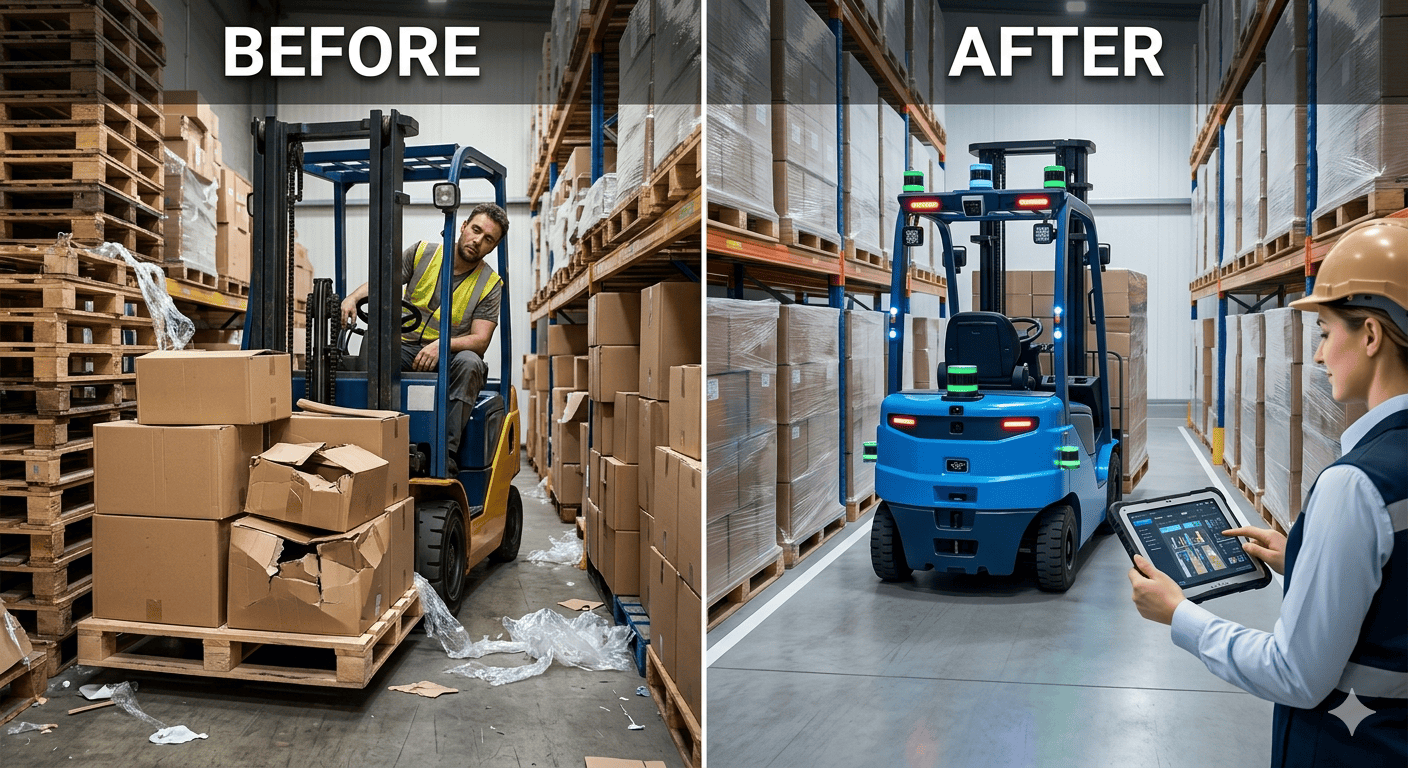
Picture This
They called it “the forklift that fired people.” Two years ago, a mid-sized plastics firm in Pune installed three autonomous forklifts to handle pallet transfers between production and dispatch. Production manager expected long onboarding. Instead, within six weeks cycle time fell by 18%, late shipments dropped, and the warehouse supervisor who feared job losses became the best advocate—because his team no longer did 12-hour night shifts moving goods; they ran exception handling, maintenance and process improvements. Productivity improved, costs fell, and the company hired two technicians to support the new fleet.
That’s the story most owners miss: autonomous forklifts don’t replace people; they free them to add more value. And yes—Indian MSMEs can actually afford them.
Why this matters now
- Labour is getting scarce and costly in many industrial belts.
- E-commerce and shorter order cycles demand faster, more reliable intralogistics.
- Automation tech prices have fallen; software-as-a-service and leasing models make advanced solutions accessible.
If you run a factory with a warehouse the size of a football field or a busy yard with frequent forklift traffic, this is not sci‑fi. It’s about cutting waste where it hurts: time, damage, and unpredictability.
The simple equation owners care about: Less handling time + fewer damages + predictable throughput = lower working capital and happier customers. Autonomous forklifts hit all three.
How autonomous forklifts actually work
Think of them as “smart drivers” for your existing material handling equipment. Key components:
- Sensors (LiDAR, cameras) map the warehouse in real time.
- Software plans safe routes, avoids people and obstacles, and optimizes traffic.
- Fleet management coordinates multiple units and integrates with WMS/ERP for task assignments.
- Safety features stop the lift on a dime and enforce no-go zones.
There are two common flavors:
- Self-driving retrofits: add-on kits that make your current forklifts autonomous.
- Purpose-built AGVs/AMRs: new machines designed from the ground up for autonomy.
For most Indian MSMEs, retrofits win on cost and speed of adoption.
A Reality check on cost and ROI
MSME owners ask: “How much? How soon will it pay back?” Indicative numbers (realistic for Indian mid-sized warehouses):
- CapEx for a retrofit kit per forklift: ₹6–12 lakh.
- Purpose-built AMR per unit: ₹15–30 lakh.
- Monthly lease or SaaS model: ₹30k–1.2L per unit (depends on coverage and support).
- Integration & setup (one-time): ₹1–6 lakh for mapping, WMS links, training.
Now the benefits, conservatively:
- Labour savings: Replace 1 full-time night-shift operator and overtime: savings ~₹3–6 lakh/year.
- Throughput gains: Faster turnaround can translate to 8–20% increase in daily moves. For a ₹25 crore/year factory, that could mean better on-time deliveries and reduced stock—real cash freed.
- Damage reduction: Less human error reduces breakage/spoilage; even a 1% drop in damage of expensive SKUs can save lakhs.
- Safety & insurance: Fewer accidents lower liabilities and can cut insurance premiums.
Payback scenarios:
- Small retrofit replacing 1–2 operators and cutting damages: payback in 24–36 months.
- Lease model for 3–5 forklifts with performance improvements: payback 12–24 months.
Those are conservative, on-the-floor numbers. If you add higher labour costs, expensive rework, or peak-season scaling benefits, payback accelerates.
How to decide if this fits your shop floor
Use a quick checklist. If you answer yes to 3+ items, explore pilots:
- You run 24x7 or long night shifts with forklift movement.
- You have >3 forklifts or frequent material moving bottlenecks.
- You see regular product damage or near-miss incidents.
- You face high overtime or difficulty hiring trained drivers.
- You need predictable throughput for e-commerce or B2B contracts.
A practical pilot plan (90 days)
- Pick one repetitive route: raw material to line or finished goods to dispatch.
- Choose retrofit for existing units or lease one AMR for trial.
- Map the route, define safety rules, and integrate minimally with WMS.
- Run day-and-night shifts, measure moves/hour, damages, and operator hours.
- Capture soft metrics: supervisor time on value-added work, reduction in overtime.
At 90 days you’ll have hard data to scale or stop.
Common objections—and short answers
- “It’s too expensive.” Try leasing or retrofit kits. Start with one route, not a full fleet.
- “Our shop is messy and crowded.” Most systems handle dynamic environments; better results come when you tidy bottlenecks, a side benefit of automation.
- “We’ll lose workers.” Reality: tasks shift. Operators move to exception handling, fleet supervision, and maintenance—higher-skill, higher-pay work. Plan training and reassignments early.
- “Integration with our WMS is complex.” Start with manual task assignment or simple barcode triggers. Deep integration can come later.
- “Maintenance and uptime?” Local vendors and managed-service contracts cover routine maintenance; predictive maintenance is often part of the SaaS.
Vendor selection—what to insist on
- Local support and spare-parts availability in India.
- Demonstrable references from factories of similar size and layout.
- Flexible commercial models: lease, pay-per-move, or retrofit.
- Open APIs to link with your WMS/ERP later.
- Safety certifications and compliance with local labour laws.
A short checklist to compare offers:
- Total cost of ownership over 3 years.
- Expected moves/hour improvement.
- Warranty, spare-parts SLA, downtime penalties.
- Training and change management support.
A caution: don’t buy tech for sparkle
Automation in warehouses often fails because owners chase “bells and whistles” instead of solving a clear pain point. The right question is not “Which robot looks cool?” but “Which tool reduces my lead time, reduces damage, or cuts overtime this quarter?”
An example that might sound familiar. A textile components maker in Tamil Nadu had erratic dispatch times and heavy peak-season overtime. They leased two retrofitted forklifts for three months, focused on the outgoing pallet line, and measured: 22% fewer late shipments, 14% drop in overtime, and a 6-month breakeven on the lease cost when accounting for reduced penalties and overtime. They now plan to convert five more units.
What leaders must do now
- Pick one small, measurable problem (late dispatches, night overtime, or pallet damage).
- Run a 90-day pilot with measurable KPIs.
- Communicate clearly with shop-floor teams, train and reskill early.
- Negotiate flexible contracts—opt for trial periods, uptime SLAs and performance-based billing where possible.
If you do nothing, your competitors who adopt will win on speed and reliability. If you adopt poorly, you’ll waste capital. The middle path—small, focused pilots with clear metrics—wins.
Action steps (for busy CXOs)
- Walk the warehouse for 30 minutes and note one repetitive route that wastes time.
- Call two vendors: one offering retrofits, one offering leased AMRs. Ask for a 90-day pilot quote.
- Set KPIs: moves/hour, damages, overtime hours, on-time dispatch.
- Commit a supervisor to own the pilot and one technician to be trained.
- Reassess at 90 days and scale based on data.
Final thoughts
Autonomous forklifts are not an aspirational luxury for large corporates. For Indian MSMEs, they’re a pragmatic lever: reduce waste, protect margins, and create safer, higher-value jobs. The right deployment is small, measurable and people-centred. Need help tailoring a pilot checklist and a short vendor comparison template tailored to your needs? Reach out to me atphoenix.advizory@gmail.com or +91-9967093949. Let’s automate your business one machine at a time.