
Supplier’s phone number is not a Supply Chain Strategy.
Picture this
It's a Tuesday morning in Coimbatore. A pump manufacturer has a ₹4 crore export order ready to ship. Everything is built, tested and packed. Except for one thing. A small imported magnet assembly, worth about ₹4 lakh, is stuck. Its only supplier has been told to hold shipments abroad.
No magnet, no motor. No motor, no pump. No pump, no payment. The owner, let's call him Ramesh, had spent 22 years building this business. He had never once thought about that magnet.
Here's the uncomfortable truth: most small manufacturers don't have a supply chain strategy. They have a supplier's phone number.
The problem nobody budgets for
MSMEs contribute roughly 30% of India's GDP and over 40% of its exports. They're the backbone of the economy. They're also the first to get hit when something breaks. Look at the last few years. A pandemic. A container shortage in 2021. Red Sea disruptions that sent freight rates and transit times climbing. China tightening exports of rare earth magnets, which rattled auto and electronics makers. US tariffs that hit Indian exporters overnight.
Big companies absorb these shocks with procurement teams, treasury desks and global vendor networks. A 60-person factory has the owner, a WhatsApp group and a very long Tuesday.
The result is predictable. Orders slip, cash gets trapped, and good customers quietly move to someone more "reliable." But some SMEs didn't just survive these shocks. They came out stronger. Here's what they did differently.
Story 1: The magnet man who stopped trusting "one"
Back to Ramesh.
He spent three frantic weeks calling everyone he knew. Eventually he found a trader in another city with a few hundred units at nearly double the price. He paid, shipped late, and lost a chunk of margin on the order. The customer was understanding. But Ramesh didn't forget how close he came to losing them.
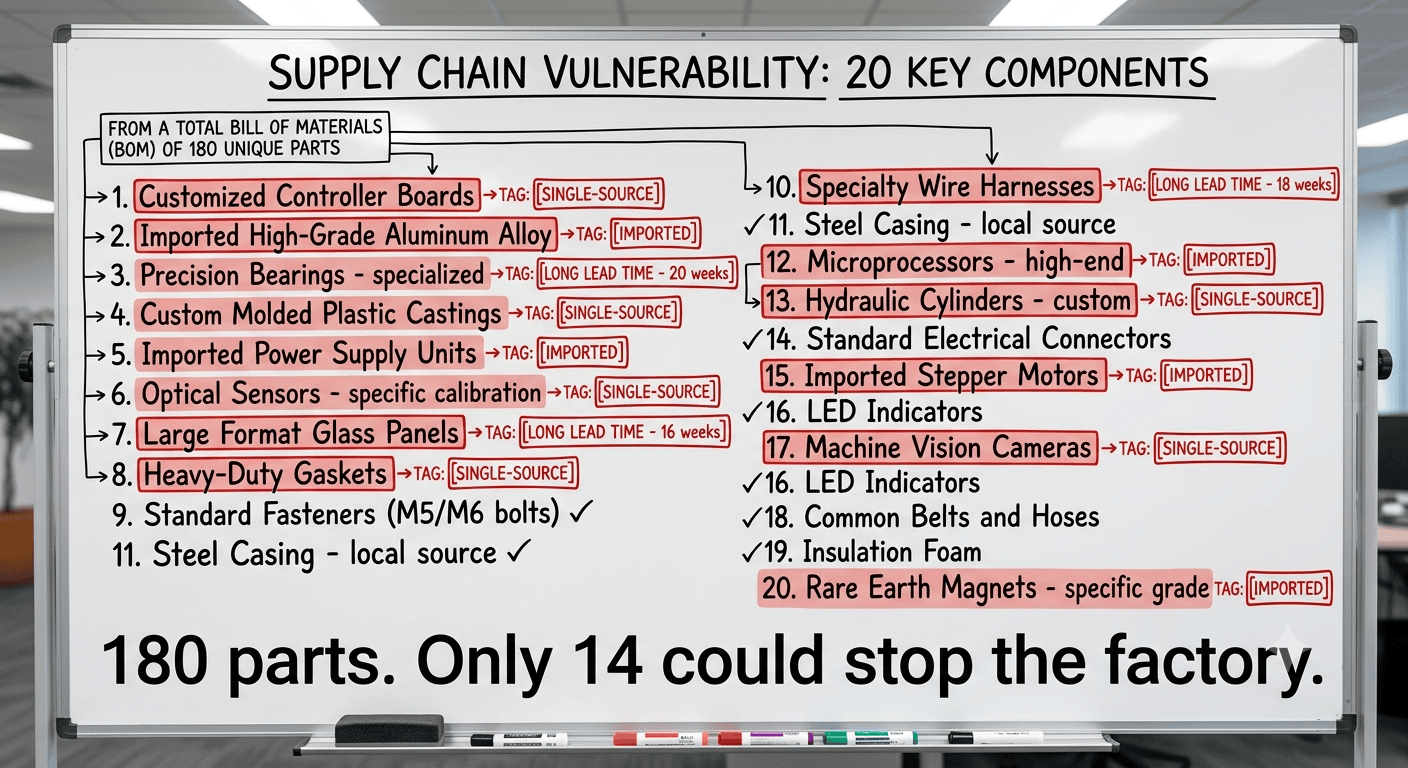
So afterwards he did something unglamorous. He sat down with his bill of materials and tagged every component with two questions:
- How many suppliers can make this?
- How long would it take me to get it if my main supplier vanished tomorrow?
Out of about 180 parts, only 14 turned out to be truly dangerous: single-source, long lead time, no easy substitute. For those 14, he did three things. He qualified a second supplier, even at a 5-8% higher price. He held an extra 8-10 weeks of buffer stock. And he asked his design team whether any of them could be swapped for an alternative.
The lesson: you don't need to fix your whole supply chain. You need to find your 10% of parts that can kill 100% of your business.
Story 2: The fastener maker who treated cash like inventory
In Ludhiana, a fastener manufacturer watched steel prices swing wildly in a single quarter. Most of his competitors did one of two things: panic-bought at the peak, or waited and got squeezed.
He did something different. He stopped treating raw material purchasing as a "buy when we run low" activity and started treating it as a risk decision with a number on it. He set simple rules. Keep a minimum of four weeks of core steel in stock. Buy in two tranches instead of one. Negotiate price-variation clauses with his top five customers so steel spikes could be passed through partially.
That last one took real courage. He had to sit across from large buyers and say, "I can't absorb 15% swings in raw material. Let's agree on a formula." Three of the five agreed. Two pushed back. He kept all five, but he stopped taking fixed-price orders longer than 90 days from the two who refused.
The lesson: resilience isn't only about inventory. It's about contracts. Every fixed-price promise is a bet you're making on someone else's commodity.
Story 3: The garment exporter who stopped putting all his eggs in one container
A knitwear exporter in Tirupur had 60% of his revenue coming from a single market. When tariffs and shipping disruptions hit, his order book shrank almost overnight.
What saved him wasn't luck. A year earlier he had quietly started two experiments: a small domestic brand line, and a pilot order for a buyer in a different region. Neither was big. Together they were maybe 12% of revenue. But when the main market stumbled, those two lines kept his looms running and his workers paid. He used the breathing room to renegotiate and find new buyers.
The lesson: concentration is comfortable when things are good and fatal when they aren't. Resilience is often just a small, boring, parallel option you built before you needed it.
What the heroes had in common
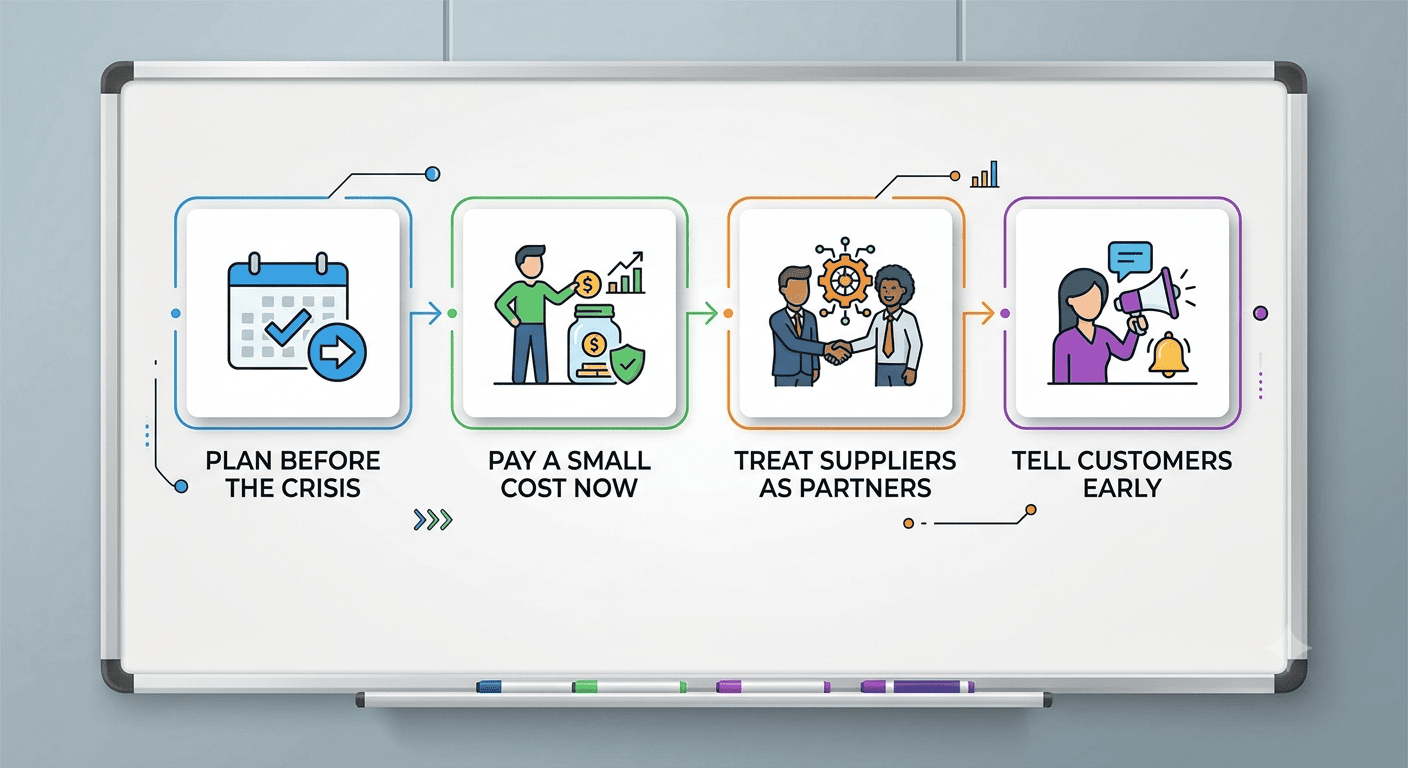 Strip away the industries and cities, and the pattern is clear.
1.They looked at the supply chain before the crisis, not during it. Crisis-mode decisions are expensive. Calm-mode decisions are cheap.
2.They accepted a small, visible cost to avoid a large, invisible one. A second supplier at 6% higher price looks wasteful on a spreadsheet. It looks brilliant the day the first supplier goes silent.
3.They treated relationships as assets. Every one of them had a supplier who picked up the phone on a bad day, because they had paid on time on a good one.
4.They shared the problem. They told key customers early about risks, instead of hiding delays until it was too late.
Your 5-step resilience playbook (start this week)
You don't need a consultant. You need a Saturday morning and a whiteboard.
1.Map your "kill list."
List your top 20 components or materials by criticality, not by spend. Mark any that are single-source, imported, or have lead times above 6 weeks. That's your kill list.
2.Qualify a Plan B.
For each item on the kill list, identify and sample a backup supplier. Place a small, real order. A backup you've never bought from isn't a backup.
3.Know your cash-to-cash cycle.
Resilience runs on working capital. If a shock hits, how many weeks can you survive paying suppliers before customers pay you? If you don't know this number, find out today.
4.Fix your contracts.
Add price-variation clauses, shorter validity on quotes, and clear delay terms. Make it normal to talk about risk with customers.
5.Build one parallel option.
A second market, a second product line, a second logistics route. Make it small. Make it real. Start before you need it.
The bottom line
You cannot control freight rates, tariffs, geopolitics or the next surprise. Nobody can. But you can control how exposed you are when they arrive.
The SMEs that win aren't necessarily the biggest or the best funded. They're the ones who asked the uncomfortable question early: "What if this one thing breaks?" Ramesh now keeps a laminated copy of his kill list on his office wall. When a visitor asks about it, he smiles and says: "That's the most expensive ₹4 lakh lesson I've ever bought." You don't have to buy the same lesson.
Your move
Pick one component in your factory right now, the one that would hurt most if it disappeared tomorrow. Ask yourself: who is my second source? If you don't have an answer, you've just found your first action item.
Tell me “what's the one part or material that keeps you up at night?” Need our help? Reach out at phoenix.advizory@gmail.com. Know a fellow MSME owner who needs to read this? Share it with them. It might save them a ₹4 crore Tuesday.