
The Next UPI Moment Is Happening on Your Factory Floor
Picture this
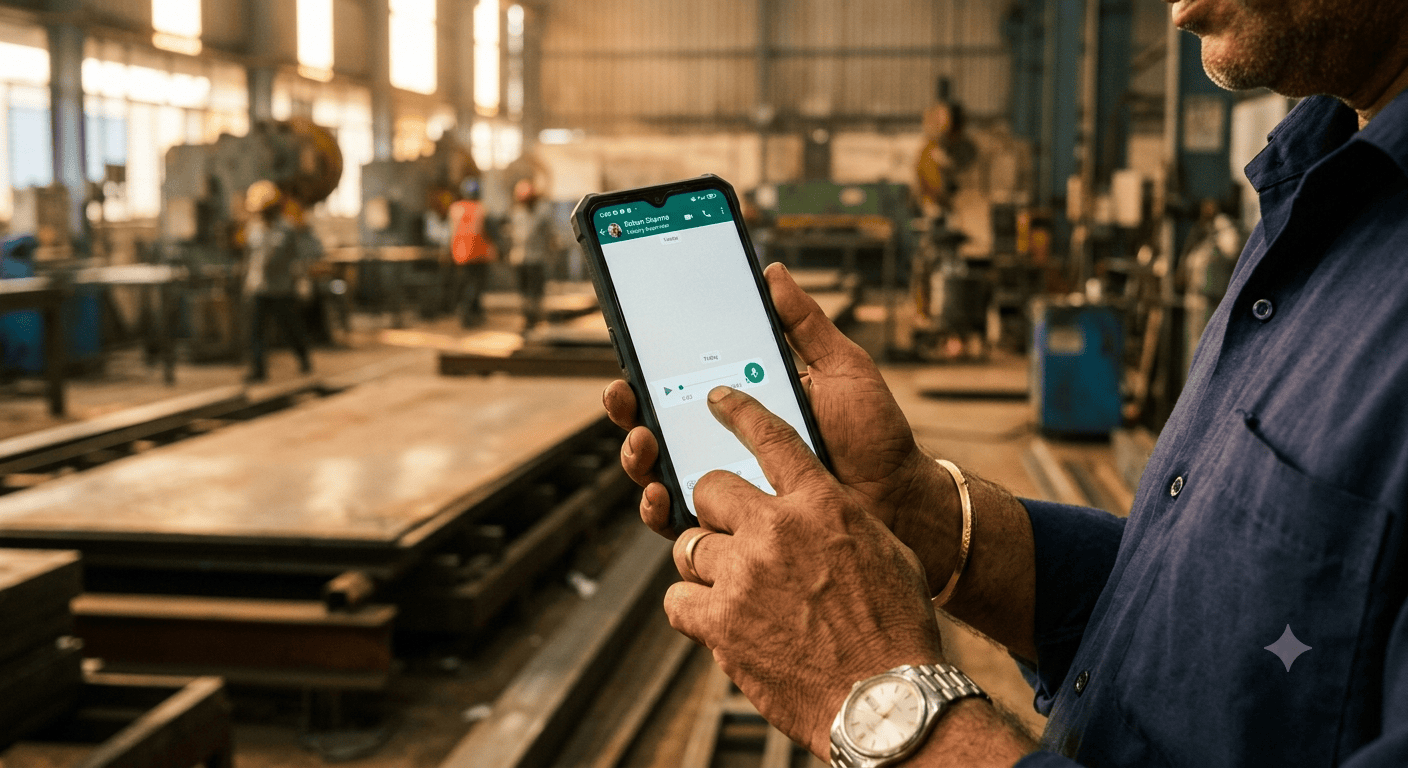
It's 7:40 AM. Ramesh Bhai is driving to his fabrication unit in Peenya, Bengaluru, when his phone buzzes. He doesn't stop. He doesn't open a portal. He doesn't log into an ERP. He taps the mic icon on WhatsApp and says: "Bhej do — 2 ton MS sheet, 3mm, jaisa pichli baar bheja tha. Friday tak chahiye."
Eleven seconds. No typing. No app-switching. No "please select from dropdown." By the time he parks his car, his supplier's system has transcribed the order, matched it against his last purchase, flagged a price change, and dropped a confirmation into his chat.
This isn't a pilot program. This isn't a fintech demo reel. This is already how a growing number of small and mid-sized manufacturers across India are placing — and receiving — orders. And if you run a factory, a trading firm, or a component supply business, this shift is about to rewrite your planning calendar whether you opt in or not. Let's talk about why.
The Problem Nobody Wants to Admit
Here's an uncomfortable truth about B2B ordering in Indian manufacturing: most of it still runs on vibes. A purchase officer calls a supplier. A WhatsApp text gets sent with half the specs missing. A verbal commitment made on the shop floor never makes it into any system. By the time it reaches procurement or planning, three details have changed and nobody remembers who said what.
Multiply that across 40-50 SKUs, a dozen vendors, and a workforce that's more comfortable speaking Hindi, Tamil, or Marathi than typing in English — and you get what every plant manager already knows in their bones: the gap between "order placed" and "order understood" is where most production chaos is born.
Late deliveries. Wrong grades. Mismatched quantities. Raw material planning built on guesswork instead of ground truth. This is the quiet tax every small manufacturer pays. And nobody's ever quantified it, because it doesn't show up as a line item — it shows up as a missed deadline, a client escalation, an inventory pile that shouldn't exist.
Enter the Voice Note
India didn't need to be taught voice messaging. Voice-based ordering on WhatsApp is already growing around 40% year on year — and that's not driven by tech-savvy D2C shoppers. It's driven by exactly the demographic that runs your supply chain: distributors, kirana owners, transporters, and yes — factory floor supervisors who'd rather speak than type.
India is WhatsApp's single largest national market, with over 500 million active users — and unlike email or a clunky ERP portal, WhatsApp is a channel your vendors, your buyers, and your own shop-floor staff already live in. Nobody needs onboarding. Nobody needs a password reset.
What's changed is what happens after the voice note lands. Businesses running WhatsApp Business API integrations are now plugging AI transcription and structuring directly into that voice message. The moment Ramesh Bhai says "2 ton MS sheet, 3mm," it doesn't just sit there as an audio blob — it gets converted into structured data: material, grade, quantity, delivery date. That structured data can flow straight into inventory checks, production scheduling, and dispatch planning.
In other words: the least structured part of your business — a spoken order — is becoming the most machine-readable.
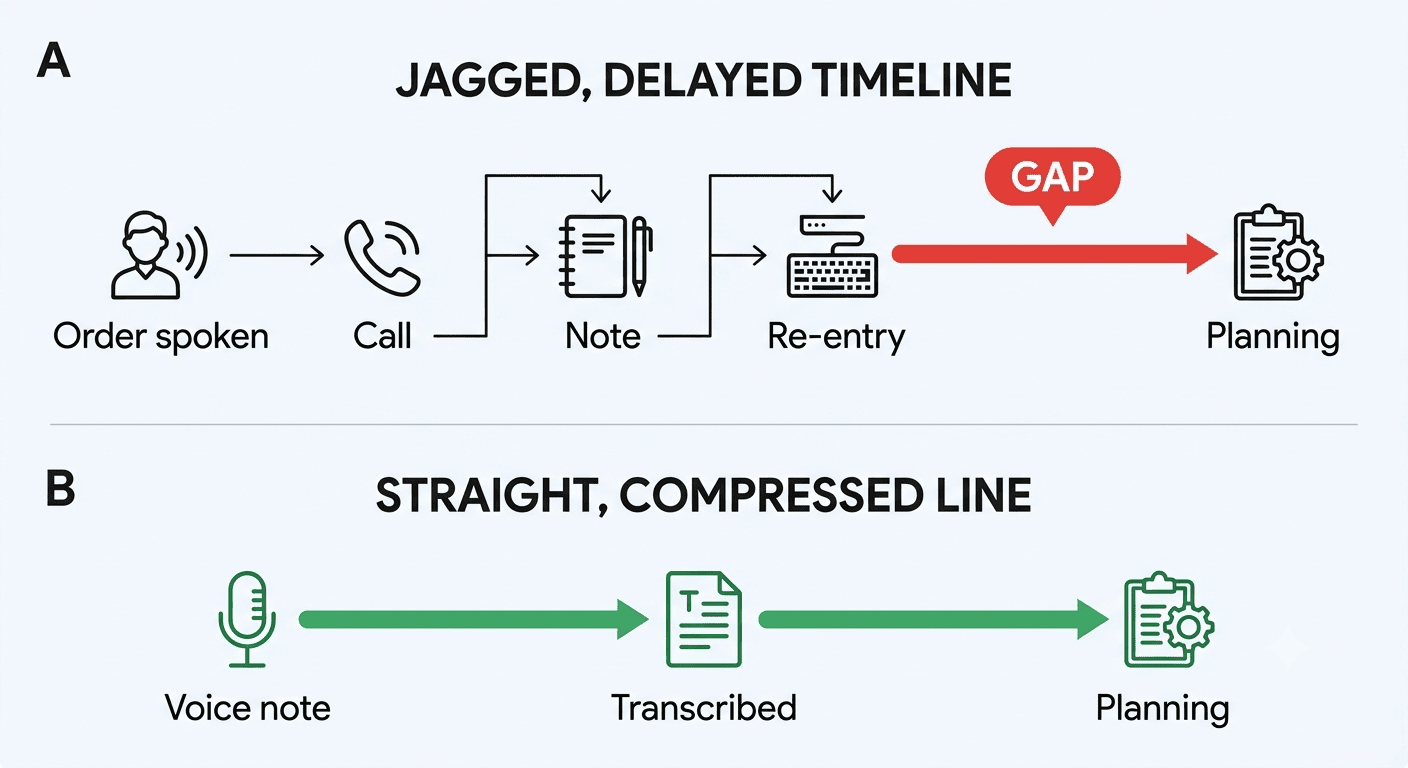 Why This Isn't Just "Nice CX." It's a Planning Weapon.
Most owners hear "voice commerce" and think customer experience. Cute. Convenient. Not urgent. That's the wrong lens. Here's the real story for anyone running production:
1.It kills the lag between demand signal and material planning.
Right now, there's a delay between "customer wants this" and "planning knows about it." That delay is where you either overproduce, underproduce, or scramble. A structured voice order hitting your system in real time compresses that lag to near-zero. Your planning team isn't reacting to a call summary written an hour later — they're reacting to the order itself.
2.It captures the language your business actually speaks.
Your most reliable purchase officer or your best long-time client doesn't order in polished English SKU codes. They order the way they've always ordered — colloquially, contextually, in their own tongue. A system that can only take structured web-form input is silently excluding your most loyal, highest-volume relationships from digital visibility. Voice-first ordering doesn't force behavior change — it captures behavior as it already exists.
3.It builds a data trail where none existed.
Every verbal order that used to evaporate into a phone call now becomes a timestamped, transcribed, searchable record. That's not just an audit trail — that's a demand-forecasting goldmine. Six months of voice orders tells you seasonality, repeat patterns, and price sensitivity that no spreadsheet ever captured because nobody was entering the data in the first place.
4.It's cheap enough that scale isn't the barrier — inertia is.
WhatsApp's utility and authentication conversation rates in India are among the lowest in the world, and the infrastructure to run this — a WhatsApp Business API connection through a BSP, layered with transcription — is no longer an enterprise-only expense. It's within reach of a 50-person manufacturing unit, not just a listed conglomerate.
The Part Everyone Skips: What It Costs You If You Don't Move
Picture your competitor down the road adopting this in the next two quarters. Their customers place orders in eight seconds while yours are still typing out specs on a chat thread or waiting for someone to pick up a call. Their planning team gets real-time, structured demand data while yours is still reconciling verbal commitments at the end of the week. Their vendors get automated reorder nudges based on actual consumption patterns while you're still calling to ask "kitna chahiye is baar?"
None of this is science fiction. It's operational plumbing that's becoming table stakes — the same way UPI QR codes went from novelty to non-negotiable in about eighteen months. The manufacturers who'll win the next five years in India aren't necessarily the ones with the biggest capacity. They're the ones who close the gap between "what the customer said" and "what the factory does about it" the fastest.
So What Should You Actually Do This Quarter?
You don't need to rebuild your tech stack tomorrow. Start smaller, but start deliberately:
- Audit how many of your orders today are verbal or voice-note based — even informally. You'll likely be surprised it's higher than you think.
- Talk to a WhatsApp Business API partner (not the free app — the API) about voice-to-text and structured order extraction. This is now a commodity feature, not custom development.
- Pilot it with your top 5 repeat customers or your most reliable raw material vendors — not your whole book. Learn where transcription breaks (accents, background noise, technical jargon) before scaling.
- Feed the structured output into your existing planning process, even manually at first. The value isn't the voice note — it's what happens downstream once that order becomes data.
The factories that treat this as "a WhatsApp feature" will miss the point. The ones that treat it as the first mile of their planning system will be the ones sitting on cleaner forecasts, tighter inventory, and fewer 11 PM firefighting calls a year from now.
Is your factory still translating spoken orders into spreadsheets by hand? Or have you already started capturing them at the source? Need our help? Reach out at phoenix.advixory@gmail.com or +91-9967093949. And if you found this useful, share it with the one person in your network still manually transcribing WhatsApp voice notes into an Excel sheet at 9 PM. They'll thank you.