
A GAME-CHANGER FOR INDIAN MSME's
Imagine this.
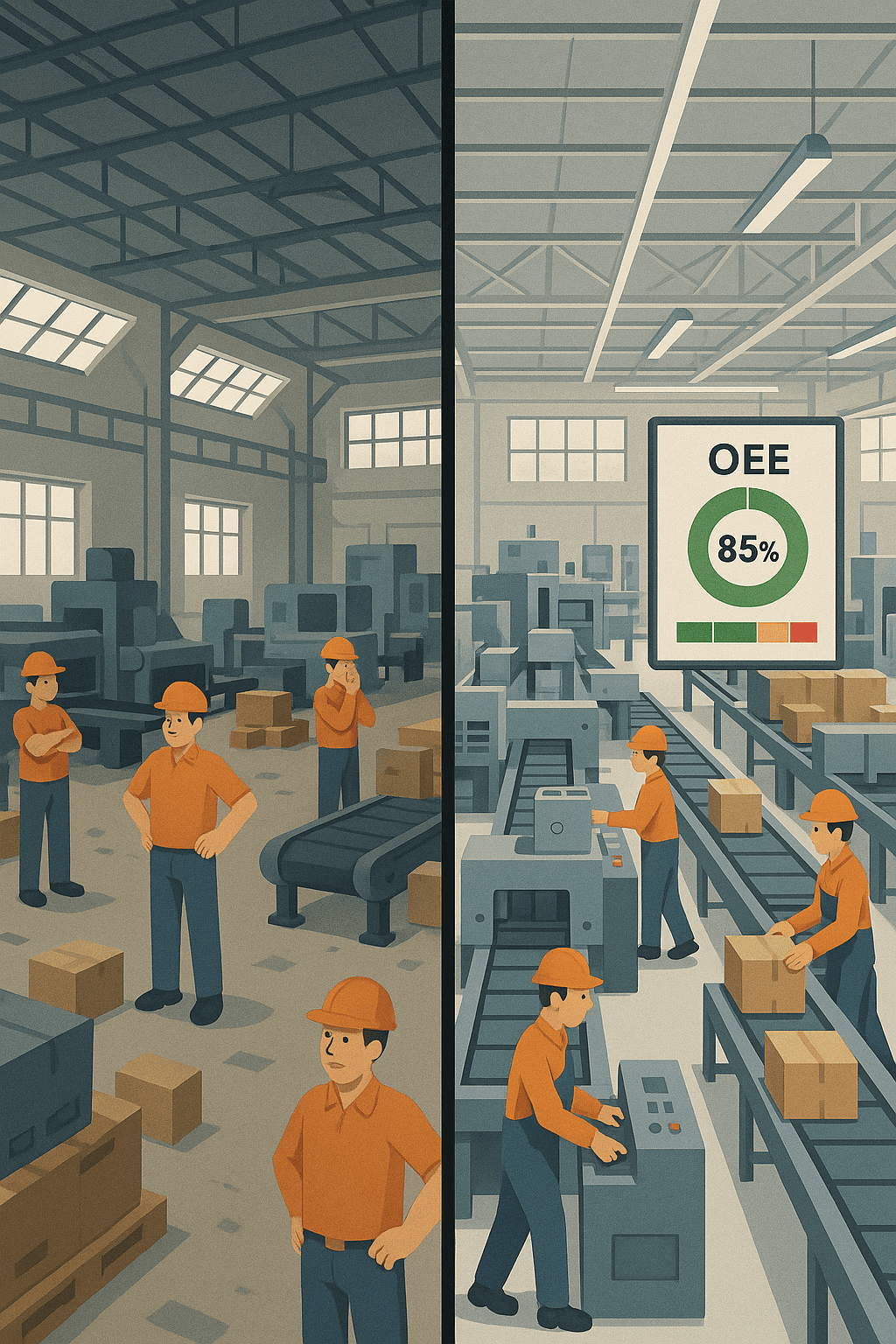
You walk into your factory on a Monday morning. Machines are buzzing, operators are on the floor, and orders are lined up. On the surface, everything looks busy. But by the end of the month, when numbers hit your desk, you realize profits aren’t where they should be. You scratch your head—production was running, machines worked, people worked—so where did the money vanish?
This is the silent drain that haunts thousands of MSME manufacturers in India. The culprit isn’t always lack of demand, bad quality, or high costs. Often, it’s hidden inefficiencies inside your own shop floor—the kind you don’t catch unless you’re tracking the right metric. That metric is OEE – Overall Equipment Effectiveness
What is OEE in Simple Words?
Think of OEE as your factory’s report card. It tells you how effectively your machines and people are working together to deliver value. It combines three key factors:
- Availability – Are your machines running when they’re supposed to?
- Performance – When they’re running, are they producing at the designed speed?
- Quality – Of what’s produced, how much is actually good enough to sell?
Multiply all three, and you get your OEE score—expressed as a percentage. 100% OEE is the dream factory—machines always available, producing at full speed, with zero defects. Most world-class manufacturers aim for 85% OEE. Many MSMEs operate in the scary 40-60% range without realizing it.
Why MSME Owners Should Care
Now here’s the hard truth. Every percentage point lost in OEE costs you money. It’s like watching water leak through tiny holes in your bucket while you keep pouring more in.
- Low Availability: Frequent breakdowns eat up hours. That’s lost output.
- Low Performance: Machines run slower than their rated speed. That’s underutilization.
- Low Quality: High rejection means wasted material, labor, and time.
If you aren’t measuring OEE, you’re blind to where your losses sit. Without this visibility, your shop floor teams will keep blaming raw materials, utility bills, or labor—even though your real enemy is hidden inefficiency.
A Short Story: The Two Manufacturers
Let’s take two MSME factory owners: Raj and Suresh.
- Raj doesn’t track OEE. His factory works long shifts, but he sees recurring complaints about delays. Employees put in overtime, yet shipments run late. Margins are wafer-thin, and he blames the economy.
- Suresh tracks OEE weekly. He notices one machine has availability issues—frequent breakdowns. Another runs at only 70% of rated speed. And a third workstation gives a higher scrap rate. Instead of hiring more labour, he fixes those leaks. His output goes up 20% without buying new machines or increasing work hours.
Same size factory. Same machines. One tracks OEE, the other doesn’t. After a year, guess who’s smiling at the bank?
The Indian MSME Context
Indian MSMEs account for nearly 30% of the country’s GDP and employ over 110 million people. Yet most operate on thin cash flows with limited buffers. Buying a new CNC machine or expanding shop floors isn’t always an option.
This means the only real lever of growth is sweating your existing assets harder and smarter. That’s exactly where OEE becomes critical:
- It helps MSMEs produce more with the same machines.
- It highlights exactly where capacity is lost.
- It turns gut feeling into hard data for decisions.
In other words, OEE is not a fancy KPI for big MNCs. It is a survival metric for small Indian manufacturers who need to do more with less.
Why Many MSMEs Avoid Tracking OEE
So, if OEE is so powerful, why don’t most MSMEs track it? Common reasons include:
- “We’re too small for such complicated metrics.”
- “We don’t have IT systems to track it.”
- “Our managers are overworked already—this will just add more paperwork.”
But here’s the reality:
- OEE only sounds technical. Even an Excel sheet, or a simple digital app, can track it.
- In fact, not tracking OEE means your managers are already spending more time firefighting problems they don’t see.
- And the more you grow, the higher the chaos without a system.
In short, not tracking OEE is like driving a truck with no dashboard—you’re always at the risk of running out of fuel or missing a gear.
Actionable Steps for MSMEs
So how do you get started? Here’s a simple 5-step playbook:
- Start Measuring, Don’t Overthink
Begin by selecting 1-2 critical machines on your shop floor. Track their Availability, Performance, and Quality daily.
- Use Simple Tools
Don’t wait for fancy ERP or IoT. Start with an Excel sheet or even pen-and-paper tracking. Once the habit forms, you can digitize later.
- Build Visual Dashboards
Put the OEE percentage where everyone can see it—on a whiteboard or a digital screen. What gets measured gets managed.
- Set Small Targets
Don’t aim for 85% immediately. Even improving from 50% to 60% can dramatically impact your output.
- Involve Your Team
Shop floor operators usually know what’s causing downtime or defects—they just aren’t asked. Make OEE tracking a team sport.
The Payoff
Here’s the exciting part. Improved OEE doesn’t just mean efficiency. It ripples across your entire business:
- Higher throughput – You handle more orders without new machines.
- Lower costs – Less rework, fewer breakdowns, lower energy wastage.
- Better delivery performance – Your customers see you as reliable.
- Stronger margins – You finally make money on existing business.
- Competitive edge – While others complain about “market conditions,” you quietly build resilience.
For many MSME owners, tracking OEE has led to 20-30% more usable capacity with zero capital investment. That is the cheapest way to scale.
Final Thoughts
Running an MSME factory in India is no easy feat. You juggle rising costs, demanding customers, and stiff global competition. The instinct is often to buy more machines or hire more people. But the smarter move is to squeeze inefficiency out of what you already have.
OEE is not just a number. It’s the flashlight that reveals the dark corners where your profits are leaking. And once you shine that light, you’ll wonder how you ever ran your factory without it.
If you’re an MSME owner reading this, ask yourself: Do I really know my factory’s OEE today?If the answer is no, this is your wake-up call. Start small. Track. Share with your team. Improve. Because in the end, factories that measure win against those that just assume.
Need a helping hand, reach out to me at phoenix.advizory@gmail.com or +91-9967093949. Let’s make Indian Manufacturing more efficient, together.