
VR/AR That Pays for Itself in Months
Picture This
Imagine cutting your factory’s training bill by 70% while doubling shopfloor competence — without hiring external trainers or sending staff to far-off centres. Sounds like a unicorn? For many Indian SMEs, AR/VR is turning that unicorn into an ROI metric.
Why this matters: Training is the silent leak in most MSME’s P&Ls. Lost production hours, repeat mistakes, quality rework, and the hidden cost of low confidence add up — and they compound when hiring is frequent or when processes change (new lines, new machines, new compliance). At the same time, skilled trainers are scarce and expensive; traditional classroom training and on-the-job shadowing are slow, inconsistent, and risky for high-value equipment.
AR (Augmented Reality) and VR (Virtual Reality) aren’t futuristic gadgets reserved for big conglomerates. They are tools that compress learning time, reduce errors, and institutionalize tacit knowledge. For Indian SMEs — where budgets are tight and disruption tolerance is low — that combination is transformational.
The PAS Framework
Problem: Training is expensive, inconsistent, and slow. New hires take weeks to become productive. Trainers are overloaded. Mistakes on the floor cost time and money.
Agitation: Every misplaced bolt, every wrong parameter set by a poorly trained operator bleeds profit. Managers spend evenings rewriting SOPs. Production targets slip. Customers notice quality variance. The human cost is stress and high attrition.
Solution (brief): AR/VR-based training standardizes learning, makes it experiential, and reduces time-to-competence dramatically — often at a fraction of current training costs.
How AR and VR actually cut costs — the mechanics
- Replace travel and third-party trainers: Remote VR sessions and AR-guided workflows let SMEs avoid sending staff to distant training centers or hiring expensive consultants for repeated sessions.
- Reduce machine downtime during training: In VR, operators train on an accurate digital twin of equipment. No machine downtime, no risk of damaging expensive assets.
- Faster learning curves: Immersive, hands-on practice leads to retention rates far higher than theoretical classroom sessions. Fewer mistakes mean less rework.
- Repeatable, measurable training: Digital modules are identical every time. Built-in assessments and analytics track competence objectively — no more “I think they’re ready” guesses.
- Scale cheaply: Once content is created, onboarding 100 operators costs almost the same as onboarding 10. That’s where the 70%+ cost-saving math appears.
Real numbers (how 70% happens)
Here’s a simplified example that reflects what we’ve seen in pilot projects for SMEs:
- Baseline: Traditional training for a new operator — 2 weeks classroom & shadowing, trainer cost (2 weeks) = INR 30,000, production loss (reduced throughput during training) = INR 20,000, error/rework cost until competency = INR 10,000. Total = INR 60,000 per operator.
- AR/VR approach: One-time content production and setup amortized over 200 trainees = INR 5,000 per operator. VR sessions (remote or local) + reduced trainer time = INR 5,000. Reduced production loss and errors thanks to safer simulated practice = INR 5,000. Total = INR 15,000 per operator.
Savings = (60,000 - 15,000) / 60,000 = 75%
Numbers will vary by industry, process complexity, and scale. But the structural savings from eliminating repeat trainer hours, reducing machine downtime, and scaling content explain how 50–80% reductions are realistic, not hype.
Use cases that win fast
- New machine commissioning: Simulate start-up sequences and safety shutdowns in VR. Teams practice without halting production.
- SOP adherence and checklists: AR overlays show step-by-step instructions on the actual machine, reducing misses during complex setups.
- Maintenance and troubleshooting: Technicians guided by AR see parts highlighted, torque specs, and video guidance in real time — fewer call-backs and faster Mean Time to Repair (MTTR).
- Safety and compliance: Near-miss scenarios and emergency drills in VR prepare teams for hazards without any real danger.
- Cross-skilling for multi-line staffing: Operators rotate lines faster because VR simulates each line’s environment.
Getting Started (a 90-day roadmap)
Week 0–2: Identify the pilot
- Pick 1 high-impact, repeatable process: a machine that causes frequent stoppages, a complex assembly, or a troubleshooting-heavy maintenance activity.
- Set clear KPIs: time-to-competence, error rate, machine downtime during training, and training cost per operator.
Week 2–4: Choose tech and partner
- Decide AR vs VR or hybrid: Use VR for immersive, high-risk simulation (start-ups, emergency drills) and AR for on-the-job overlays and guided work.
- Options: Off-the-shelf SaaS platforms reduce upfront costs; custom builds fit unique machines but cost more. Ask providers about integrations with digital twins and analytics.
- Hardware: For VR, basic headsets (standalone) are enough for most training. For AR, tablets or entry-level smart glasses suffice. Start modest.
Week 4–8: Build the module
- Work with engineers and senior operators to capture tacit steps.
- Create micro-modules (10–15 minutes each) rather than long courses.
- Include assessment checkpoints: rule-based pass/fail and task completion metrics.
Week 8–12: Pilot and measure
- Run the pilot with a small cohort (10–20 operators). Measure KPIs against baseline.
- Iterate on content and UI; fix common friction points.
- Expand after demonstrating clear ROI.
Practical tips that save time and money
- Start with “show-me-where” AR overlays before heavy VR. It’s cheaper and often solves 60% of training issues.
- Keep modules short and role specific. Microlearning is easier to adopt on shifts.
- Incentivize trainers to codify knowledge. Make subject matter experts co-creators and recognize them.
- Use blended learning: short theory videos + VR practice + AR-guided live tasks.
- Leverage local vendors and institutes (polytechnics) for content creation to cut costs and speed deployment.
- Track competency digitally: tie training completion to shopfloor scheduling systems so only certified operators run specific machines.
Risks and how to mitigate them
- Upfront cost anxiety: Start small with a single-line pilot; use savings from reduced downtime to fund expansion.
- Content obsolescence: Make content modular and easy to update; store scripts and recordings centrally.
- Resistance from workforce: Use champions (respected senior operators) to evangelize. Gamify assessments and celebrate milestones.
- Overreliance on tech for soft skills: AR/VR is excellent for procedural and technical skills but combine with mentorship for judgment and problem-solving training.
Case Study
A mid-sized sheet-metal shop in Pune introduced an AR-guided checklist for press setup and a VR module for die-change simulations. Within six months:
- Setup-related stoppages decreased by 60%.
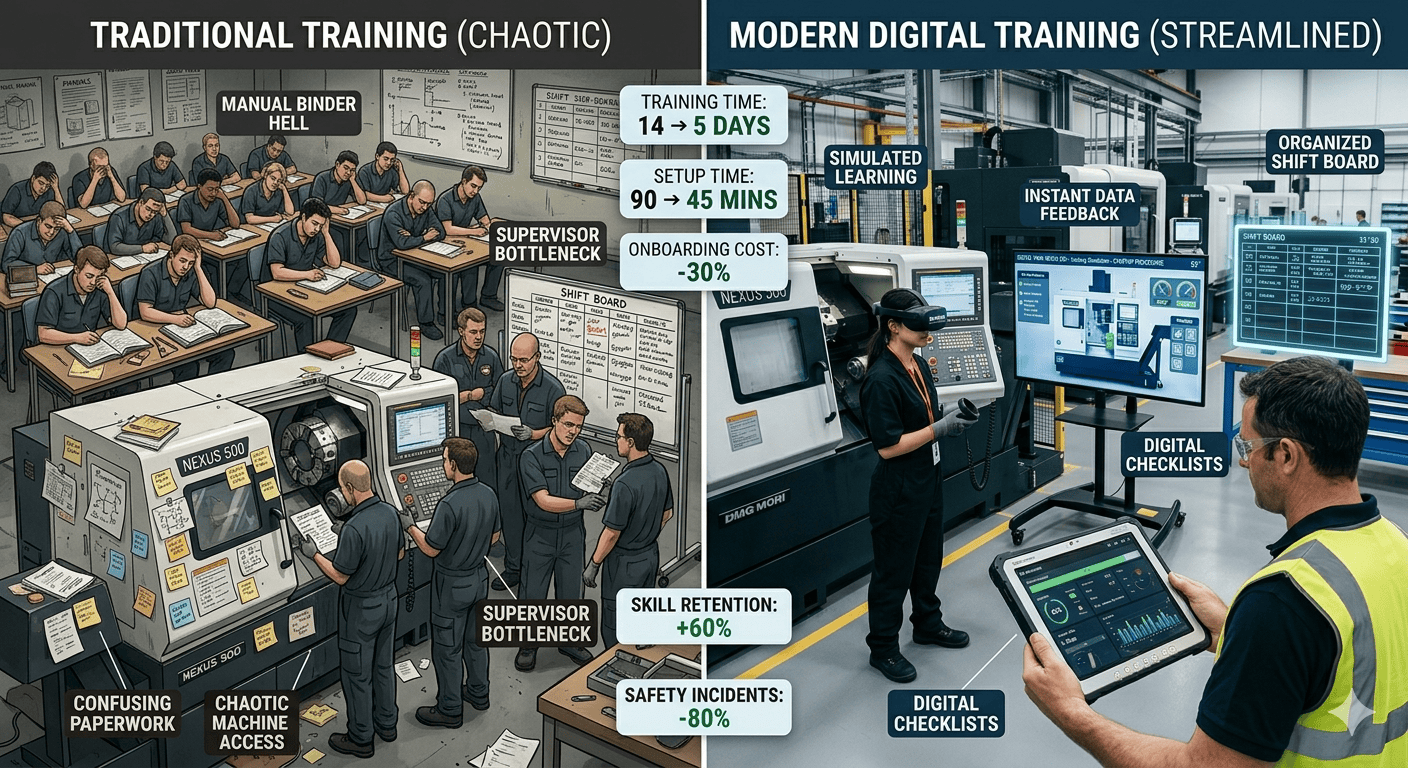
- Average setup time fell from 90 minutes to 45 minutes.
- New operator onboarding time reduced from 14 days to 5 days.
- Training cost per operator fell by ~68%.
That’s the compound effect: faster setups increase capacity; fewer stoppages lower overtime; better confidence reduces attrition.
ROI considerations for CXOs
- Payback period: With modular pilots, many SMEs break even within 6–12 months, thanks to reduced downtime and fewer quality escapes.
- Intangible ROI: Improved safety record, higher employee morale, stronger customer confidence, and faster scalability when new lines or contracts arrive.
- Capital vs Opex: SaaS models let you convert capital expense into predictable operating expense. Consider subscription models for content updates and analytics.
The human angle — why operators will like it
Operators don’t resist technology that makes their work safer and less stressful. AR/VR reduces the fear of “breaking things” during learning, speeds up confidence, and creates visible career paths (digital certifications). Present training as an upskilling benefit, not surveillance.
Action plan for CXOs (3 quick steps)
- Approve a pilot budget equal to one month of lost production on the target machine.
- Assign a cross-functional team (production lead, a senior operator, HR/training, IT) to run the pilot.
- Insist on measurable KPIs and a 12-week review to decide scale-up.
Final thoughts
If your factory still treats training as a recurring operational headache, AR/VR offers a chance to turn that headache into a strategic advantage. For Indian SMEs battling thin margins and fierce competition, cutting training costs by 50–75% isn’t just savings — it’s the margin that keeps you competitive on price, quality, and delivery.
Need help to tailor this to your factory (process, estimated costs, and 90-day ROI)? Reach out to me atphoenix.advizory@gmail.com or +91-9967093949. Share this if it hits home. Tag a fellow manufacturer who needs it. Let's upskill your team, together.