
The ₹40 Lakh Chair That Never Got Made
Picture This
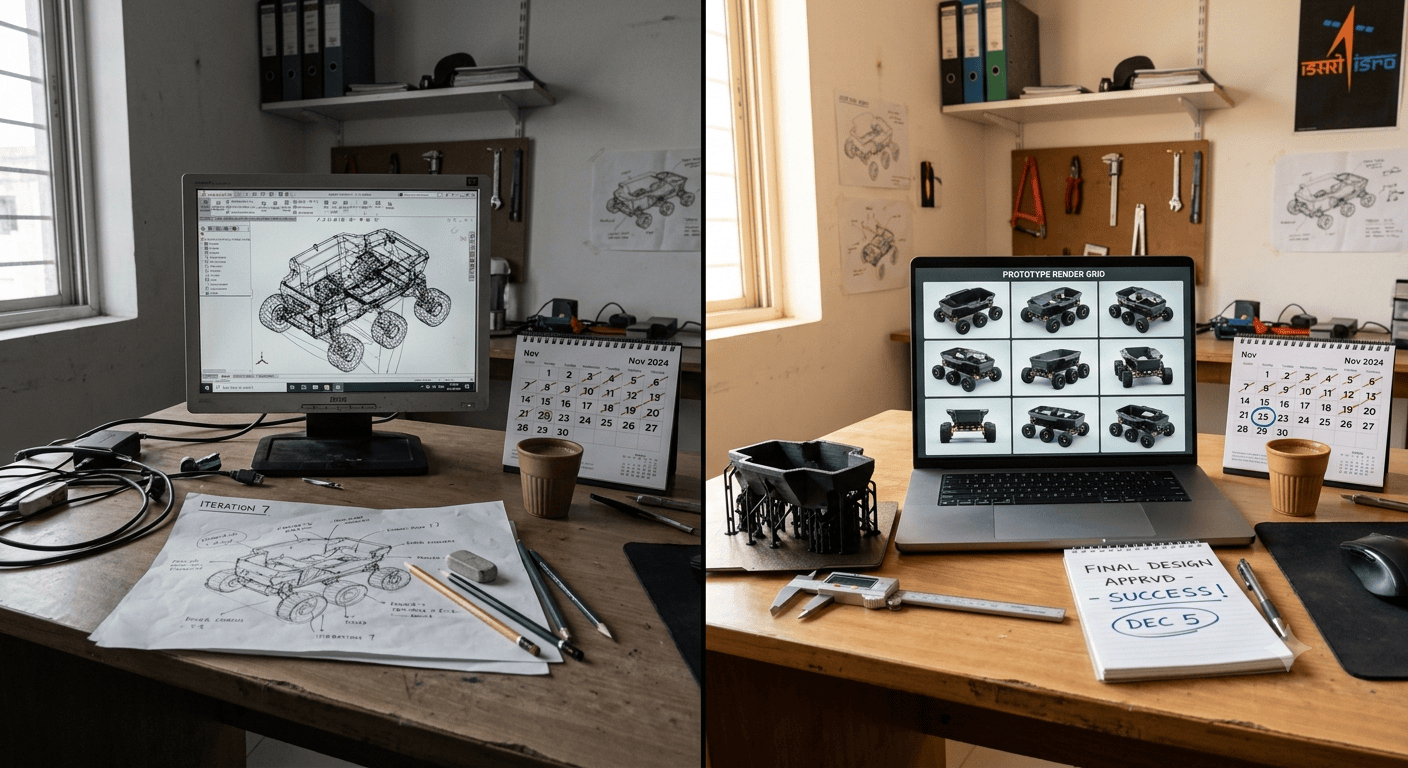
A furniture exporter in Rajkot lost a big order last year. Not because his price was high, and not because his quality was poor. He lost it because the buyer asked for three design variants by Friday, and his designer took three weeks.
The buyer didn't complain. They just went to a Vietnamese supplier who sent renders in two days. The Indian factory had better craftsmen and lower costs. It lost anyway, to speed. (This is a composite of stories I keep hearing from small manufacturers. The details change, but the ending doesn't.)
If you run a small manufacturing company in India, this should make you a little uncomfortable. It should also make you curious.
The slow, expensive loop we all live in
Here's how product development works at most MSMEs:
- The customer or sales team describes what they want, often vaguely.
- Someone sketches it on paper or a whiteboard.
- A CAD operator spends days turning it into a model.
- A prototype gets made, which costs money and takes a week or two.
- The customer says "can we change this a little?"
- Go back to step 3.
Every loop costs time, money and goodwill. Most small manufacturers run this loop four to six times before a design is approved. By then, the customer is irritated and your cash is tied up in prototypes nobody wanted. Now imagine compressing that entire loop from weeks to a day. That's what generative AI is starting to do. Not in a lab in California, but on a regular laptop in a regular factory.
First, what "generative AI for design" actually means
Forget the hype. It's really three different tools, and you need to know which does what.
1.Concept generators (image AI). You type or sketch an idea, like "a stackable steel stool, industrial look, powder-coated, for cafés." You get 20 visual options in two minutes. Midjourney, Stable Diffusion and Adobe Firefly sit here. Think of it as an unlimited, tireless brainstorming partner.
2.Image-to-3D tools. You upload a sketch or a chosen concept, and the AI builds a rough 3D model. Tools like Meshy and Tripo do this. The output is rough, but it's a starting point that used to take a CAD operator days.
3.Generative design engines (engineering AI). This is the serious one. You tell software like Autodesk Fusion what loads the part must bear, where it's fixed, which material and which manufacturing process. The software generates dozens of optimized shapes, often lighter and stronger than what a human would draw. This is how aerospace companies cut weight from brackets, and it's now available at a price a mid-sized workshop can consider.
Most owners confuse these three and conclude "AI isn't ready." In reality, each solves a different problem. Concept AI makes you faster at ideas. Generative design makes you better at engineering.
A day in the life: sketch to prototype in hours
Let me walk you through what this looks like. Take a 60-person company in Pune making sheet-metal enclosures and brackets. A customer wants a new mounting bracket for an EV charger.
9:30 AM: The brief.
The sales head photographs the customer's hand sketch and sends it over. Normally this would sit in someone's queue for two days.
10:00 AM: Concepts.
The design engineer feeds the sketch and a text description into an image AI. Fifteen variations come back in minutes. Two stand out. The sales head sends them to the customer on WhatsApp for a quick reaction.
11:30 AM: Customer feedback.
The customer picks one and asks for a thicker mounting flange. In the old world, this feedback would have arrived next week. Today it arrives before lunch.
1:00 PM: Into 3D.
The chosen concept goes into an image-to-3D tool for a rough model. The engineer imports it into CAD, cleans it up, and sets exact dimensions. This step still needs a human. Always.
2:30 PM: Engineering optimization.
The engineer sets the load conditions in a generative design tool: 12 kg hanging load, four bolt points, 3 mm mild steel. The software suggests several shapes. One uses roughly a fifth less material than the original. Less steel means lower cost on every single unit you'll ever make.
4:30 PM: Prototype.
The file goes to a 3D printer in-house or at a local service bureau. Most Indian metros now have several. Printed in plastic, it's a fit-check prototype by the next morning.
Next day, 11 AM: The customer holds the part in their hand.
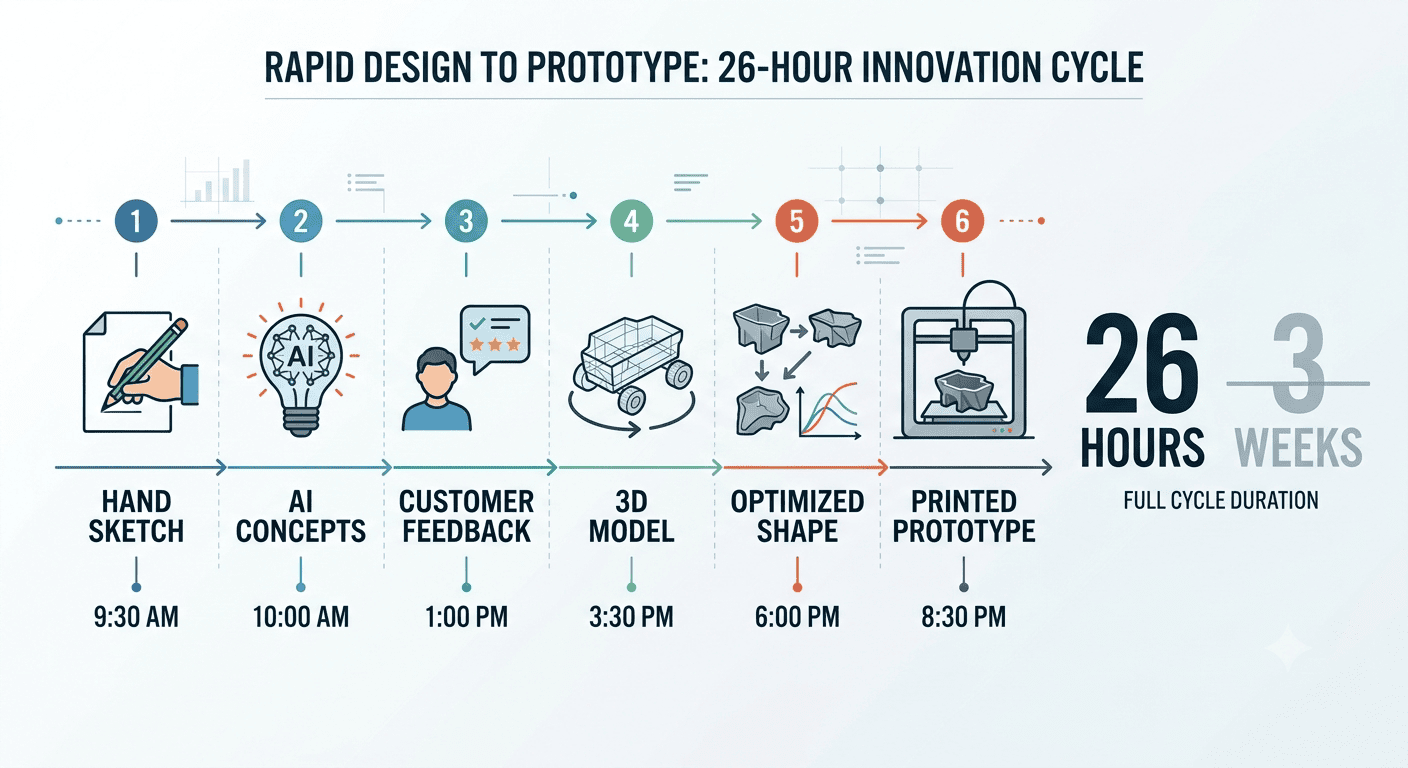 Total time from sketch to physical prototype: about 26 hours instead of three weeks. And cost? A fraction of what multiple rounds of machined prototypes would have run.
Why this matters more for us than for big companies
Big manufacturers can throw design departments at a problem. We can't. But look at what's changing:
- Customers are impatient. Whether it's a global buyer or a Tier-1 auto supplier, "we'll revert in two weeks" is now a losing sentence.
- China+1 is real, but conditional. Global buyers are looking at India as an alternative. They'll choose suppliers who can co-design quickly, not just build to print. Speed in design is how you move from job-worker to partner.
- Talent is scarce. Good CAD and design engineers are hard to hire and harder to retain in smaller towns. AI lets one good engineer do the work of two or three.
- Material is your biggest cost. Even a modest weight reduction compounds across thousands of units.
The pattern is simple. The companies that win aren't the ones with the most machines. They're the ones that go from "idea" to "yes, we can make that" fastest.
Before you get carried away: the honest caveats
I'd be doing you a disservice if I only sold the dream. Here's where it breaks.
AI doesn't understand your shop floor. It might design a beautiful part that your press brake can't bend or your CNC can't reach. Manufacturability knowledge still lives in your experienced people. Treat AI output as a draft, never a drawing.
Image AI hallucinates geometry. That elegant concept may have parts that are physically impossible. Always verify in real CAD with real dimensions.
Confidentiality is a risk. Don't upload a customer's proprietary drawings into free public tools. Check data policies, use enterprise plans where needed, and put a simple "what can go into AI" rule in writing.
IP ownership is murky. The legal position on AI-generated designs is still evolving. For anything you plan to patent or register, involve your IP counsel, and keep records of human design decisions.
Your people may be nervous. If your designers think AI is there to replace them, they'll quietly sabotage it. Position it as "you'll do more interesting work, faster," and mean it.
Your 30-day starter plan
You don't need a big budget or an "AI transformation." You need one small, real experiment.
1.Week 1: Pick one pain point.
Find the product category where design iterations hurt the most. Not your whole business, just one product line.
2.Week 2: Run a concept sprint.
Take your most recent design request. Have your designer use an image AI tool for two hours to generate options. Compare the output with what usually takes days. Cost: close to zero.
3.Week 3: Try generative design on one real part.
Pick a bracket, fixture or housing you already make. Run it through a generative design tool (many offer free trials or startup/education tiers). Compare weight and cost against your current version.
4.Week 4: Prototype and measure.
Print it. Test it. Then record three numbers: time saved, material saved, and customer reaction. These three numbers will tell you whether to scale.
If the results are underwhelming, you've spent a month and very little money. If they're good, you've found a real edge.
The bottom line
Generative AI won't design your product for you, and it won't replace the instinct of a 25-year veteran who can look at a part and say "that'll crack at the weld." But it will change who gets to the customer first with a believable answer. And in manufacturing, the first believable answer very often wins the order.
The Rajkot exporter I mentioned? He started a small design sprint a few months later. He's not a technologist, and he'd be the first to tell you that. But his latest sample went out in four days, not four weeks. The tools are cheap. The cost of waiting is not.
Your move:
This week, pick one product, one designer and one two-hour experiment. Then come back and tell me what happened.
If this was useful, share it with the one person in your company who's always complaining that "design takes too long." And if you're already experimenting with AI in your factory, drop a comment or reach out at phoenix.advizory@gmail.comor +91-9967093949 if you need our help. I'd love to hear what's working and what's not.