
A practical guide to streamlining your value chain
Setting the Scene
If you run a small manufacturing company in India, you already know this truth: The real leak in your P&L is not in sales. It’s somewhere between procurement and packaging. A delayed raw material shipment here. A quality rejection there.
Somewhere in the middle, WIP sits idle, finished goods wait for dispatch, and your margins quietly bleed. This blog is about plugging those leaks – with simple, MSME-friendly practices you can implement on the shopfloor, not just in a PowerPoint.
The Domino Effect Inside Your Factory
Your sales team closes a big order with a tight delivery timeline. Production commits. Procurement scrambles. The cheapest supplier gets the PO. Material arrives late. Quality flags issues. Rework begins. Overtime kicks in. Dispatch scrambles to meet the deadline. Packaging is rushed. Customer complains.
Everyone worked hard. Everyone is exhausted. Yet profitability took a hit. The problem? Your operations are working in silos, not like a single value stream from procurement to packaging.
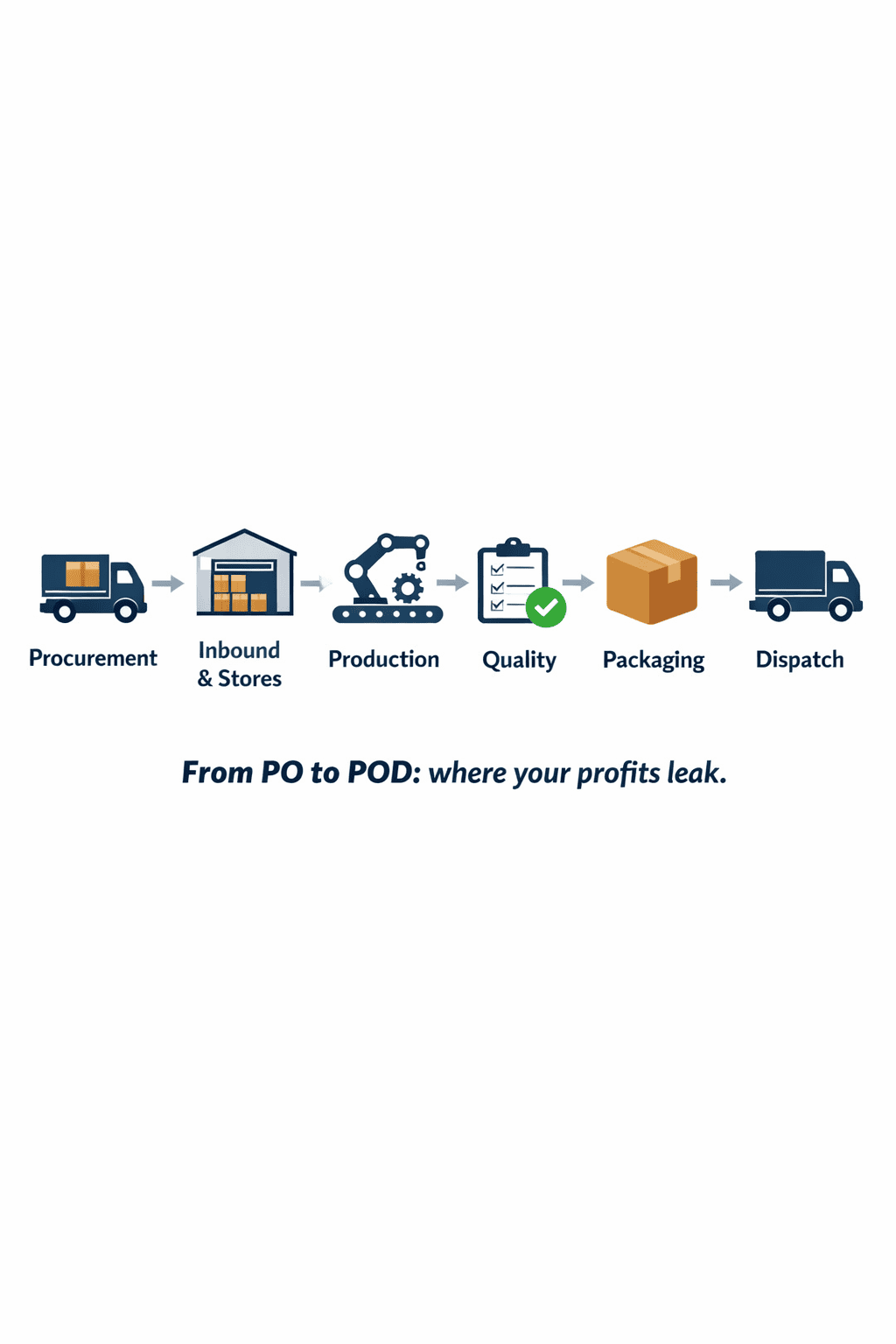
Let’s break that chain into four stages and see how to streamline each one:
- Procurement – buying right, not just buying cheap
- Inbound, inventory, and material flow
- Production – flow, not firefighting
- Packaging and dispatch – the last mile your customer actually sees.
Procurement: From “Lowest Quote” To “Total Cost”
Most MSMEs still treat procurement as a price negotiation function. But CXOs who scale understand, procurement is a risk and reliability function first, and a price function second. Here are practical shifts you can make.
a) Move from “three quotes” to “qualified suppliers”
Instead of collecting three random quotes and praying, build a basic supplier scorecard for your top 10 critical items. Use simple parameters:
- On-time delivery (number of delayed deliveries in last 10)
- Quality performance (rejection or return rate)
- Price stability (how often they revise rates)
- Responsiveness (how quickly they respond to changes)
You don’t need SAP for this. An Excel sheet or simple Tally/Zoho custom reports are enough. The goal: stop treating every PO like a new experiment.
b) Standardize what you buy
If every new order needs a new spec, new vendor, and new negotiation, your costs and complexity go up.
- Standardize raw material grades where possible
- Create a preferred BOM for recurring products
- Reduce the number of variants unless the customer truly pays for customization
Standardization gives you better pricing, faster deliveries, and fewer quality surprises.
c) Think “landed cost” not “rate per kg”
Cheap material that leads to rework, scrap, missed delivery, or penalties is not cheap. Ask your team:
- What is the rework/scrap percentage by supplier?
- How much overtime did we do because of delayed supplies?
- How many urgent air/express shipments have we booked this quarter?
When you add all this up, a slightly higher rate but a reliable supplier usually wins.
d) Digitise just enough
You do not need a massive ERP to be “digital”. Start small:
- Use simple e-POs and email approvals instead of WhatsApp chaos
- Track at least your top 20 items’ stock and vendor performance in one shared dashboard
- Use basic alerts: reorder level, minimum stock, expected delivery date vs actual
The win for you as a CXO: visibility. You can’t control what you can’t see.
Inventory & Material Flow: From “Godown” To “Nervous System”
In many MSMEs, the store or godown is a black hole. Material goes in, sometimes comes out, and no one is fully sure what’s inside. This one area alone can release a lot of working capital and reduce stress.
a) Define what “enough” looks like
Instead of shouting “We’re always short of something!”, define three levels for your key materials:
- Minimum stock (below this, you’re in danger)
- Reorder point (when you should place a PO)
- Maximum stock (beyond this, you’re killing cash flow)
You can calculate this loosely using:
- Average consumption per month
- Lead time in days
- A safety factor (based on how unreliable suppliers are)
Even a rough number is better than pure guesswork.
b) Clean, label, and locate
If your team spends time searching for material, you’ve already lost productivity.
- Fix storage locations and label them clearly
- Use simple bin cards or digital equivalents
- Physically separate similar but different items (e.g., M8 vs M10, 1.5mm vs 2mm sheet)
This is classic 5S but applied to your stores area with discipline. Think of it like Google Maps for your materials.
c) Make material flow visible
On-time production starts with on-time material availability.
- Use a simple board (or a basic tool) that shows: PO due dates vs material received
- Highlight shortages for the next 3–5 days of production
- Review this daily in a 15-minute stand up with procurement, stores, and production
Your job as CXO: insist on visibility and short daily reviews instead of long weekly post-mortems.
Production: From Firefighting To Flow
Most small factories are busy, but not necessarily productive. Machines are running, people are moving, but orders are still late. The culprit? Poor flow.
a) Schedule backwards from dispatch
Start with the dispatch date and work backwards:
- How many hours of processing per operation?
- What is the bottleneck machine or process?
- How many orders are competing for that bottleneck?
Create a simple load chart for your key bottleneck resources. If your paint shop, heat treatment, or CNC line is overloaded, nothing downstream will be on time. When you schedule from dispatch backwards, you protect customer commitments, not just machine utilization.
b) WIP is not wealth
Excess WIP hides problems: quality issues, capacity mismatch, wrong priorities. Try this for one month:
- Put a simple WIP cap per workstation or per line
- Do not release new jobs unless WIP goes below the cap
- Watch what problems surface – those are your real issues
You’ll see more clarity on where delays happen.
c) Standard work for repeated operations
In MSMEs, “best operator” knowledge is often in someone’s head. When they’re absent, productivity drops. Document:
- Setup instructions for key machines
- Standard cycle time for common parts
- Critical quality checks per operation
Print and display these near machines. The aim is not ISO documentation; it’s to ensure today’s output isn’t dependent on that one experienced operator.
d) Daily production huddles
Five things reviewed in 10–15 minutes at the start or end of the shift:
- Plan vs actual for yesterday
- Top 2–3 reasons for deviation
- Material shortages for today/tomorrow
- Quality issues and rework
- Any machine breakdowns
No blame, no long lectures. Just facts and next actions. Your presence in these huddles once or twice a week sends a strong signal about what you care about.
Packaging & Dispatch: Your Customer Only Sees This Part
Here’s the irony: you can have world-class production, but if your dispatch is sloppy, the customer will still think you’re unreliable. For them, your “factory” is the box that arrives at their gate.
a) Standardise packing for top SKUs
For your top 20% SKUs that drive 80% of your revenue:
- Define standard packing material and method
- Fix quantity per box/pallet
- Have clear labels: part number, batch, date, quantity, handling instructions
Check with your key customers: what packing problems have they faced in the past from any supplier? Fix those proactively.
b) Integrate dispatch with production & sales
This is where most MSMEs break:
- Sales commits a date
- Production plans something else
- Dispatch gets instructions at the last minute
At least once a week, bring sales, planning, and dispatch together:
- Review dispatch plan for next 7 days
- Confirm which orders are at risk and why
- Align on priorities (what must go, what can wait)
A simple shared view of the next 7 days reduces last-minute truck bookings, part shipments, and penalties.
c) Documentation is part of the product
Wrong invoice, missing e-way bill, incorrect packing list – these cause as much pain as a rejected part. Make a simple checklist:
- Are customer-specific documents attached?
- Are all regulatory documents in place?
- Does the label exactly match customer PO description?
Train one person to own this checklist. Quality is not just dimensions and tolerances; it’s also paperwork.
Stitching It Together: From Silos to a Single System
You’ve seen the pieces. The real magic happens when you connect them.
a) One simple “control tower” view
You don’t need a fancy system. You need one page that answers:
- What are we dispatching this week?
- For those orders, is material available?
- What is the status at each key production stage?
- What risks exist (material, machine, manpower, quality)?
This could be:
- A shared Google Sheet
- A simple ERP dashboard
- A physical board in your planning room
The discipline is more important than the software.
b) Measure what matters
If you measure everything, people ignore everything. Start with 4–5 metrics:
- OTIF (On-Time In-Full) – percentage of orders delivered as promised
- Supplier on-time performance – for your top ten suppliers
- First-pass yield – how much passes without rework
- Inventory days – how long stock sits before it moves
- Customer complaints per month – and the reason
Review this monthly with your leadership team. Ask: what 1–2 changes will move these numbers?
c) Culture: from blame to problem solving
This is the hard part, but it’s where small companies win. Instead of:
- “Stores did not issue material.”
- “Production delayed the order.”
- “Sales overcommitted to the customer.”
Shift to:
- “What broke in our system?”
- “Where did the signal fail?”
- “What do we change so this doesn’t repeat?”
When people see that talking about problems doesn’t get them punished, they start surfacing issues earlier. That’s when your operations truly begin to streamline.
A Simple 30-Day Action Plan
If you’re a founder or CXO, here’s how to get started without overwhelming your team.
Week 1: See the current reality
- Walk the flow yourself – procurement to packaging – for one key product
- Ask dumb questions, listen more than you speak
- Identify 3–5 obvious bottlenecks or leakages
Week 2: Fix visibility
- Create a simple list of top 20 materials and track stock, lead time, and supplier performance
- Start a daily 10–15 minute huddle between procurement, stores, and production
- Put up a basic dispatch plan for the next 7 days
Week 3: Standardize the basics
- Define standard packing for your top 10 SKUs
- Document standard work for 2–3 critical operations
- Set minimum and reorder levels for at least your critical A-class items
Week 4: Review and refine
- Review the impact: fewer stockouts? fewer last-minute dispatch issues?
- Pick one metric to formally track (e.g., OTIF) and set a realistic improvement target for next quarter
- Decide what to keep, what to improve, and what to stop
You don’t need a massive “transformation project”. You need consistent, boring, small changes that compound.
Your Next Step
If you’re still reading, chances are this hits close to home. Maybe you’ve seen:
- Customers praising your product but complaining about delivery
- Cash stuck in slow-moving inventory
- Teams working hard but still missing commitments
You don’t have to fix everything overnight. But you do have to start. Here’s the ask:
- Pick one product line or one customer.
- Map their journey from procurement to packaging in your factory.
- Identify just three leaks – and plug them in the next 30 days.
If you’d like a more structured approach tailored to your plant – process walk-throughs, simple dashboards, and MSME-friendly systems – reach out to me at phoenix.advizory@gmail.com or +91-9967093949. Because in the end, it’s not the biggest plant that wins. It’s the one where procurement, production, and packaging move like one well-run system – quietly, predictably, and profitably.