
A playbook for building a vendor ecosystem that saves money AND protects your business
Picture This
In early 2023, a Coimbatore-based auto-component manufacturer got a call that every founder dreads. Their single source for a critical alloy casting had a fire at their plant. Not a small one. Production down for six weeks, minimum.
The manufacturer had exactly one supplier for that part. Zero backup. Zero leverage. Zero options. They lost a ₹6 crore order to a competitor within nine days. Not because their product was worse. Not because their price was worse. Because they had nowhere else to turn.
This is the story nobody tells you when they talk about "cost optimization." Everyone's chasing the cheapest quote. Almost nobody is asking the more expensive question: what happens when your cheapest vendor lets you down? Let's talk about multi-vendor strategy — and why, in a high-inflation, high-uncertainty economy, it's not a supply chain tactic anymore. It's survival.
The Single-Vendor Trap
Here's the seduction of a single vendor: better pricing, smoother communication, one relationship to manage, maybe even a personal rapport built over years. It feels efficient. It feels like loyalty. It feels safe. It isn't.
A single vendor means a single point of failure. One price hike, one quality slip, one geopolitical hiccup, one factory fire — and your entire production line stops. You have no negotiating leverage because they know you have nowhere else to go. And every cost pressure they face — raw material inflation, fuel costs, labour shortages — gets passed straight to you, because who's going to stop them?
Indian manufacturers learned this the hard way during COVID, again during the Red Sea shipping crisis, and yet again with the semiconductor and electronics component shortages that are still rippling through supply chains today. Companies with single-source dependencies didn't just lose margin. Some lost customers permanently. The irony? The "cheaper" vendor often ends up being the costliest decision you ever made.
So Why Doesn't Everyone Diversify?
Because multi-vendor sourcing sounds expensive on paper. More vendors means more onboarding time, more quality audits, smaller order volumes per vendor (so you lose bulk discounts), and more relationships to manage with a lean team that's already stretched thin.
This is the real tension every CXO in manufacturing feels right now: cost pressure is pushing you toward consolidation, but risk pressure is pushing you toward diversification. The good news? This isn't actually an either-or choice. The smartest manufacturers in India aren't picking one over the other. They're building structured multi-vendor strategies that get them both — cost efficiency AND resilience. Here's how.
1.The 70-20-10 Rule
Don't split your business evenly across vendors. That just multiplies your management headache without buying you real protection.
Instead, structure it like this:
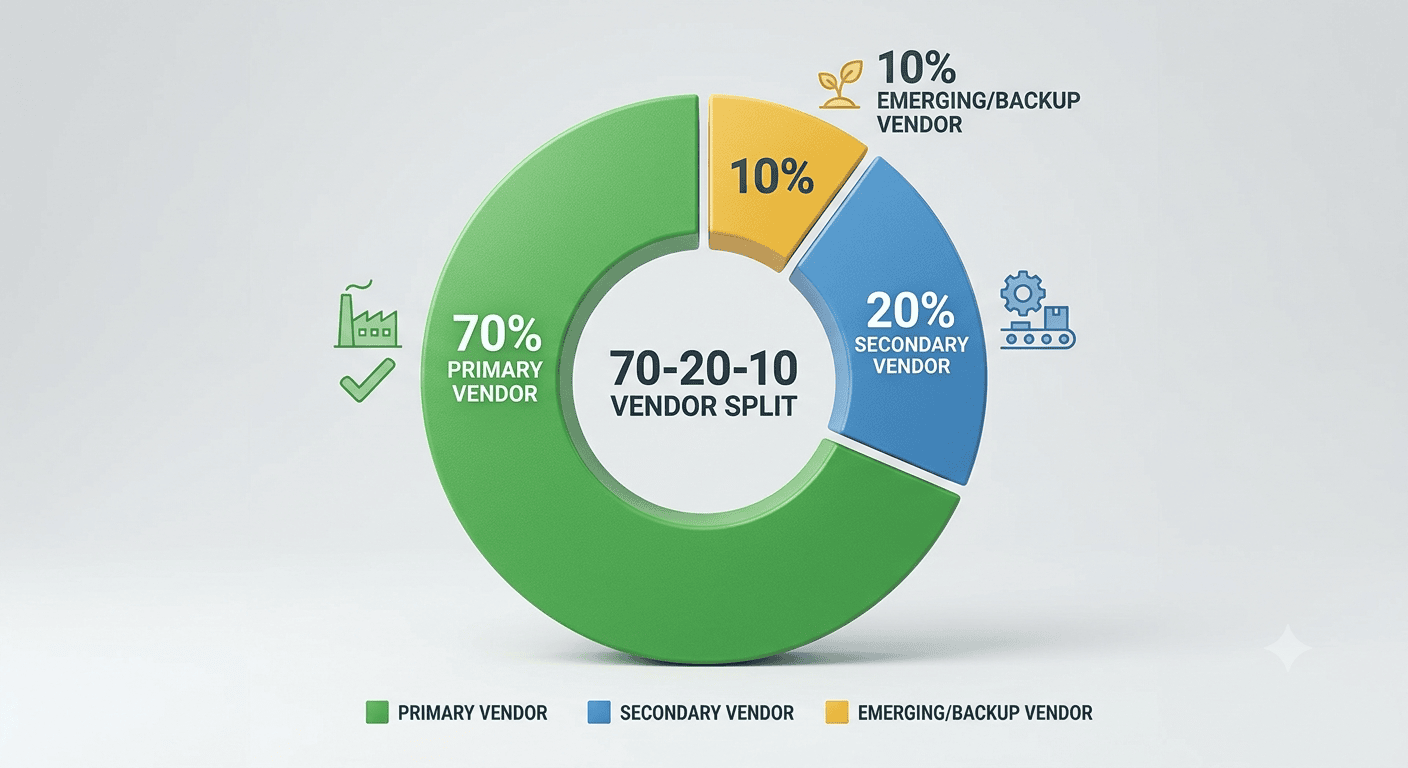
- 70% of volume to your primary, most cost-efficient vendor — the one who earns your loyalty through performance.
- 20% to a secondary vendor who's kept warm, audited, and ready to scale up fast if vendor one falters.
- 10% to an emerging or backup vendor — smaller, maybe newer, but one you're actively testing and developing.
This gives you the bulk-pricing leverage of near-single-sourcing, while keeping two live alternatives ready to absorb shock. When the Coimbatore manufacturer's alloy supplier burned down, a 70-20-10 setup would have let them shift volume to vendor two within days, not weeks.
2.Use Multiple Vendors as a Negotiation Weapon, Not Just a Backup Plan
Here's what most manufacturers miss: a second vendor isn't just insurance. It's leverage.
The moment your primary vendor knows they're your only option, price discipline disappears. But the moment they know 20-30% of your volume can shift elsewhere within a quarter, negotiations change completely.
Smart CXOs use this actively — not aggressively, but strategically. Share benchmarked quotes (without necessarily naming competitors). Renegotiate annually, not just when contracts expire. Let vendors know you track their performance against alternatives. This single shift — from "trusting one vendor" to "actively managing a competitive vendor ecosystem" — has helped mid-sized Indian manufacturers cut input costs by 8-15% without ever compromising on quality.
3.Geographic De-Risking Is No Longer Optional
If all your vendors sit in the same industrial cluster — say, all in and around Pune, or all in the same district in Gujarat — you haven't actually diversified. A single flood, power grid failure, or local labour strike takes out your entire supply chain simultaneously.
Real diversification means geographic spread: a vendor in South India, one in the West, maybe one in the North or even a trusted vendor in a neighbouring country for select components. Yes, this adds logistics complexity. But logistics complexity is a manageable, plannable cost. A production halt is not.
4.Build a Vendor Scorecard — And Actually Use It
Most manufacturing companies "know" who their good and bad vendors are — but it lives in someone's head, not on paper. That's dangerous. People leave. Memory fades. Relationships get emotional.
Build a simple scorecard tracked quarterly across four dimensions:
- Cost competitiveness (are they still priced fairly vs. market?)
- Quality consistency (defect rates, rejection rates)
- Delivery reliability (on-time delivery %)
- Financial health (is this vendor themselves under stress? Vendors who are financially shaky often cut corners first)
This isn't bureaucracy for its own sake. It's the data that lets you make fast, confident decisions when — not if — something goes wrong.
5.Treat Your Best Vendors Like Partners, Not Suppliers
Multi-vendor strategy doesn't mean playing vendors against each other constantly. That erodes trust, and your best vendors will eventually deprioritize you for customers who treat them better.
The winning move is nuanced: maintain genuine partnership with your top 1-2 vendors — share forecasts, give them visibility into your growth plans, help them plan capacity — while still maintaining live, tested alternatives in the background. Your primary vendor should feel secure enough to invest in serving you better, but never so secure that they stop trying.
The Real Cost of "Cost Savings"
Every rupee you save by squeezing a single vendor to the bone is a rupee of risk you're quietly accumulating on your balance sheet. It just doesn't show up until the day it does — and on that day, it shows up as a lost customer, a missed shipment, or a scramble that costs you far more than you ever saved.
Cost pressure is real. Margins in Indian manufacturing are tighter than they've been in years, with input costs, energy prices, and compliance costs all climbing. But the answer to cost pressure isn't fewer vendors. It's smarter vendor architecture — one that gives you pricing leverage, quality consistency, and business continuity, all at once.
The manufacturers who'll win the next five years in India aren't the ones with the single cheapest supplier. They're the ones who built a resilient, competitive vendor ecosystem before they needed it.
Your Move
If you're reading this and realizing your business has one critical vendor with no real backup — don't wait for your "fire" moment. Start this week: pick your single riskiest vendor dependency, and identify one alternate vendor you could onboard within 90 days. That's it. That's the whole first step.
Are you managing your vendors, or are they managing you? If this resonated and need our help, reach out at phoenix.advizory@gmail.com or +91-9967093949. Share it with a fellow founder who needs to hear it and let's build a sharper playbook together.