
The silent profit engine inside Indian factories
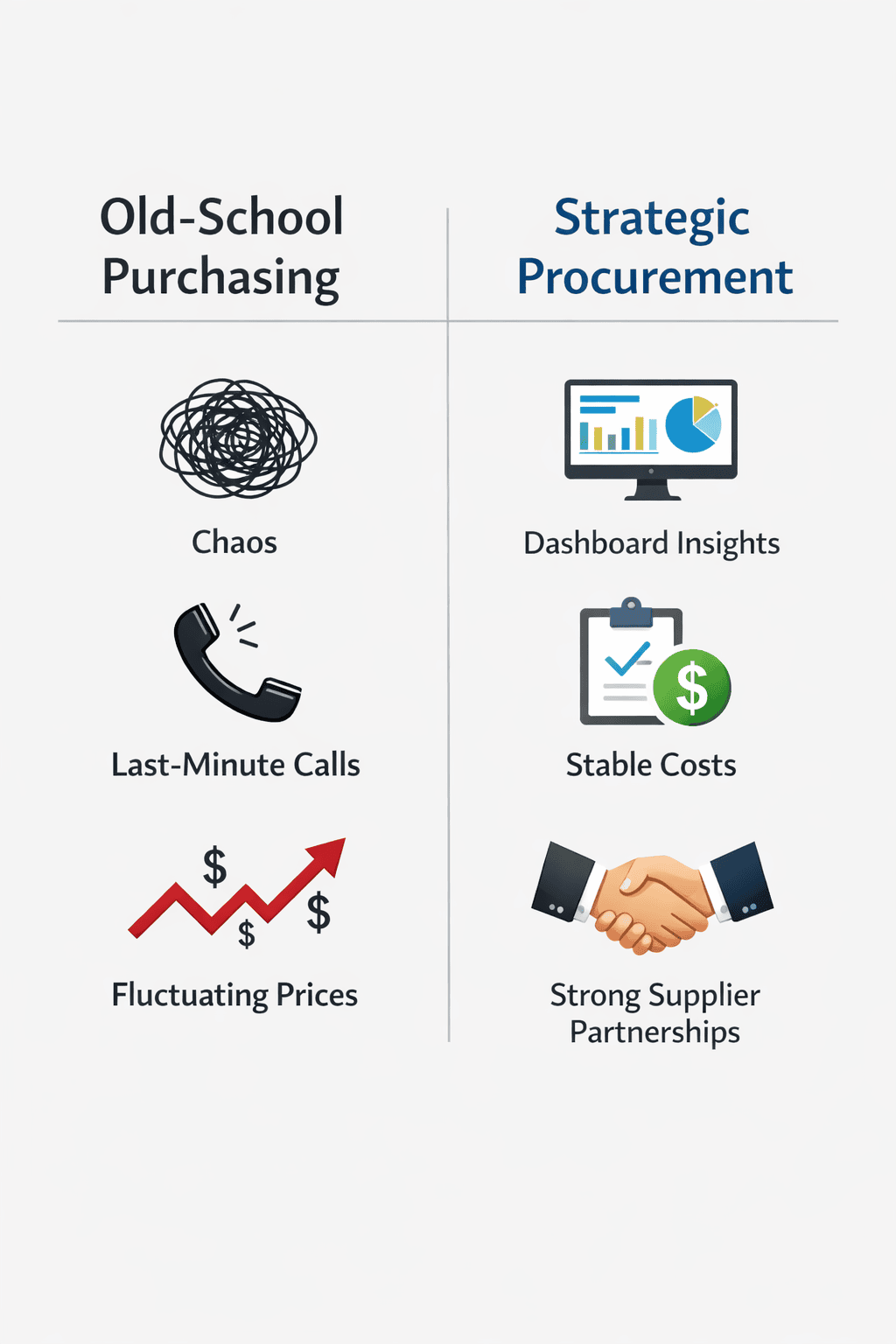
The Secret Weapon Indian MSME’s forget to sharpen
Imagine this. Your sales team lands a big new order. The factory hums with energy. Production plans are drawn up.
And then, quietly, procurement makes one phone call. Prices have gone up. The supplier’s lead time has doubled. That single phone call just wiped out your margins. Now, you’re firefighting—calling alternate vendors, negotiating last-minute deals, paying premiums, and praying that delivery schedules hold. Here’s the truth: most manufacturing problems don’t start on the shop floor; they start in procurement.
And yet, in small and mid-sized manufacturing companies across India, procurement is still treated like a back-office function — a paper-pushing department meant to “get materials cheaply.” That mindset is costing MSME’s crores. Because in 2025, “cheap” and “strategic” are not the same thing anymore. Let’s unpack why strategic procurement might be the most powerful lever you’re not using.
What Strategic Procurement Actually Means
Procurement isn’t just about finding the lowest price. Strategic procurement is a deliberate, data-driven approach to sourcing materials that aligns purchasing decisions with your company’s long-term goals—like quality, profitability, risk reduction, and innovation.
Think of it this way:
- Traditional procurement asks, “Can I buy this cheaper?”
- Strategic procurement asks, “How can I use procurement to build a competitive advantage?”
That tiny shift in thinking transforms procurement from a cost centre into a profit enabler.
Why This Matters Now More Than Ever
If there’s one thing the pandemic, supply chain disruptions, and raw material price spikes taught us, it’s this — predictability is gone. Your Chemical supplier in Pune could shut down over labour strikes. Solvent prices could jump 10% overnight. A container stuck at Nhava Sheva could delay your exports for weeks.
In this new reality, survival isn’t about reacting faster. It’s about anticipating smarter. And that starts with procurement. Because procurement is where your supply chain choices begin. Every rupee, every relationship, every risk stems from those decisions.
The Cost of “Old-School” Procurement Thinking
Let’s be honest. In many Indian manufacturing companies, the procurement department looks like this:
- One or two long-serving buyers who “know all the suppliers.”
- No proper digital system — approvals happen over WhatsApp or email.
- Price lists stored in Excel sheets.
- Decisions made purely on cost, never on total cost of ownership.
It works… until it doesn’t. Here’s what that old model quietly eats away:
- Margins: You think you’re buying cheaper, but constant firefighting, emergency logistics, and inconsistent quality silently drain profits.
- Credibility: Frequent supplier changes, delayed deliveries, or poor-quality inputs hurt customer trust.
- Scalability: When knowledge is stuck in one buyer’s head, your operations can’t scale without chaos.
Strategic procurement fixes all three. The Strategic Playbook: From Cost to Capability
So how do you move from “just buying” to “buying strategically”? Let’s break it into three levels.
Level 1: Align Procurement with Business Strategy
Procurement should mirror where your business is going. For example:
- If your company’s strategy is to grow exports, procurement should focus on global sourcing for consistent quality and international compliance.
- If your plan is to dominate the domestic market through speed, procurement should prioritize local supplier networks for fast turnaround.
Too often, procurement teams chase “the lowest quote” without understanding why certain materials, certifications, or delivery cycles matter for your growth goals. Start by asking: “What does our business need most — price, reliability, or innovation?”
Then, build sourcing strategies around that.
Level 2: Build Supplier Partnerships, Not Transactions
Old-school procurement treats suppliers like vending machines. Modern procurement treats them like strategic allies. Your suppliers are not just vendors — they’re extensions of your factory.
The most successful manufacturers now create Supplier Relationship Programs (SRP) that include:
- Regular review meetings (quality, on-time performance, cost trends).
- Early supplier involvement in design and development.
- Transparent, win-win pricing models.
When you build trust, suppliers give you something money can’t buy — honest information. That’s your shield against market volatility.
Level 3: Data, Digitization, and Decisions
This is the one most MSME manufacturer’s shy away from — but it’s where the biggest leverage hides. Even with modest budgets, there are now lightweight digital tools that can transform your procurement visibility:
- Spend analysis dashboards (using Power BI or Zoho Analytics).
- Vendor performance trackers.
- Automated purchase request and approval flows.
- Supplier databases with shared performance records.
When your data is clean, you can spot trends — which supplier’s lead times are shrinking, which product costs are rising, and what your total cost of ownership actually looks like.
In short: stop relying on gut feeling. Start relying on data.
The Hidden ROI of Strategic Procurement
Here’s what companies discover when they make procurement strategic:
- Material cost reductions of 5-10%. Not by negotiating harder, but by consolidating smarter.
- Lead time reductions of 20-30%. Thanks to better forecasting and closer supplier alignment.
- Improved quality and fewer production disruptions. Because vendors become partners in success.
But beyond numbers, something else happens. The company culture changes. People start treating procurement as an investment lever, not an expense line. And that mindset shift compounds. Year after year.
A Real-World Example
Take an API MSME in Vapi I worked with last year. For years, they had one central buyer, seven core suppliers, and no structured evaluation. Frequent price disputes and delays were killing production schedules.
In six months, here’s what changed:
- They introduced a vendor scorecard—quality, delivery, price stability.
- Moved half their processes off Excel and into a basic ERP module.
- Began quarterly review meetings with key suppliers.
Result? Procurement cost dropped 8%. More importantly, the company stopped losing weekends over supplier fires. That’s the power of treating procurement strategically — it quietly builds peace of mind.
Your 90-Day Procurement Transformation Plan
If you’re a manufacturing CXO, you don’t need an 80-slide consulting deck to start. You just need 3 months of focus.
Here’s a simple roadmap:
Month 1: Diagnose
- Identify your top 10 suppliers by spend.
- Map out current procurement processes.
- Track 3 metrics — price variance, on-time delivery, and defect rate.
Month 2: Design
- Define what “good procurement” means for your company.
- Simplify approval workflows.
- Introduce digital dashboards for spend visibility.
Month 3: Develop
- Train your procurement team in negotiation and relationship management.
- Launch supplier review meetings.
- Set quarterly KPI reports for continuous improvement.
This one quarter of effort can transform your next five years.
The Bottom Line
Strategic procurement isn’t glamorous. You won’t find executives posting photos of purchase orders on LinkedIn. But every rupee saved, every delay avoided, every supplier relationship strengthened — that’s silent power.
In an industry where small margins make or break survival, procurement is not a function. It’s your competitive weapon. So maybe, before the next board meeting where you’re reviewing sales or expansion plans. Ask one quiet question: “Is our procurement truly strategic?” Because sometimes, the biggest growth story in your company begins not on the factory floor — but at the negotiation table.
Ready to turn procurement into your growth engine? Start with one small step — talk to your buyers today, not about price, but about purpose. That shift alone can redefine your bottom line. If you need us to help, reach out to me at phoenix.advizory@gmail.com or +91-9967093949. Let’s make MSME Procurement strategic and cost efficient, together.